



|
Getting your Trinity Audio player ready...
|
By: Fern Sidman
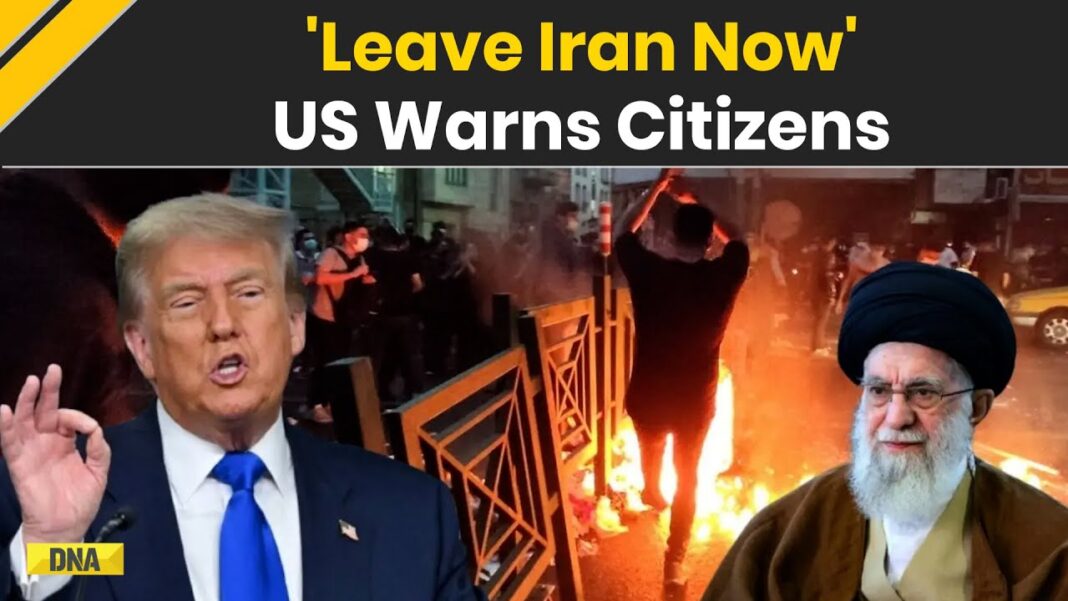
In a sharply worded security alert that carries the cadence of urgency rather than routine advisory, the United States has urged American citizens to depart Iran immediately, citing a convergence of risks that threaten to render ordinary mobility and communication suddenly untenable. As VIN News reported on Thursday, the warning reflects mounting concern over widespread internet shutdowns, disruptions to transportation networks, and the imposition of heightened security measures across the country—developments that together signal a rapidly constricting operating environment for foreign nationals. The language of the advisory is unambiguous: Americans should leave Iran now, and they should do so without relying on U.S. government assistance to facilitate their departure.
According to the information provided in the VIN News report, U.S. officials emphasized that Iranian authorities continue to impose restrictions on mobile, landline, and national internet networks, effectively constricting the arteries of communication that travelers depend upon to make informed decisions in real time. In an era when mobility is inseparable from digital connectivity—flight changes relayed by apps, embassy notices distributed online, emergency communications coordinated through networks—the curtailment of internet access is not merely an inconvenience. It is a strategic constriction that can rapidly transform uncertainty into isolation. The advisory anticipates continued outages and urges Americans to prepare alternative means of communication, a tacit acknowledgment that the infrastructure of modern travel is being deliberately thinned.
The warning also underscores the fragility of air travel to and from Iran at this juncture. VIN News reported that airlines have reduced or canceled flights, raising the prospect that Americans could find themselves unable to depart on short notice. The State Department cautioned that flight disruptions may occur with little or no warning and encouraged travelers to verify arrangements directly with carriers. This is not merely a logistical inconvenience; it is a risk multiplier. In volatile environments, the capacity to leave swiftly is often the decisive factor separating inconvenience from peril. The erosion of that capacity, especially when paired with communication blackouts, creates a scenario in which travelers may be compelled to make consequential decisions with partial information.
The alert’s repeated injunction—“Leave Iran now”—carries a rhetorical force that departs from the more measured language typically employed in travel advisories. The VIN News report noted that U.S. officials went further, warning Americans not to rely on U.S. government assistance to depart the country. The implication is sobering: consular capabilities may be constrained by circumstances on the ground, and diplomatic channels may not provide the customary lifeline in moments of acute disruption. This is not an abdication of responsibility so much as a candid appraisal of the operational limits imposed by a host country’s security posture and communications controls. It is an acknowledgment that the usual scaffolding of protection may not be accessible when states assert sovereign control through restrictions on movement and information.
For those Americans who are unable to leave, the advisory delineates a posture of cautious self-preservation. U.S. officials urged such individuals to find secure shelter, maintain adequate supplies of food, water, and medications, and avoid public demonstrations. These instructions, while practical, reveal the gravity of the assessment underpinning the alert. Advising civilians to shelter, stock provisions, and keep a low profile is language more commonly associated with crisis zones than with routine travel guidance. It reflects a recognition that public gatherings may become flashpoints and that disruptions to supply chains could render basic necessities more difficult to obtain without advance preparation.
The alert also counsels Americans to monitor local media for breaking developments and to be prepared to change plans quickly, an exhortation that presumes volatility rather than stability. The VIN News report highlighted the recommendation that travelers keep phones charged and maintain contact with family and friends, calling attention to the psychological dimension of the crisis. In environments where information is constrained, maintaining lines of personal communication becomes a lifeline not only for practical coordination but for emotional resilience.
The advisory further encourages enrollment in the Smart Traveler Enrollment Program (STEP), which provides security updates—a reminder that, even as official assistance may be limited in facilitating departures, information dissemination remains a critical function of the U.S. government’s duty of care.
The strategic logic behind advising land departures through Armenia or Turkey is equally revealing. It acknowledges that air corridors may become unreliable or unavailable, and that terrestrial routes, while potentially arduous, could offer a viable alternative for those seeking to exit the country. Such guidance reflects an understanding of Iran’s geography and regional connectivity, but it also underscores the gravity of the moment: when official advisories begin mapping escape routes across borders, the assumption of ordinary travel conditions has already been abandoned.
The broader context of the alert is one of ongoing instability and heightened regional tensions that have prompted Iranian authorities to increase security measures. While the advisory does not detail the precise catalysts for the current escalation, its tone suggests a confluence of pressures—internal and external—that have led to tighter controls over movement and communication. The U.S. government’s renewed warnings about the risks of remaining in the country are thus less a reaction to a single event than a response to a pattern of tightening constraints that can rapidly compound risk for foreign nationals.
The implications of widespread internet shutdowns merit particular scrutiny. In modern crises, the ability to access real-time information is not merely a convenience but a determinant of safety. VIN News reported that restrictions on national internet networks limit communications nationwide, a measure that can impede access to embassy advisories, airline updates, and local news. Such shutdowns also hinder coordination among travelers and between travelers and their families, amplifying uncertainty. In authoritarian contexts, information control is often deployed to manage public perception and limit mobilization. For foreigners, the effect is to increase opacity at precisely the moment when clarity is most needed.
Transportation disruptions compound this opacity. Flight cancellations and reductions are not merely economic signals; they are indicators of perceived risk by carriers whose calculations are grounded in safety, insurance, and regulatory compliance. When airlines curtail service, they effectively withdraw a layer of redundancy from the mobility ecosystem. These changes can occur with little warning, a volatility that places a premium on anticipatory action. The advisory’s insistence on immediate departure is thus an attempt to preempt a scenario in which exit options narrow abruptly.
The advisory’s admonition to avoid public demonstrations speaks to the unpredictability of crowd dynamics in tense environments. Public gatherings can become sites of confrontation, whether between demonstrators and security forces or among competing groups. For foreign nationals, proximity to such flashpoints carries disproportionate risk, as they may be perceived as symbols or leverage points in broader political narratives. The VIN News report stressed the U.S. government’s counsel to keep a low profile, an acknowledgment that visibility itself can be a liability in moments of heightened security.
At a more human level, the alert confronts Americans in Iran with an unenviable calculus: whether to leave behind routines, livelihoods, or family connections in response to an advisory that, by design, errs on the side of caution. The language of “Leave Iran now” compresses this calculus into an imperative, reflecting the State Department’s assessment that the risks of remaining outweigh the disruptions of departure. The VIN News coverage captured the gravity of this guidance, emphasizing that the advisory is not framed as a suggestion but as a directive grounded in a sober appraisal of conditions.
For policymakers, the alert illustrates the limits of consular protection in environments where host governments assert tight control over information and movement. The warning that Americans should not rely on U.S. government assistance to depart is a candid acknowledgment that diplomatic reach has practical boundaries. It also underscores the importance of individual preparedness in international travel, particularly to regions subject to rapid shifts in security posture. VIN News’s emphasis on enrolling in STEP and maintaining alternative communication methods reflects a broader doctrine of shared responsibility between states and citizens in managing risk.
The alert also reverberates beyond the immediate cohort of Americans in Iran. It sends a signal to international observers about the perceived trajectory of stability in the country and the region. Travel advisories, especially those urging immediate departure, are read by markets, airlines, and allied governments as indicators of risk. The VIN News report situated the alert within a pattern of heightened warnings amid regional tensions, suggesting that the advisory is part of a broader recalibration of risk assessments rather than an isolated pronouncement.
In the end, the starkness of the message—leave now, do not depend on assistance, prepare for communication blackouts and transport disruptions—encapsulates a moment in which the ordinary infrastructures of global mobility appear fragile. For the Americans still in Iran, the advisory is not an abstract policy statement but a pressing summons to action. For the wider public it is a reminder that in an interconnected world, geopolitical tremors can rapidly constrict the freedoms of movement and communication that many take for granted. The alert’s urgency, repeated for emphasis, underscores a simple truth: when states move to control borders and bandwidth, the margin for delay narrows, and prudence demands departure before the exit closes.
