



|
Getting your Trinity Audio player ready...
|
By: Fern Sidman
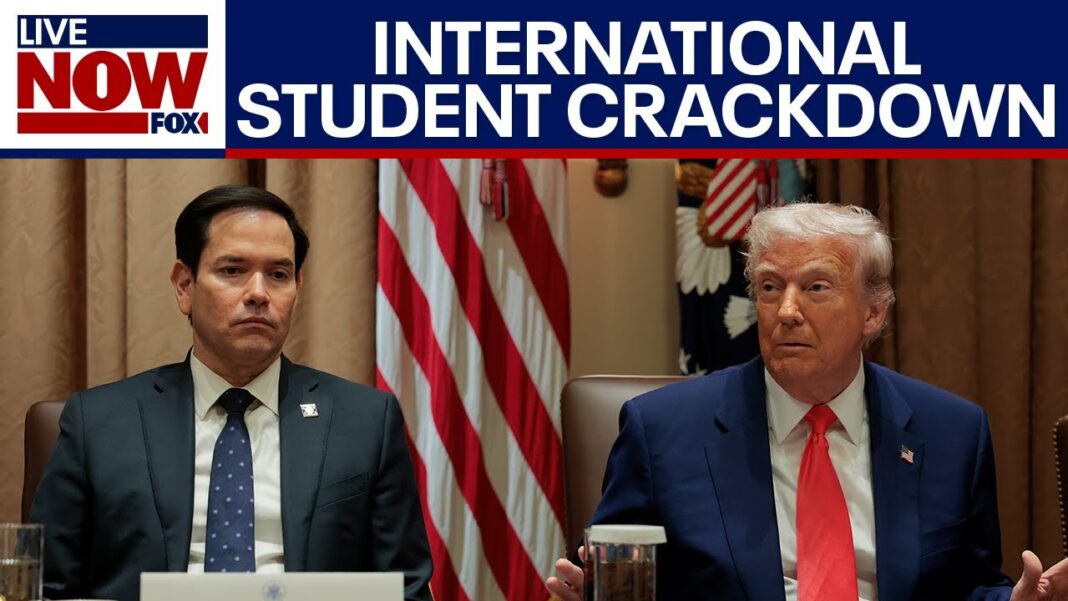
In a sweeping escalation of its ongoing confrontation with Harvard University, the U.S. State Department has issued a directive to all consular missions worldwide to enforce stringent new vetting protocols for visa applicants intending to travel to the Ivy League institution. According to a classified internal cable dated May 30 and reviewed by Reuters, the move — signed by Secretary of State Marco Rubio — signals a dramatic intensification of President Donald Trump’s crackdown on Harvard, amid broader efforts to reshape U.S. higher education policy through the lens of national security and ideological scrutiny.
As reported on Friday by The Indian Express, the cable mandates that any non-immigrant visa applicants connected to Harvard — including prospective students, visiting faculty, guest speakers, contractors, and even tourists with stated plans to visit the university — be subjected to an expanded security review. The directive instructs consular officers to investigate applicants’ digital footprints, particularly their social media activity, to detect signs of past antisemitic behavior or affiliations with radical or violent political movements.
Applicants with private social media accounts are to be treated with heightened suspicion. Officers are empowered to request applicants to unlock or make their profiles public during the interview process. Failure to comply, the memo states, “may be considered a negative factor in the adjudication process.”
In his cable, Rubio indicated that new instructions for social media vetting procedures will be circulated “in the coming days.” These forthcoming measures, according to the report in The Indian Express, are expected to formalize a tiered-risk assessment model that incorporates keywords, affiliations, and location history into visa decisions.
The intensified scrutiny is just one element of a broad offensive against Harvard that includes the freezing of federal grant disbursements, threats to revoke the university’s tax-exempt status, and ongoing Department of Justice investigations into alleged hiring discrimination. The administration has accused Harvard of institutional bias against white, Asian, male, and heterosexual candidates in its recruitment practices — allegations that have prompted multiple federal probes.
As previously reported by The Indian Express, one of the most drastic actions taken was a failed attempt to prohibit Harvard from enrolling foreign students — a move temporarily blocked by a federal judge on constitutional grounds. However, officials have signaled that alternative regulatory mechanisms are under review.
According to analysts cited in The Indian Express, the administration’s strategy appears two-pronged: limiting what it views as foreign ideological infiltration on elite campuses, while simultaneously waging a culture war against institutions perceived as hostile to conservative values.
Harvard has so far declined to comment publicly on the latest developments, though senior administrators are said to be consulting legal counsel and coordinating with other universities potentially facing similar scrutiny. International student advocates and civil liberties groups have strongly condemned the move, warning that it threatens not only academic freedom but also America’s global reputation as a hub for higher learning.
“Targeting an entire university — especially one with the international prestige of Harvard — undermines the U.S. higher education system’s credibility,” said a senior education analyst in an interview with The Indian Express. “It’s going to force students and scholars to reconsider their plans, and potentially shift their focus to Canada, the U.K., or Australia.”
The Trump administration has also taken aim at Chinese students and researchers, particularly those with alleged ties to the Chinese Communist Party. Under a previous State Department order, thousands of Chinese students have had their visas revoked or denied in recent months, often with little explanation beyond vague national security concerns.
The ripple effects of the Harvard directive could prove substantial. With over one million international students studying in the U.S. — many of whom attend elite institutions like Harvard — the order could further strain America’s already declining share of the global education market.
As the report in The Indian Express noted, the move is expected to create significant backlogs at consular missions and spark diplomatic tensions with countries that supply a large number of Harvard-bound students, including India, China, and several European nations.
The State Department has yet to release a public statement on the directive, but internal sources suggest that similar measures could soon be extended to other institutions named in congressional hearings or federal investigations related to campus unrest, foreign funding, or allegations of antisemitism.
