



|
Getting your Trinity Audio player ready...
|
U.S. Accepts $200 Million Jet from Qatar for Potential Use as Trump’s Future Air Force One
By: Ariella Haviv
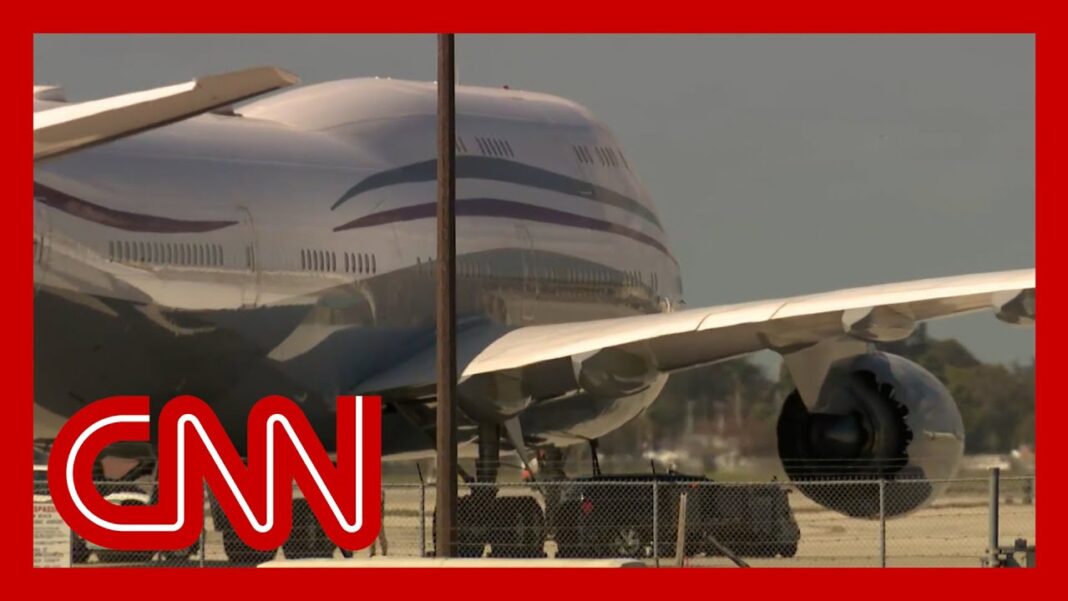
In a move that is raising both intrigue and eyebrows, the United States government has officially accepted a state-of-the-art Boeing 747-8 aircraft from the government of Qatar, intended for potential use as a future Air Force One during the second term of President Donald J. Trump. As reported by The New York Times and extensively covered by VIN News, the luxury aircraft, once used by the Qatari royal family, has been transferred to the U.S. Department of Defense and is now slated for extensive retrofitting to meet the security, communications, and operational standards required for presidential travel.
The aircraft, valued at approximately $200 million, represents a significant addition to the U.S. presidential aviation fleet—one steeped in symbolism, diplomacy, and technical precision. While the decision has sparked controversy in political and diplomatic circles, Pentagon officials and the Trump administration have insisted the acquisition is both legal and strategic.
According to the information provided in The New York Times report, the jet had previously been configured for VIP transport by the Qatari royal family, outfitted with luxury features, cutting-edge technology, and exclusive amenities designed for heads of state. It was not sold on the open market but instead offered as a diplomatic gift to the U.S. government.
VIN News reported that President Trump himself toured the aircraft earlier this year at Palm Beach International Airport. Though it is not yet in official presidential use, the jet’s potential as a future Air Force One underscores both its capabilities and its symbolic significance.
Pentagon spokesperson Sean Parnell confirmed the jet’s formal acceptance, telling reporters that Defense Secretary Pete Hegseth had signed off on the aircraft “in accordance with all federal rules and regulations.” As the VIN News report highlighted, the Department of Defense emphasized that the plane is not a personal gift to President Trump but a strategic asset accepted on behalf of the U.S. government.
“We will now work to ensure proper security measures and functional-mission requirements are considered for an aircraft used to transport the president of the United States,” Parnell said in a public statement cited by VIN News.
However, the Pentagon has not provided a specific timeline for when—or even if—the aircraft will be fully outfitted and cleared for official presidential use. Given the complexity of the retrofitting process, including the installation of hardened communications, missile-defense systems, and classified materials storage, it may take years before the aircraft is operational.
Not surprisingly, the move has attracted criticism from various quarters. Ethics watchdogs and foreign policy analysts have raised questions about the propriety of accepting a gift of such magnitude from a foreign monarchy. Some warn that the arrangement could give the appearance of undue foreign influence or favoritism, especially given Qatar’s complex diplomatic relationships with both the West and its Gulf neighbors.
Still, administration officials insist the arrangement adheres to all relevant statutes and ethical guidelines. The VIN News report noted that the Trump administration has repeatedly stressed the plane is being handled strictly as a government property, with all decisions made under the authority of the Department of Defense.
Beyond the symbolism and controversy, the jet acquisition may also be viewed through a pragmatic lens. The Air Force One program has faced delays and ballooning costs in recent years, with the replacement of the aging VC-25A aircraft—modified Boeing 747-200Bs—already estimated at over $5 billion. As VIN News reported, integrating a preexisting long-range aircraft like the Qatar-donated 747-8 could offer a partial solution to some of these cost and timeline challenges.
The current Air Force One aircraft, commissioned in the 1990s, is due for retirement by the end of the decade. Boeing is currently working on new VC-25B aircraft as part of a modernization project begun during Trump’s first term, but those aircraft are not expected to be delivered until at least 2027, leaving a window of opportunity for supplemental aircraft to serve interim or support roles.
The political symbolism of presidential aircraft cannot be overstated. Air Force One is more than a mode of transportation—it is a flying White House, a command center, and a globally recognized emblem of American power. If the Qatar-donated 747-8 becomes operational in Trump’s second term, it could serve not only as a practical asset but also as a powerful visual marker of his administration’s priorities and global partnerships.
While the road to operational readiness may be long and technically demanding, VIN News points out that this development has already stirred discussions among defense officials and political observers about the broader implications of such diplomatic exchanges.
The acceptance of the Qatari 747-8 jetliner represents a bold and complex step in the evolution of U.S. presidential air travel. It remains clear that the aircraft’s future role—whether symbolic, practical, or both—will be shaped by political decisions, technical upgrades, and public scrutiny.
With President Trump at the helm of a new administration, the jet could eventually become one of the most iconic images of his return to power—or it may remain a backup tool of diplomacy, quietly serving behind the scenes. Either way, its journey from Doha to Washington is already reshaping the conversation around presidential mobility and the global partnerships that sustain it.
