



|
Getting your Trinity Audio player ready...
|
By: Fern Sidman
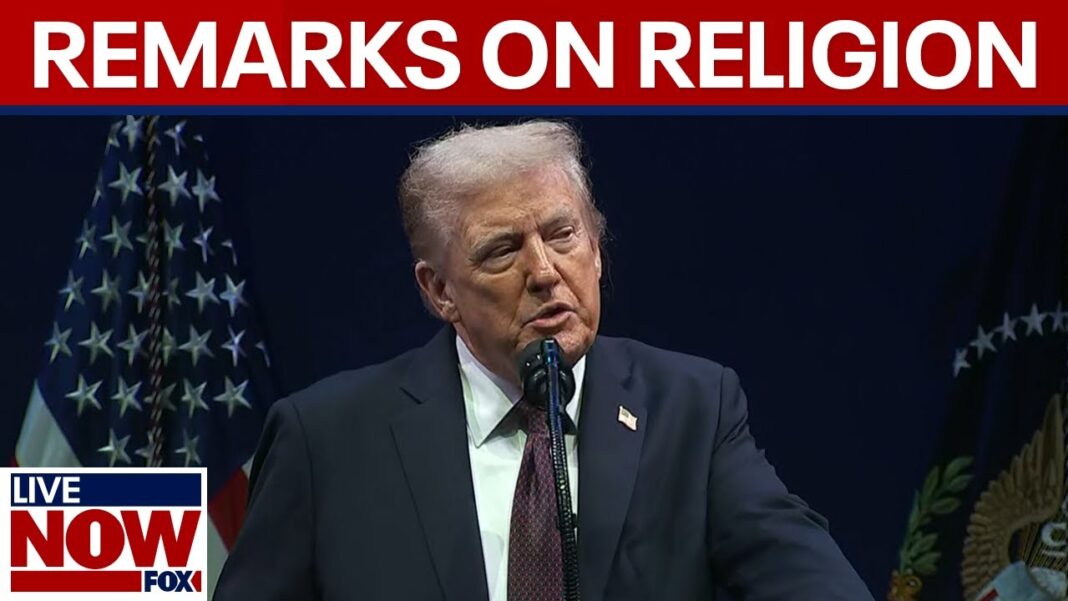
From the moment he returned to the White House in January 2025, President Donald J. Trump has positioned himself as the most pro-faith leader in American history. For his supporters in the religious community, the evidence is overwhelming: new offices dedicated to protecting religious liberty, aggressive efforts to combat antisemitism, the dismantling of government overreach into matters of conscience, and bold policies affirming the primacy of family, faith, and biological truth.
Since America’s founding, presidents have courted religious communities, but few have pursued such a comprehensive agenda to transform the intersection of faith and governance. Trump’s allies argue that no previous occupant of the Oval Office — not Reagan, not Bush, not even Trump in his first term — has delivered so consistently for believers. Critics, of course, view many of these actions as divisive or regressive. But there is little doubt that Trump has placed religion squarely at the center of national policy.
Perhaps the most visible change under Trump has been institutional. His creation of the White House Faith Office — the first office of its kind, based in the West Wing and reporting directly to the president — marked a structural shift. This wasn’t a symbolic gesture; it embedded religious liberty into the very machinery of policymaking.
Complementing the Faith Office, Trump mandated that every federal department and agency establish Centers for Faith, staffed by Faith Directors or Liaisons. These officials act as conduits between religious communities and government, ensuring that policy is filtered through the lens of faith considerations.
The administration also unveiled the Religious Liberty Commission, tasked with safeguarding rights across faiths, and appointed diverse leaders to its advisory boards. For evangelicals, Catholics, Jews, Muslims, and smaller denominations, this represented an unprecedented opening of doors.
Trump’s Justice Department reinforced these structures, backing religious charter schools, affirming tax exemptions for religious groups, and clarifying that sermons addressing matters of faith are constitutionally protected even if they touch on political themes. The Office of Personnel Management issued new guidance protecting religious expression in the federal workplace. The Department of Veterans Affairs scrapped Biden-era rules that censored chaplains’ sermons. Even the Small Business Administration ended restrictions that had denied disaster relief to faith-based organizations.
The message was unmistakable: government would no longer treat faith communities as afterthoughts, but as essential partners in national life.
Trump’s pro-faith record cannot be separated from his relentless focus on antisemitism, an issue that surged after October 7, 2023, when Hamas terrorists launched their atrocities in Israel.
The Department of Justice launched a Task Force to Combat Antisemitism, working across agencies to investigate hate crimes and discriminatory practices. The Department of Education opened investigations into 60 universities where Jewish students alleged harassment, charging several institutions — including Harvard and Columbia — with violations of Title VI of the Civil Rights Act. In a watershed move, multiple agencies canceled billions in federal grants to universities that failed to protect Jewish students, sending shockwaves through higher education.
Trump’s administration also secured a historic settlement with Columbia University, holding the school accountable for civil rights failures. Symbolically, Trump personally condemned antisemitic acts of terror on American soil, including the killing of two Israeli Embassy staffers in Washington, D.C., and a violent attack in Boulder targeting pro-Israel demonstrators.
These measures reinforced his reputation as the most pro-Israel and staunchly pro-Jewish president in U.S. history, bolstered by his foreign policy alignment with Prime Minister Benjamin Netanyahu.
Central to Trump’s second-term agenda has been dismantling what he calls the “weaponization of government” against people of faith and dissenting voices.
He issued executive orders ending federal censorship, prohibiting agencies from debanking Americans over political or religious beliefs, and launching a Justice Department working group to investigate past abuses — particularly against Catholics, parents at school board meetings, and pro-life activists.
The administration scaled back prosecutions under the FACE Act, dismissing cases against pro-life demonstrators and restricting the law’s application. At the same time, Trump directed agencies to repeal regulations that violated newly affirmed Supreme Court religious liberty precedents.
In effect, Trump sought to draw a bright line: the government exists to protect, not police, religious expression.
Beyond policy, Trump has made symbolic gestures that resonate deeply with faith communities. He has restored the White House as a space for religious observance, hosting National Day of Prayer events, Easter dinners, Passover celebrations, and even iftar meals for Muslim leaders.
Messages marking Ash Wednesday, Pentecost, Jewish American Heritage Month, and Global Coptic Day carried presidential weight, reinforcing that faith is integral to American identity. Trump also issued solemn proclamations for Holocaust remembrance, including the 80th anniversary of Auschwitz’s liberation.
Critics dismiss these gestures as ceremonial, but for communities often overlooked by secular politics, they carry profound significance.
Few issues illustrate Trump’s alignment with faith more than education. He signed executive orders expanding school choice, enshrining the first national program that allows parents to direct funds to private, charter, or religious schools.
He pushed to dismantle the Department of Education altogether, framing it as a bastion of bureaucratic overreach. Under his watch, DEI programs were ordered removed from schools, vaccine mandates were lifted, and radical curricula were challenged.
His administration required schools to allow parents full access to records, including those related to “gender identity,” and defended parental rights at the Supreme Court. For religious families, long frustrated with government intrusion, this represented a watershed.
Perhaps the most controversial plank of Trump’s faith agenda has been his insistence on “biological truth.” He issued executive orders affirming the reality of two sexes, male and female, and prohibiting men from competing in women’s sports.
The Justice Department and Department of Education created a Title IX Special Investigations Team to safeguard female athletes, while lawsuits targeted states that failed to protect women. The Department of Health and Human Services released reports warning of the harms of gender-transition procedures for minors and rescinded Biden-era guidance promoting “gender-affirming care.”
For faith communities alarmed by what they view as radical gender ideology, these actions underscored Trump’s willingness to legislate morality in line with traditional values.
Trump’s pro-life stance has been another cornerstone. He reinstated the Mexico City Policy, banned federal funding for abortion providers, and mandated enforcement of the Hyde Amendment.
He ended abortion funding for illegal immigrants, VA hospitals, and military reimbursements. He defunded Planned Parenthood and directed federal websites to emphasize adoption over abortion.
Trump’s rhetoric matched his policies. He addressed the March for Life, calling the unborn “precious little babies,” and issued proclamations celebrating Mother’s Day as a tribute to both born and unborn life.
His “One Big Beautiful Bill” included tax credits for families, strengthened adoption support, and new savings accounts for newborns, framing family policy as intrinsically pro-life.
The military, long a battleground over cultural issues, was also reshaped. Trump reinstated service members discharged over vaccine mandates, protected chaplains’ rights, and banned policies allowing service with gender dysphoria.
He dismantled DEI programs in the armed forces and across government, dissolved the White House Gender Policy Council, and directed agencies to close ideological offices. These moves reflected his conviction that diversity initiatives had undermined unity and excellence.
Trump’s vision of faith and nation extends beyond policy. He has emphasized America’s heritage as a nation “under God,” championing truth in history and patriotism in institutions.
He ordered the Smithsonian and other museums to restore “sanity” to exhibits, replaced Kennedy Center board members accused of promoting radical ideologies, and directed agencies to ensure foreign aid aligned with American interests.
Symbolically, the “One Flag Policy” restricted embassies to flying only the American flag, reinforcing national unity over ideological diversity.
No faith agenda would be complete without reference to Israel, where Trump has cemented his legacy as perhaps the most pro-Israel president in U.S. history.
He appointed Governor Mike Huckabee as ambassador, welcomed Netanyahu as his first foreign guest, and imposed sanctions on the International Criminal Court for targeting Israeli leaders.
He withdrew the U.S. from the UNHRC, UNRWA, and UNESCO over their anti-Israel stances, and launched a joint DOJ task force to investigate crimes from Hamas’ October 7 attack.
His administration facilitated the release of hostages from Gaza and took decisive action through Operation Midnight Hammer to prevent Iran from developing nuclear weapons.
For many evangelicals and Jewish Americans, these moves epitomize Trump’s alignment with biblical prophecy and America’s strategic interests.
Trump’s second term has redefined the role of religion in American public life. Supporters hail him as the strongest defender of religious liberty in history, citing a litany of actions — from the White House Faith Office to school choice, from defending biological truth to supporting Israel.
Critics counter that these policies blur the line between church and state, threaten pluralism, and roll back hard-won rights. Yet the breadth and depth of his agenda are undeniable.
For Trump, faith is not peripheral; it is central. He has restored prayer to the public square, placed religious liberty at the heart of governance, and aligned America’s global posture with its biblical roots.
As the nation approaches its 250th anniversary, Trump promises a grand celebration rooted in history, faith, and freedom. Whether one sees this as revival or regression, one fact is clear: no president has done more to make religion not just a private matter of conscience, but a defining feature of American political life
This is a glowing description. Unfortunately, American liberal Jews, primarily Democrat, and American “Jewish organizations“ are often at war with his public agenda.
I have elsewhere today in my comments cited an article expressing a strong indictment of the American Jewish leadership, which has and continues to betray Israel and the Jewish people. We are on our own and must face reality, and re-organize and coalesce if we are to survive as Jews. Although compared with the evil enemy Democrat party and administrations, Trump offers a political lifeline to American Jews, there is another side to the story, and I see some fault lines within his administration. Ultimately, American Jews need to act aggressively to save themselves and defend the Jewish state of Israel.