



|
Getting your Trinity Audio player ready...
|
By: Jerome Brookshire
President Donald Trump is once again signaling his willingness to return tariff revenues directly to American households, raising the prospect of rebate checks worth up to $2,000 per person. The idea, which he has described as a “dividend to the people,” comes as the Supreme Court prepares to weigh the legality of the very tariffs that have generated those funds — a looming decision that could reshape both U.S. trade policy and the president’s political fortunes.
Speaking in an interview with One America News Network on Thursday, Trump argued that the unprecedented flow of tariff revenues into federal coffers represents a windfall for the country. “They’re just starting to kick in,” Trump said, adding that, in his projection, “ultimately, your tariffs are going to be over a trillion dollars a year.”
The comments, reported by The New York Post on Thursday, reflect both Trump’s confidence in his trade agenda and his desire to channel its benefits in a populist direction. By framing tariff revenues not simply as a fiscal tool, but as a potential source of direct payments to American citizens, Trump is aligning his trade policy with the bread-and-butter politics that have long animated his appeal to working- and middle-class voters.
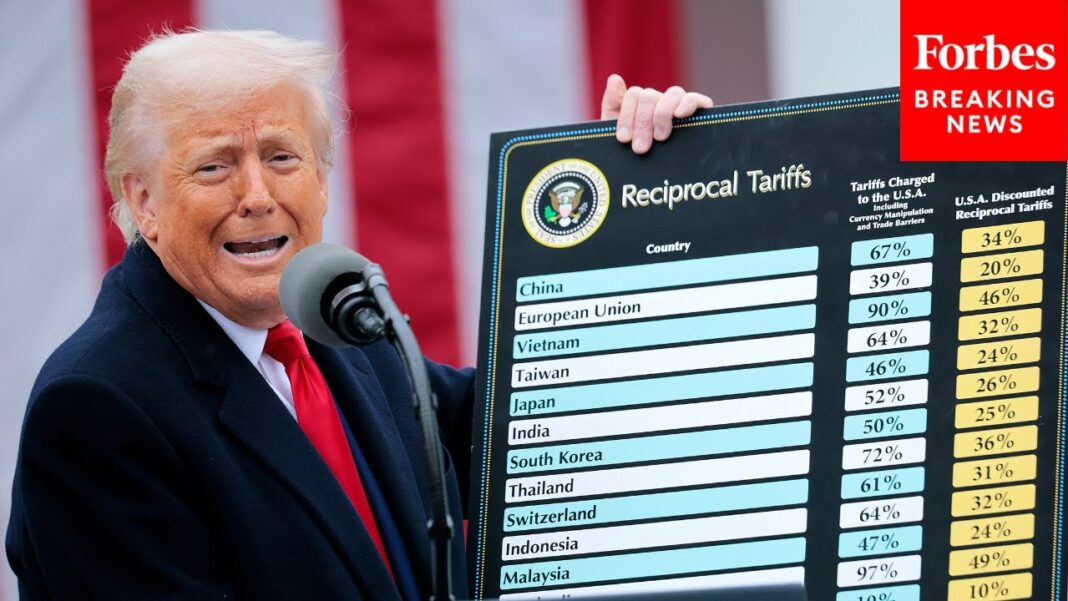
Since April, Trump’s administration has imposed sweeping levies on foreign imports, targeting not only traditional rivals such as China but also European trading partners and even certain goods from Canada and Mexico. These tariffs, which range across industries from steel and aluminum to electronics, have been justified by the president as both a mechanism to reduce U.S. trade deficits and a means to pressure foreign governments into more favorable deals.
Yet the secondary effect — the sheer amount of money flowing into the U.S. Treasury — has become central to Trump’s messaging. According to Treasury Department data cited by Fox Business and reported in The New York Post, tariff revenues this year have already reached $214.9 billion. September alone yielded $31.3 billion, slightly below August’s record haul but still an extraordinary sum by historical standards.
Treasury Secretary Scott Bessent has projected that by the end of the calendar year, tariff receipts will exceed $300 billion. Over a longer horizon, Trump has suggested that tariffs could ultimately deliver over $1 trillion annually.
“The United States is bringing in money that past presidents never dreamed of,” Trump told supporters recently. “This isn’t just about trade — this is about rebuilding our country and putting America first.”
What Trump proposes to do with this revenue remains a subject of intense speculation. In Thursday’s interview, he outlined a two-pronged approach: using tariffs to reduce the national debt, while also contemplating direct disbursements to American households.
“Number one, we’re paying down debt,” Trump said. “People have allowed the debt to go crazy.”
At the same time, he emphasized his openness to sharing the bounty directly with the public. “We also might make a distribution to the people,” he explained. “We’re thinking maybe $1,000 to $2,000 — it would be great.”
The New York Post report highlighted this proposal as part of a broader effort by Trump to reframe tariff policy, long controversial among economists, as not merely punitive but redistributive. The concept of issuing checks from tariff revenues has been floated before by Trump, but his renewed emphasis suggests he sees political traction in marrying his hardline trade policy with a tangible benefit for ordinary citizens.
Any such disbursement, however, would require congressional approval. With Congress deeply divided, and with fiscal conservatives wary of any new spending initiative, the path forward is uncertain. Still, the sheer popularity of direct payments — as demonstrated during the pandemic-era stimulus checks — could make the idea politically potent.
Trump’s framing of tariff revenues as a tool for debt reduction is also notable. With the national debt now exceeding $37 trillion, the president has repeatedly sought to minimize its relative impact by pointing to the government’s revenue streams. “The debt is very little, relatively speaking, because the government is taking in unprecedented sums of money from tariffs,” he argued.
Economists remain divided on this claim. Critics note that tariffs function as a tax on imports, with much of the cost ultimately borne by American consumers and businesses in the form of higher prices. Supporters counter that tariffs are a legitimate means of correcting unfair trade practices and reasserting U.S. sovereignty in global commerce.
As The New York Post has reported, Trump’s insistence that tariffs represent a sustainable revenue stream positions him against traditional free-trade orthodoxy, which views such levies as distortive and counterproductive. By tying tariffs to debt repayment and citizen rebates, Trump is recasting the debate in terms that emphasize fairness, reciprocity, and national self-sufficiency.
All of this unfolds against a backdrop of legal uncertainty. Next month, the Supreme Court is scheduled to hear arguments in a case that will determine whether the president possesses the authority to impose such sweeping tariffs under existing law.
In August, the U.S. Court of Appeals for the Federal Circuit ruled that most of Trump’s tariffs were not covered by the International Emergency Economic Powers Act — the statute his administration had invoked to justify them. Two lower courts had already reached similar conclusions. However, the appellate court allowed the tariffs to remain in place pending an appeal to the high court.
The stakes are enormous. If the Supreme Court finds the tariffs illegal, the government could be forced to refund between $750 billion and $1 trillion in collected and projected revenues, according to Treasury Secretary Bessent’s warning to the justices. Such an outcome would not only erase the funds Trump envisions for debt repayment and rebates but also undercut the administration’s broader economic strategy.
As The New York Post report noted, the looming case introduces a profound element of risk. Trump’s bold talk of rebates and dividends to the people is premised on the continued legality of his tariffs. Should the court strike them down, the political and fiscal consequences would be severe.
Trump’s renewed focus on rebate checks also carries an unmistakable political dimension. As he campaigns for re-election, the promise of $1,000 to $2,000 payments resonates with voters still feeling the pinch of inflation and economic uncertainty.
The New York Post report observed that by linking tariffs to direct payments, Trump is seeking to turn a complex trade policy into a simple, populist message: foreign nations pay, Americans benefit. It is a narrative that dovetails with his longstanding slogan of putting “America First” and frames the tariff program as a form of economic justice.
Yet the risks are equally apparent. If tariffs are ultimately struck down, or if the promised rebates fail to materialize, the political backlash could be significant. Trump’s critics would likely seize on the episode as evidence of overreach and fiscal recklessness.
Trump’s proposal is also informed by recent history. During the COVID-19 pandemic, direct government payments proved both popular and politically impactful. The checks issued under both the Trump and Biden administrations offered a lifeline to millions of households and demonstrated the electoral appeal of direct aid.
By proposing tariff-funded rebates, Trump is effectively seeking to replicate that model, but with a distinctly nationalist twist. Rather than deficit spending or borrowing, the funds would come from tariffs imposed on foreign nations. It is, in Trump’s telling, a redistribution of wealth from America’s trading partners back to its own citizens.
As the Supreme Court prepares to deliberate, and as Congress weighs the feasibility of any rebate plan, Trump’s proposal remains more of a political declaration than a concrete policy. Still, it calls attention to the extent to which he has tied his political identity to tariffs — not only as a negotiating tactic abroad but as a revenue stream at home.
The New York Post report has framed the debate in stark terms: Trump’s tariffs are either a transformative tool for American renewal or a reckless gamble that could unravel under judicial scrutiny. By dangling the prospect of $2,000 checks, Trump is doubling down on his bet that tariffs can deliver both political and economic dividends.
Whether the Supreme Court validates that bet will determine not only the fate of his trade agenda but also the credibility of his broader promise to make foreign nations pay for America’s prosperity.
