



|
Getting your Trinity Audio player ready...
|
By: Fern Sidman
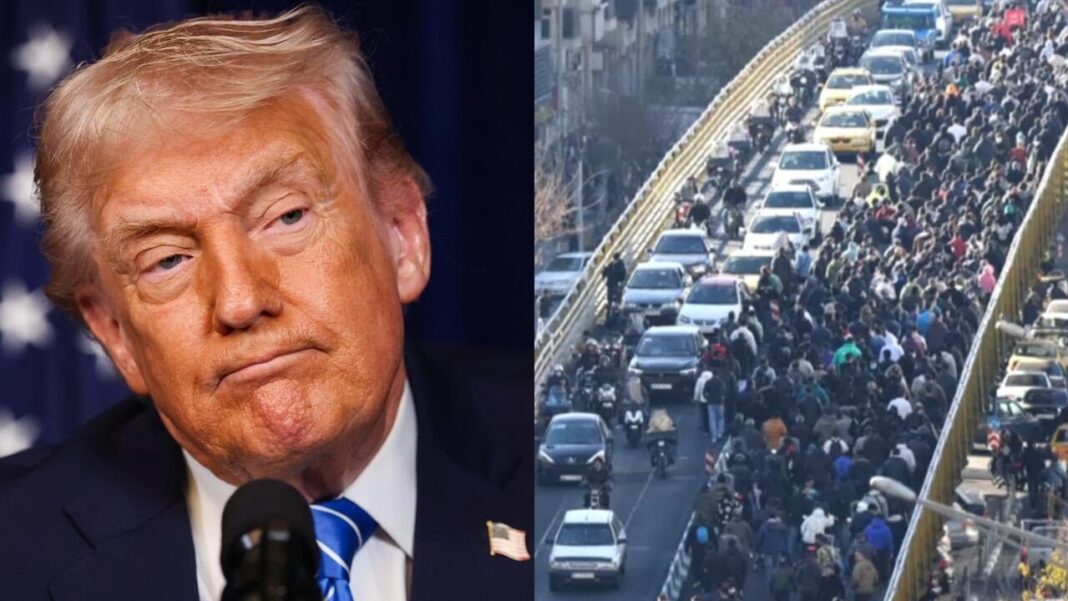
As Iran convulsed this week under the weight of spreading protests, collapsing economic confidence and an increasingly brittle political order, President Donald Trump injected a new variable into the crisis. In a late-night post on Truth Social, Trump declared that if Tehran’s authorities “kill peaceful protesters, which is their custom, the United States of America will come to their rescue. We are locked and loaded and ready to go.” The statement ricocheted across capitals and newsrooms alike, amplifying fears that a domestic uprising in the Islamic Republic could spiral into a wider geopolitical confrontation.
NBC News, which has tracked the unrest through open-source intelligence and geolocated video footage, reported on Friday that this is the most serious outbreak of anti-regime demonstrations since the “Woman, Life, Freedom” movement of 2022–2023. That earlier uprising, sparked by the death of Mahsa Amini in morality-police custody, was crushed only after months of lethal repression that left hundreds dead and thousands imprisoned. Today’s protests, born of economic despair but increasingly suffused with political defiance, are testing the regime once again — and Trump’s rhetoric has ensured that Washington now looms visibly over the confrontation.
The current wave of demonstrations erupted on Sunday in Tehran after Iran’s beleaguered currency plunged to a record low against the U.S. dollar. Inflation has been relentless, eroding purchasing power and transforming daily life into a gauntlet of price shocks. The NBC News report noted that demonstrators initially chanted about the cost of bread, fuel and rent, a familiar repertoire in a nation whose economy has been bludgeoned by sanctions, mismanagement and a short but bruising 12-day war with Israel last June — a conflict that also saw U.S. forces strike Iranian nuclear facilities.
Within days, however, the protests metastasized. What began as economically inflected grievance spread to provincial cities and towns, with slogans turning openly political. Crowds were soon heard chanting “Death to the Dictator,” a phrase aimed squarely at Supreme Leader Ayatollah Ali Khamenei, the unelected apex of Iran’s theocratic system.
NBC News has verified video footage from several flashpoints: in Marvdasht, in southern Fars province, a large crowd advances toward lines of security forces while chanting “shameless”; in Azna, in Lorestan province, two cars burn in front of a police station as gunfire cracks in the background and onlookers cheer. These images, circulated by opposition networks and corroborated by NBC News geolocation analysis, offer a rare, unfiltered glimpse into a country where state media traditionally monopolizes narrative control.
The violence has already claimed lives. The Hengaw Organization for Human Rights, a Kurdish-Iranian watchdog group, reported at least seven fatalities in multiple provinces, identifying individuals allegedly shot by security forces in Azna, Marvdasht, Lordegan, Fuladshahr and Kuhdasht. Semi-official outlets such as Fars and Tasnim, which often mirror the state’s preferred framing, acknowledge fatalities but present a different narrative. Tasnim, for example, described Amirhesam Khodayari Fard — whom Hengaw said was a protester killed by police — as a Basij militiaman who died in clashes with demonstrators.
NBC News has underscored that it cannot independently verify which account is accurate. This epistemic uncertainty is not incidental; it is the structural hallmark of unrest in the Islamic Republic, where information is weaponized and every death becomes a contested symbol.
Still, the scale of the disturbances is difficult to deny. Gunshots are audible in multiple videos verified by NBC News, and the semiofficial Fars news agency itself reported that three people were killed and 17 wounded in what it described as an attack on a police station in Azna. The regime’s willingness to admit casualties — even while reframing responsibility — suggests that the unrest has crossed a psychological threshold.
It was against this combustible backdrop that Trump’s warning landed. His declaration that the United States is “locked and loaded” to defend peaceful protesters marked one of the starkest threats of intervention he has issued since returning to office. The NBC News report contextualized the comment within a week of heightened U.S.–Israeli coordination: Trump had met with Israeli Prime Minister Benjamin Netanyahu in Florida, where he warned that Iran “may be behaving badly” and hinted it was trying to rebuild nuclear sites destroyed in last year’s U.S. strikes.
Iranian officials responded with a choreography of defiance that has become almost ritualized. Ali Larijani, secretary of Iran’s Supreme National Security Council, accused Washington and Jerusalem — without evidence — of fomenting the protests, writing on X that American intervention would unleash “chaos in the entire region and the destruction of the U.S. interests.” Ali Shamkhani, a senior adviser to Khamenei, was blunter: any “hand of intervention” would be “cut off before it can act.”
The NBC News report noted the irony that these rebuttals were posted on a platform that Iranian authorities officially block, underscoring the regime’s selective pragmatism when it comes to projecting its narrative abroad.
To analysts, the unfolding drama reflects a deeper structural paralysis. Hadi Ghaemi, executive director of the Center for Human Rights in Iran, told NBC News that the leadership is trapped between two irreconcilable imperatives: it cannot satisfy the public’s demands, yet it cannot tolerate dissent.
“So violence has always been their only tool,” Ghaemi said, a bleak diagnosis borne out by the historical record. The state’s declaration of a public holiday on Wednesday — ostensibly due to cold weather — was widely interpreted as a tactical move to sap momentum, creating a four-day lull that includes the Iranian weekend and the religious birthday of Imam Ali. But NBC News reported that security forces are expected to deploy heavily on Saturday, which coincides with the anniversary of Gen. Qassem Soleimani’s killing in a 2020 U.S. drone strike, a date freighted with nationalist symbolism.
What distinguishes this uprising from episodic protests of the past is the density of overlapping crises. Iran’s water shortages have left taps dry in some regions; its energy sector strains under sanctions; its young population faces unemployment and social immobility. President Masoud Pezeshkian, a reform-minded civilian leader constrained by unelected power centers, has acknowledged the protesters’ “legitimate demands” and signaled a desire for dialogue. Yet the NBC News report pointed out that in Iran’s bifurcated system, the presidency is not where ultimate authority resides. When unrest threatens the regime’s core, the calculus shifts from negotiation to containment.
The shadow of the Woman, Life, Freedom movement looms large. That revolt, galvanized by gendered injustice, expanded into a wholesale repudiation of clerical rule before being crushed with lethal force. Some 500 people were killed, thousands detained, and the protest movement eventually smothered. NBC News suggested that the memory of that crackdown now cuts both ways: it deters some would-be demonstrators, but it also fuels the rage of those who believe they have nothing left to lose.
The chants heard this week — “Death to Khamenei,” “shameless” — echo that earlier moment, signaling that the psychological barriers to confronting the regime’s sacred cows have eroded further.
Trump’s threat of U.S. intervention, though rhetorical for now, reverberates far beyond Iran’s borders. Tehran’s leaders are acutely aware that domestic instability has historically invited foreign pressure, from the CIA-backed coup of 1953 to the sanctions regimes of the past two decades. By framing the protests as an externally orchestrated plot, figures such as Larijani seek to reassert a siege narrative that has long legitimized repression.
Yet the NBC News report noted that the regime’s invocation of foreign enemies risks misfiring. For a generation raised on encrypted messaging apps and satellite television, the idea that Washington can choreograph spontaneous eruptions of anger over bread prices and water shortages rings hollow.
As night falls over Tehran and provincial capitals alike, the trajectory of Iran’s unrest remains perilously uncertain. The government’s tactical holiday may buy time, but it cannot reverse a currency collapse or conjure water from desiccated aquifers. Trump’s vow to act if protesters are killed, meanwhile, injects an unpredictable external variable into an already volatile equation.
For now, NBC News continues to monitor the situation through a mosaic of geolocated footage, human-rights reporting and on-the-ground testimony. What emerges from this mosaic is not yet a revolution, but neither is it a fleeting spasm. It is, rather, the sound of a society grinding against the constraints of a system that has lost its capacity to persuade.
Whether the regime chooses to repeat the blood-soaked script of 2022–2023 or attempts a more calibrated response will determine not only the fate of these protesters but the stability of a region where every tremor is felt from the Mediterranean to the Persian Gulf. Trump’s “locked and loaded” ultimatum may never be tested, but its mere articulation has already transformed Iran’s domestic crisis into a global drama — one in which the next move, by protesters or by power, could carry consequences far beyond Iran’s fractured streets.
If Trump is serious about militarily intervening in Iran (particularly on the pretext of defending Iranians from their government), I can only hope that he does not botch it up. Frankly, it sounds like an empty threat.