




|
Getting your Trinity Audio player ready...
|
By: Jason Ostedder
In a dramatic escalation of the media scandal engulfing Britain’s public broadcaster, President Donald Trump has threatened to take legal action against the BBC, following what he called a “blatantly dishonest and politically motivated” distortion of his January 6, 2021 address. As Israel National News (INN) reported on Monday, the controversy erupted after the BBC admitted that key portions of Trump’s speech had been misleadingly edited—prompting the resignations of both Director-General Tim Davie and CEO of News and Current Affairs Deborah Turness amid an international outcry over the network’s journalistic integrity.
In a statement posted to his Truth Social platform on Sunday, Trump hailed the resignations as a “victory for truth,” accusing the BBC of “doctoring” his words to make him appear as though he had incited violence during the events of January 6. “The TOP people in the BBC, including TIM DAVIE, the BOSS, are all quitting/FIRED, because they were caught ‘doctoring’ my very good (PERFECT!) speech of January 6th,” Trump wrote. “Thank you to The Telegraph for exposing these corrupt ‘journalists.’ These are very dishonest people who tried to step on the scales of a Presidential Election. On top of everything else, they are from a foreign country—one that many consider our Number One Ally. What a terrible thing for Democracy!”

According to the information provided in the Israel National News report, Trump’s legal team has since issued a formal letter of intent to sue the BBC for defamation and malicious misrepresentation. The BBC confirmed receipt of the letter on Monday, saying only that it “would respond in due course.”
As the report at INN detailed, the controversy centers on a Panorama documentary aired by the BBC earlier this month, which featured an edited version of Trump’s January 6 speech that spliced together remarks from separate sections of the event. The resulting edit—broadcast to millions of viewers in the United Kingdom and across the BBC’s international channels—gave the impression that Trump had called for violence immediately after urging his supporters to march to the U.S. Capitol.
The program omitted a key line in which Trump told demonstrators to “act peacefully and patriotically,” instead blending unrelated phrases to suggest a call to insurrection. “We’re gonna walk down to the Capitol and I’ll be with you—and we fight. We fight like hell,” the broadcast version aired. However, as Israel National News reported, the phrase “we fight like hell” was spoken nearly an hour later in an entirely different context.
The manipulation was first uncovered by The Telegraph of the UK, whose investigation found that the BBC’s editorial staff had combined separate clips to create what appeared to be a continuous statement. The exposé ignited a firestorm across the media and political worlds, prompting questions about whether the BBC had deliberately distorted the speech to fit a particular political narrative.
In the wake of the scandal, internal BBC documents reviewed by INN revealed that an independent consultant, Michael Prescott, had raised alarms months earlier about systemic bias and editorial misconduct within the organization. Prescott, a former political editor for The Sunday Times, submitted a confidential memorandum to the BBC’s Editorial Guidelines and Standards Committee, detailing several serious breaches of journalistic ethics.
According to the information contained in the Israel National News report, Prescott’s report described the editing of Trump’s speech as “a deliberate act of distortion that undermines public trust in the BBC’s credibility.” He further noted that concerns raised by internal reviewers were “dismissed or ignored by senior management.”

Following publication of these findings, Director-General Tim Davie and News CEO Deborah Turness tendered their resignations, acknowledging “errors of judgment” and “failures in oversight.” Their departure represents one of the most significant leadership upheavals in the BBC’s modern history.
“The BBC has long enjoyed a reputation for impartiality,” INN observed, “but the revelations have cast a shadow over that image, suggesting an entrenched culture of political bias within the institution.”
The BBC scandal has resonated far beyond London. As the Israel National News report pointed out, Trump’s legal threat underscores a broader crisis of confidence in global media institutions accused of distorting facts to influence political outcomes.
For Trump, the issue is personal as much as political. His 2021 speech, delivered before a crowd of supporters on the day Congress certified the 2020 election results, has long been central to claims that he incited the Capitol riot—a charge he has consistently denied. The BBC’s edited version, critics argue, reinforced that false narrative.
“This is not simply about one broadcaster,” an unnamed adviser close to the president told INN. “This is about the manipulation of truth on an international scale. The BBC’s actions show how state-backed media can cross from journalism into propaganda.”
Legal analysts cited in the Israel National News report say Trump’s case may hinge on whether he can prove “actual malice,” the standard required under U.S. defamation law. However, the potential for diplomatic fallout is significant, given the close cultural and political ties between Washington and London.
“If the BBC’s actions were politically motivated,” said Professor Jonathan Bailey, a media ethics scholar at Cambridge University, “it represents not only a violation of journalistic standards but also an act that could have distorted international perceptions of American democracy.”
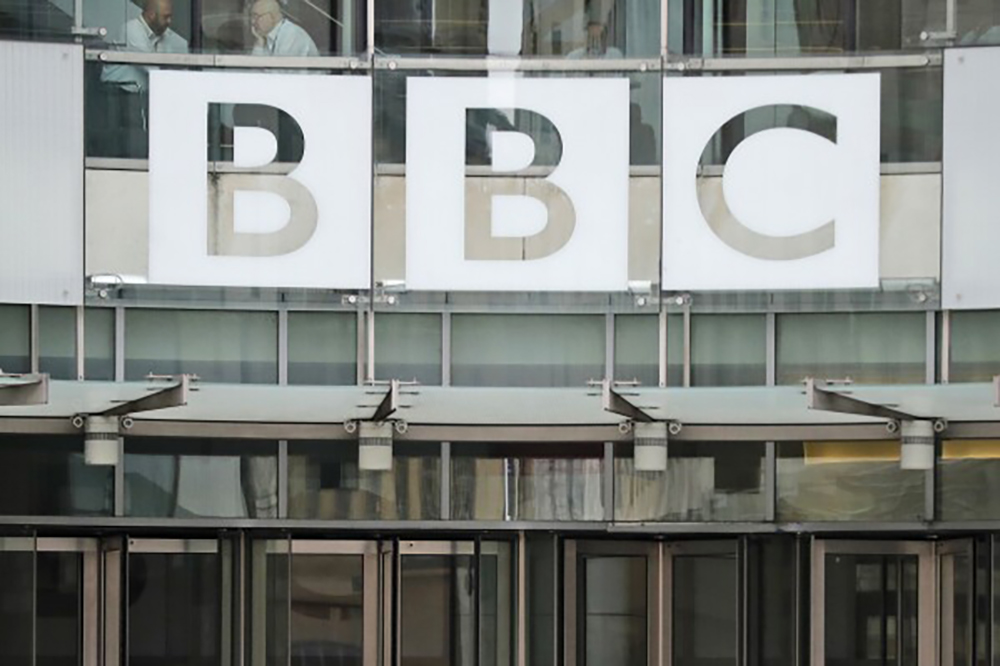
The controversy has also revived longstanding criticism of the BBC’s Middle East coverage. According to the Israel National News report, Prescott’s leaked report included a section documenting “consistent and unjustifiable anti-Israel bias,” particularly within the BBC’s Arabic-language service.
Examples cited in the report included sympathetic framing of Hamas statements, disproportionate coverage of Palestinian casualties without contextual reference to terrorism, and the frequent omission of Israeli civilian deaths in Gaza-related reporting.
A report by a British law firm, endorsed by major UK Jewish organizations, claimed the BBC breached its editorial guidelines over 1,500 times during its coverage of the Israel-Hamas war in Gaza.
The BBC has also been widely criticized for its editorial policy of not using the word “terrorist” to describe Hamas members, despite the group being designated as a terrorist organization by the UK and other governments.
“BBC Arabic systematically portrays Israel as the aggressor and minimizes acts of violence against Israelis,” the report alleged. The findings echo years of complaints by Israeli officials and watchdog organizations accusing the broadcaster of applying double standards in its coverage of the Jewish state.
In one case, BBC Arabic contributor Ahmed Qannan, who publicly described a Palestinian gunman who killed five Israelis as a “hero,” appeared 217 times on air between February 2024 and April 2025 — always introduced as a “journalist.” Another regular contributor, Ahmed Alagha, who had referred to Jews as “devils” and Israelis as “less than human,” appeared 522 times during the same period.
“Imagine the BBC platforming an extremist who referred to any other ethnic or religious group as ‘devils,’” columnist Melanie Phillips wrote in a recent op-ed titled, “Defund the BBC.’ “There would be outrage — and rightly so. Yet when the hatred is directed at Jews, it is recast as political commentary,” she added.
Perhaps the most chilling example of what Phillips called “journalistic malevolence” concerned BBC reports on the mass graves in Gaza. In April and June 2024, BBC correspondents published stories alleging that Israeli soldiers had buried hundreds of Palestinian bodies at Al Nasser and Al Shifa hospitals before withdrawing. The source for both stories was the Hamas-controlled Gaza Civil Defense Agency, a fact that the BBC did not disclose in its coverage.
Internal reviews later found no independent corroboration of these claims. One BBC article even implied that a UN official had confirmed the allegations of summary executions — a claim the UN itself denied. Ironically, the same BBC journalists had earlier reported that Palestinians were digging graves at those exact hospitals weeks before Israel’s ground operations.
“How could the BBC forget its own reporting?” Phillips asked pointedly. “How could it recycle Hamas propaganda as if it were evidence of Israeli war crimes? This is not bias. This is evil masquerading as journalism.”
According to Prescott’s testimony, the BBC’s editorial leadership did not simply fail to correct these violations — it actively resisted acknowledging them. He recounted instances in which BBC executives brushed aside complaints, failed to discipline offenders, and refused to implement reform.
“I have never, in my professional life,” Prescott wrote, “witnessed what I did at the BBC with regard to how management dealt with (or failed to deal with) serious recurrent problems.”
For Phillips, this speaks to a moral and epistemic collapse within the institution. “BBC executives believe their left-wing worldview is the center ground,” she argued. “Anyone who challenges that worldview is automatically cast as an extremist. The result is a hermetically sealed thought system — impervious to truth, insulated from accountability.”
The collapse, she says, is not ideological alone but civilizational. “The BBC once defined Britain’s moral voice in the world. It now peddles propaganda with the arrogance of a priesthood convinced of its own sainthood.”
The political fallout has been seismic. In London, the scandal has forced Prime Minister Keir Starmer’s government into crisis management mode. As Phillips noted, Downing Street fears the affair could strain U.S.–U.K. relations.
BBC Chairman Samir Shah is expected to deliver a formal apology to the House of Commons Culture Committee this week, though Phillips dismissed such gestures as “performative damage control.”
“This is not a problem that can be resolved by two resignations or a committee apology,” she wrote. “It is structural, spiritual, and endemic.”
But it is the BBC’s handling of Israel, Phillips maintains, that reveals something darker than bias. “The BBC’s coverage of the Jewish state,” she wrote, “reflects not mere political slant but deep-seated animus — a reflexive hostility rooted in cultural contempt and moral relativism.”
By presenting Israel’s self-defense as aggression while humanizing terror groups like Hamas, the BBC, she argues, “has become a global amplifier of antisemitic narratives.”
In one particularly damning passage, Phillips declared: “As producers of Britain’s cultural mood music, the BBC has been drip-feeding poison about Israel into the nation’s psyche for years. It is directly responsible for the tsunami of Jew-hatred now engulfing British campuses and streets — and for stoking the hatred of Jews in the Muslim world. The BBC has Jewish blood on its hands.”
Phillips’s solution is both radical and, in her view, inevitable: defund the BBC.
Already, calls for defunding are gaining traction. Conservative MPs have demanded a parliamentary inquiry into the BBC’s governance, while free-speech advocates argue that its license fee model — which forces every household with a television to pay an annual levy — is anachronistic in the digital age.
As Phillips emphasized, “A taxpayer-funded broadcaster cannot also be a partisan political actor. The BBC must choose: journalism or activism. It cannot be both.”
To her credit, Phillips does not treat the BBC’s corruption as a uniquely British problem. Instead, she places it within the wider collapse of Western media ethics — a decline marked by groupthink, ideological censorship, and contempt for dissent.
As the INN report noted, the revelations have drawn attention in Jerusalem, where officials have often clashed with the BBC over its reporting. One senior Israeli media analyst told Israel National News that “the same ideological bias that led the BBC to distort Trump’s speech is what fuels its anti-Israel editorial line. The worldview is identical—progressive, post-national, and hostile to Western self-defense.”
For now, Trump appears intent on turning the scandal into a broader indictment of international media bias. As Israel National News reported, the president has instructed his legal team to prepare filings both in U.S. and U.K. jurisdictions. “We are reviewing all options to ensure accountability,” said a spokesperson for the Trump legal team. “This is not merely a matter of correction or apology. The BBC engaged in malicious fabrication.”
While the BBC has promised an internal review, the network continues to face mounting pressure from British lawmakers, who have called for a parliamentary inquiry into its editorial oversight. Some members of the House of Commons have even suggested revisiting the BBC’s Royal Charter, which mandates impartiality as a condition of its public funding.
“Trust in the BBC has been badly shaken,” Conservative MP Andrew Bridgen told Israel National News. “When a publicly funded broadcaster manipulates political speech to serve a narrative, it crosses a red line that cannot be ignored.”
The scandal has left one of the world’s most respected news organizations fighting to restore its reputation. Yet as Israel National News concluded, the damage may be irreversible. The episode has become emblematic of what critics see as an ideological drift within elite media institutions — a departure from fact-based reporting toward advocacy journalism.
For Trump, the incident represents vindication of his long-standing claim that global media networks are “rigged” against him and his supporters. For the BBC, it is a reckoning that threatens its credibility not only in Britain but around the world.