



|
Getting your Trinity Audio player ready...
|
Trump Signals More Attacks on Kharg Island While Pressing Allies to Protect Vital Oil Route
By: Tzirel Rosenblatt
The war between the United States, Israel, and Iran entered a perilous new phase this week as President Donald Trump issued stark warnings that American forces could launch additional strikes against Kharg Island, Iran’s primary oil export hub, while insisting that any potential ceasefire agreement with Tehran remains unacceptable under current terms.
The remarks, delivered during an interview with NBC News and widely reported on Sunday by Reuters and The Algemeiner, underscore the widening scope of a conflict that has already shaken global energy markets, closed one of the world’s most critical shipping routes, and intensified fears of a prolonged regional war.
With the Strait of Hormuz effectively shut down for much of the world’s commercial shipping and oil prices soaring past $100 per barrel, analysts warn that the confrontation could have far-reaching consequences for the global economy. Speaking in an interview on Saturday, Trump declared that recent U.S. strikes had already inflicted catastrophic damage on Kharg Island, the Iranian facility responsible for handling the vast majority of the country’s oil exports.
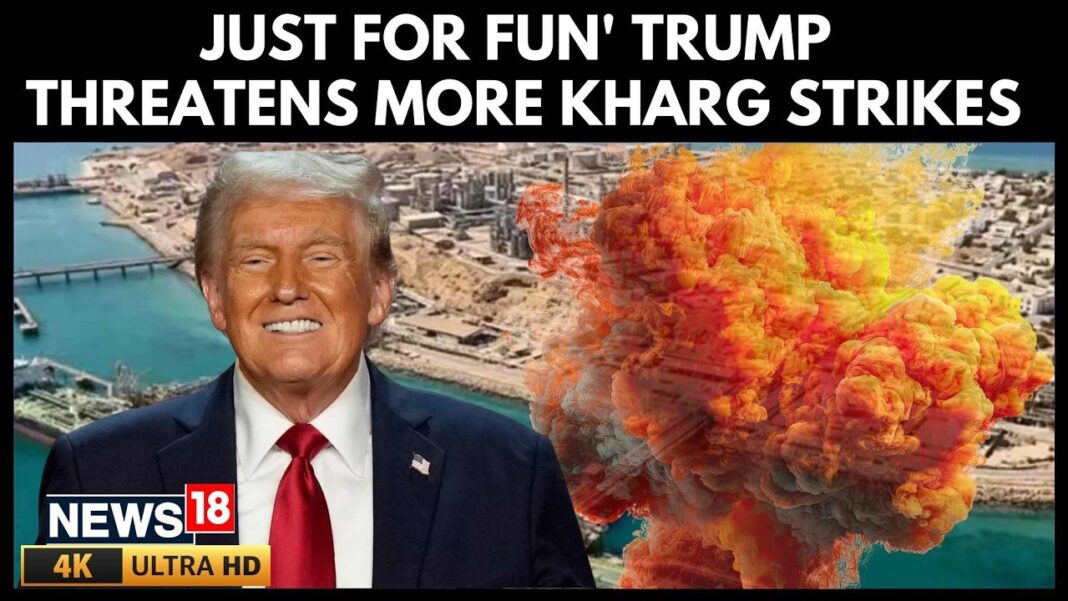
According to the Reuters report, the president said U.S. military operations had “totally demolished” large portions of the island’s infrastructure, a claim that Iranian authorities have disputed but which satellite imagery and intelligence assessments suggest may reflect significant damage to storage tanks and loading terminals. Trump also suggested that the United States might strike the facility again. “We may hit it a few more times just for fun,” Trump told NBC News, in comments that quickly reverberated through diplomatic circles and global energy markets.
The remarks represent a notable shift from earlier statements by the White House indicating that U.S. military operations were targeting only Iranian military installations rather than energy infrastructure. Observers cited by The Algemeiner noted that Kharg Island occupies a central role in Iran’s economic survival, accounting for the majority of the Islamic Republic’s oil exports and serving as a key hub for tankers transporting crude to international markets. A sustained campaign against the facility could cripple Iran’s ability to generate revenue from energy sales.
Trump’s comments also dealt a blow to tentative diplomatic initiatives aimed at halting the war, which has now entered its third week.
According to the Reuters report, several Middle Eastern governments have quietly attempted to mediate discussions between Washington and Tehran, but those efforts have so far yielded little progress. Sources familiar with the negotiations told the news agency that the United States has brushed aside several proposals for talks. Trump himself suggested that Iran may be prepared to negotiate but insisted that the terms currently offered by Tehran fall far short of American expectations. “They’re ready to make a deal,” Trump said in the NBC interview. “But the terms aren’t good enough yet.”
Among Washington’s demands are sweeping conditions that include the dismantling of Iran’s nuclear program, severe restrictions on its ballistic missile capabilities, and broader political concessions. According to The Algemeiner report, Trump has even floated the possibility that the United States should have a role in determining Iran’s future leadership—a proposal certain to be rejected by Tehran.
The war’s most immediate and dramatic impact has been felt in global energy markets. The Strait of Hormuz, a narrow maritime passage connecting the Persian Gulf to the Indian Ocean, serves as the conduit for roughly one-fifth of the world’s oil and liquefied natural gas supplies. Since the outbreak of hostilities on February 28, shipping traffic through the strait has been severely disrupted. Reuters reported that most international shipping companies have suspended transit through the waterway amid fears of missile attacks, naval mines, and drone strikes.
The International Energy Agency warned last week that the closure represents the largest disruption to global oil markets in modern history. Analysts estimate that the blockade could cut roughly 8 percent of global oil supplies, sending shockwaves through energy markets already strained by geopolitical instability. Oil prices have surged above $100 per barrel, and economists warn that sustained disruptions could trigger inflationary pressures across major economies.
In response to the crisis, Trump has called on major energy-consuming nations to deploy naval forces to help reopen the strait. “The countries of the world that receive oil through the Hormuz Strait must take care of that passage,” Trump wrote in a social media post cited by Reuters. “And we will help — a lot.” According to The Algemeiner report, Washington has specifically urged nations such as China, France, Japan, South Korea, and the United Kingdom to contribute warships to a multinational maritime security effort. The proposal echoes earlier international naval missions designed to protect shipping lanes in the region.
European officials are now reportedly considering expanding the European Union’s Aspides naval mission, which currently operates in the Red Sea to counter attacks by Iran-backed Houthi terrorists. The Financial Times, cited by Reuters, reported that EU foreign ministers are expected to discuss widening the operation’s mandate to include patrols in the Strait of Hormuz. France has also been working to assemble a coalition capable of safeguarding maritime traffic once the immediate security situation stabilizes.
Iranian leaders, however, have shown little indication that they intend to reopen the waterway. The country’s new supreme leader, Mojtaba Khamenei, who assumed power after the death of his father Ayatollah Ali Khamenei during the opening phase of the war, has publicly endorsed keeping the strait closed. Tehran argues that the blockade represents a legitimate response to U.S. and Israeli attacks on Iranian territory.
Iran’s Foreign Minister Abbas Araqchi warned European governments that any further escalation could provoke retaliation against regional energy infrastructure. He also dismissed accusations that Iran had targeted civilian areas. As Reuters reported, Araqchi insisted that Tehran was striking only military targets and proposed the formation of an investigative committee to examine claims of attacks on civilian facilities. However, critics note that multiple Gulf states have reported damage to residential districts and energy installations during the conflict.
While diplomatic maneuvering continues, the military confrontation shows little sign of slowing. Iran’s Islamic Revolutionary Guard Corps (IRGC) announced Sunday that it had launched additional waves of missiles and drones targeting Israeli territory and U.S. military bases in the region. Saudi Arabia reported intercepting at least ten incoming projectiles.
At the same time, Israeli aircraft conducted fresh strikes against military targets in western Iran, including facilities associated with the IRGC and the Basij militia in the city of Hamadan. According to the Reuters report, Israeli forces have also begun targeting transportation routes believed to be used by Iranian commanders, including bridges and road junctions. These strikes are designed to disrupt military coordination and restrict the movement of senior officials.
Iranian authorities have responded with a sweeping internal crackdown, arresting dozens of individuals accused of passing intelligence to Israel.
The human cost of the war continues to mount. According to figures cited by Reuters, more than 2,000 people have been killed since the conflict began, with the majority of casualties reported in Iran and Lebanon. In one recent incident, an airstrike struck a factory producing refrigerators and heaters in the Iranian city of Isfahan, killing at least 15 people. Iran’s semi-official Fars News Agency reported that the victims were workers caught inside the facility during the attack. The IRGC vowed retaliation, accusing Israel of targeting civilian infrastructure.
Israeli officials have not confirmed the strike but maintain that their operations focus exclusively on military and strategic targets.
Beyond Iran itself, Israel has intensified operations against Iranian-backed militias in neighboring countries. According to The Algemeiner report, Israeli forces have resumed strikes against Hezbollah positions in Lebanon, targeting weapons depots, command centers, and rocket-launching infrastructure. However, Israel’s Foreign Minister Gideon Saar rejected reports suggesting that Israel was exploring diplomatic talks with Lebanon. Saar also denied speculation that Israel was running low on missile interceptors for its air-defense systems. The Israeli government has consistently maintained that it will continue military operations until Iran’s ability to threaten Israeli territory is significantly reduced.
Despite predictions from some officials that the war could conclude within weeks, the strategic outlook remains highly uncertain. U.S. Energy Secretary Chris Wright suggested that the conflict might end relatively soon, allowing energy supplies to rebound and oil prices to stabilize. But with missile exchanges continuing and the Strait of Hormuz still largely closed, many analysts fear the crisis could deepen. The war has already disrupted global air travel, strained international shipping networks, and heightened tensions across the Middle East.
As Reuters and The Algemeiner have repeatedly emphasized in their reporting, the conflict now sits at the intersection of geopolitics and economics, threatening to reshape energy markets and regional alliances alike. For now, the world’s attention remains fixed on the narrow waters of the Persian Gulf—and on the decisions of leaders in Washington, Tehran, and Jerusalem whose next moves could determine whether the crisis spirals further or begins a long path toward
