



By: Fern Sidman
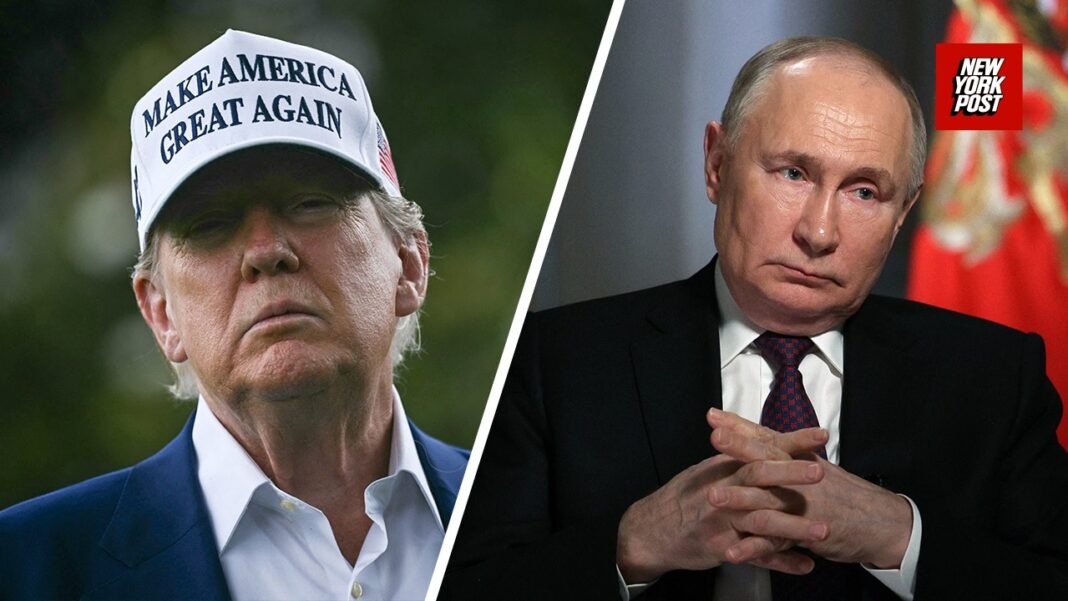
In a bold and pointed rebuke on the White House lawn Wednesday, President Donald J. Trump revealed he flatly rejected Russian President Vladimir Putin’s proposal to serve as a mediator in the escalating Iran-Israel war—advising the Kremlin leader instead to resolve the brutal war he launched in Ukraine before extending diplomatic ambitions elsewhere.
Speaking to reporters beneath a newly erected flagpole, Trump relayed the contents of his recent conversation with Putin, noting, “I spoke to Putin yesterday and he actually offered to help mediate.” According to Trump, his response was sharp and unequivocal: “Do me a favor, mediate your own. Let’s mediate Russia first. You can worry about this later.” As reported by The New York Post, the president’s dismissive tone drew attention to Washington’s mounting frustration with Moscow’s ongoing aggression in Eastern Europe and its close ties with Tehran.
The New York Post report noted that the exchange comes amid a highly volatile military confrontation between Israel and Iran. In less than a week, the Jewish state has launched a barrage of strategic airstrikes against Iranian nuclear sites and high-level regime targets, effectively dismantling key elements of Iran’s air defense infrastructure. Iran’s munitions stockpile—already depleted from years of proxy warfare—is reportedly nearing exhaustion, with The New York Post citing intelligence suggesting dwindling supplies of drones and ballistic missiles.
Russia, alongside China, remains one of the Islamic Republic’s most vocal international backers. Both powers have condemned Israeli airstrikes, despite mounting evidence—widely disseminated by Israeli and U.S. intelligence—that Tehran continues to enrich uranium at weapons-grade levels, in direct violation of international agreements. According to the report in The New York Post, this growing alliance of authoritarian states has become a flashpoint in what many analysts are now describing as a “multi-theater cold war.”
Despite Putin’s overtures, Trump appears deeply skeptical of Moscow’s motives. Just weeks ago, the president publicly denounced Putin’s conduct in Ukraine, slamming what he called an “absolutely CRAZY” campaign of terror against civilians. In an editorial briefing covered by The New York Post, Trump reiterated his call for immediate peace talks between Russia and Ukraine but expressed outrage over the Kremlin’s continued use of cruise missiles and thermobaric weapons against non-combatants.
While rejecting Putin’s peace offer on the Middle East front, Trump has simultaneously escalated American rhetoric toward Tehran. In remarks covered by The New York Post, he issued a grave warning to Supreme Leader Ayatollah Ali Khamenei: any attack on U.S. forces in the region would be met with deadly force. “If Iran touches a single American soldier,” Trump reportedly told aides, “Khamenei is gone.”
Military officials close to the White House have confirmed to The New York Post that Trump is weighing a dramatic show of force: authorizing the deployment of a 30,000-pound “bunker buster” bomb—officially known as the Massive Ordnance Penetrator (MOP)—against Iran’s underground Fordow nuclear facility, hidden beneath a mountain and long thought to be impenetrable to conventional airstrikes.
Such a strike, if approved, would mark a seismic shift in U.S. engagement in the Middle East conflict and send a clear message to both Iran and its international allies that Washington’s strategic patience has reached its limits. According to defense sources cited by The New York Post, the Fordow facility represents a “red line” for both the U.S. and Israel, and any attempt by Iran to resume centrifuge operations within its fortified depths could trigger direct military intervention.
Meanwhile, Israel’s military campaign continues with lethal precision. In addition to striking nuclear infrastructure, Israeli fighter jets have reportedly assassinated several top Iranian Revolutionary Guard Corps commanders and nuclear scientists, a tactic consistent with previous Mossad-led operations. The New York Post report emphasized the psychological impact of these decapitation strikes on Iran’s leadership, with multiple regime insiders expressing alarm over the rapid pace and accuracy of the Israeli attacks.
The broader geopolitical implications are staggering. U.S. allies in the Gulf are reportedly increasing their military readiness, while NATO planners are bracing for potential cyber retaliation or proxy escalations by Iran’s regional clients, including Hezbollah and the Houthis. The New York Post has reported that oil prices spiked sharply on news of Trump’s potential intervention, reflecting global market anxiety over a full-scale U.S.-Iran conflict.
In Washington, reactions to Trump’s dismissal of Putin’s proposal have been largely bipartisan, with lawmakers on both sides expressing doubts about the sincerity of Russian diplomacy in a conflict where Moscow is seen as a partisan actor. The New York Post report noted that senior members of Congress have called for additional sanctions on both Iran and Russia, accusing the Kremlin of materially supporting Tehran’s weapons program.
In his final remarks on the matter Wednesday, Trump once again doubled down on his America First posture while reaffirming support for Israel. “We are not looking for war,” he said, “but we will not let Iran go nuclear, and we will not take lectures from Vladimir Putin about peace while he bombs Ukrainian schools.”
As tensions escalate and strategic calculations evolve by the hour, The next steps taken by the United States—whether measured restraint or forceful retaliation—may very well determine the trajectory of the Middle East for decades to come.
