



|
Getting your Trinity Audio player ready...
|
By: Fern Sidman
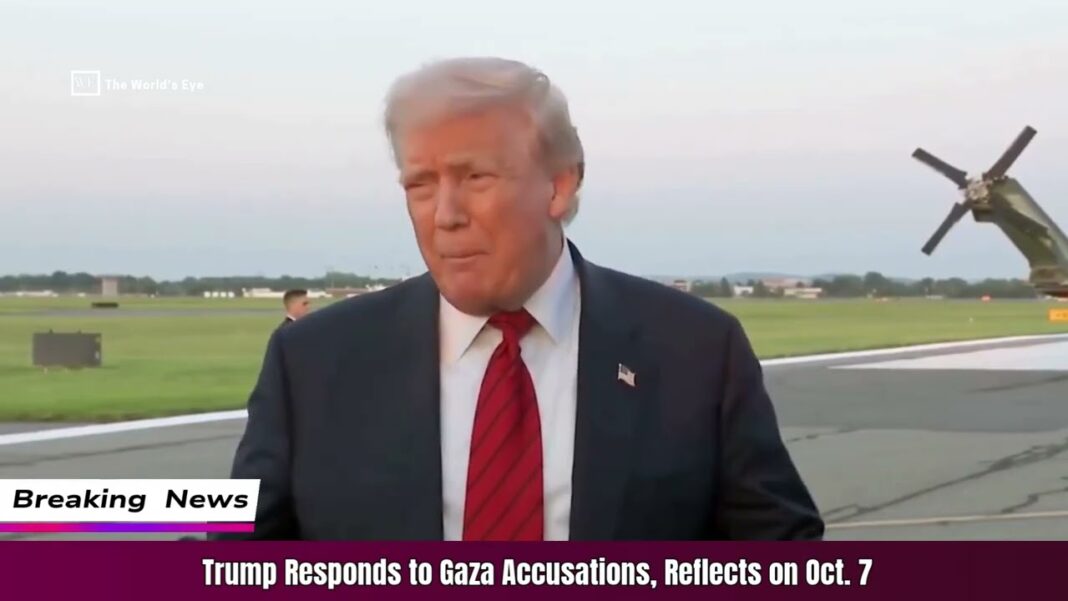
President Donald Trump has firmly rejected accusations that Israel is carrying out a “genocide” in Gaza, insisting that the Jewish state is engaged in a legitimate military campaign against Hamas following the group’s brutal October 7, 2023 assault. Speaking to reporters before boarding Air Force One in Pennsylvania on Sunday, Trump framed Israel’s ongoing military operations as an unavoidable consequence of Hamas’s atrocities and a necessary effort to dismantle the terrorist group’s infrastructure.
According to a report that appeared on Tuesday in The Algemeiner, Trump was asked directly by reporters whether he agreed with the characterization of Israel’s war as genocide. His response was unequivocal. “I don’t think it’s that. They’re in a war,” he said, stressing that the conflict cannot be detached from the horrors that precipitated it.
Trump emphasized that Hamas’s October 7 assault, in which the terror organization and allied Palestinian groups invaded southern Israel, was among the most horrific attacks he had ever seen. “Some horrible things happened on Oct. 7,” he told the press. “It was a horrible, horrible thing. One of the worst I’ve ever seen.”
As The Algemeiner has reported, the October 7 massacre left 1,200 people brutally massacred and saw 251 hostages abducted into Gaza. Testimonies and evidence have revealed widespread atrocities, including sexual violence, killings of entire families, and the destruction of communities in Israel’s southern border regions. The unprecedented attack set off the current war, with Israel vowing to eradicate Hamas and ensure that Gaza could never again be used as a launchpad for mass terror.
Despite his strong defense of Israel, Trump also made clear that he sees a moral obligation to alleviate suffering among Gaza’s civilian population. “We want the people fed. We’re the only country that’s really doing that. We’re putting up money to get the people fed. And Steve Witkoff is doing a great job,” Trump said, referring to his Middle East envoy.
As The Algemeiner report noted, Trump’s comments reflect the United States’ central role in coordinating aid shipments into Gaza, even as the conflict continues. Washington has supported humanitarian corridors in cooperation with Egypt and Israel, while encouraging the delivery of food, medicine, fuel, and water. Trump underscored that his administration is intent on ensuring that hunger does not become a secondary tragedy of the war, positioning the U.S. as a key broker of relief efforts.
Israeli officials, as cited by The Algemeiner, have consistently argued that their operations are directed against Hamas’s military infrastructure, not civilians. The government has insisted that extensive precautions are taken to minimize harm, including advance warnings of strikes, the designation of evacuation zones, and the careful selection of targets tied to Hamas operatives.
Nevertheless, Hamas’s deeply entrenched tactics—embedding fighters and weapons in schools, hospitals, and civilian neighborhoods—make civilian casualties an unavoidable consequence of combat, Israeli officials argue. The Israeli Defense Forces have repeatedly accused Hamas of using civilians as human shields, a strategy designed both to complicate Israel’s military objectives and to fuel international condemnation when civilian casualties occur.
Trump’s comments come against the backdrop of intensifying international scrutiny of Israel’s campaign. Several human rights organizations and international institutions have leveled accusations of “genocide” against Israel, alleging that its military operations amount to the systematic destruction of Gaza’s population. Israel has categorically rejected such claims, calling them politically motivated and devoid of factual or legal foundation.
As The Algemeiner report highlighted, Israeli leaders argue that the real genocide threat came on October 7, when Hamas targeted Jewish civilians with deliberate mass killings. They maintain that the war in Gaza is not only defensive but existential—aimed at ensuring that Hamas can never repeat such atrocities.
Trump’s dual message—supporting Israel’s right to wage war against Hamas while stressing humanitarian relief for Gaza—reflects a delicate balance. His remarks emphasize that while Israel is fighting a terror organization, the United States sees an obligation to prevent civilians from starving or being denied medical assistance.
Israeli officials have echoed this point, noting that despite ongoing hostilities, they have facilitated aid deliveries. According to the information provided in The Algemeiner report, Israel has enabled the transfer of essential goods through multiple crossings, even at times when such aid risked being diverted by Hamas for its own purposes.
Trump’s rejection of the “genocide” accusation also plays into broader political debates in the United States. With divisions sharpening over U.S. policy toward Israel, his clear defense of the Jewish state aligns with pro-Israel voices warning against the spread of narratives that undermine Israel’s legitimacy.
For Israel, such high-level political backing is critical. As The Algemeiner report observed, the framing of the conflict in international media and political discourse has become nearly as significant as the fighting on the ground. Hamas and its supporters have sought to portray the Gaza war as a war against Palestinians broadly, while Israel has labored to keep the focus on Hamas as a terrorist entity bent on destruction.
In his remarks from Pennsylvania, President Trump sought to cut through the competing narratives by returning to first principles: Israel, he said, is not carrying out a genocide but fighting a war forced upon it by the mass atrocities of October 7. At the same time, he pledged continued U.S. engagement to provide humanitarian relief to Gaza’s civilian population.
As The Algemeiner report indicated, the central question remains whether the international community will acknowledge the distinction between a state defending its citizens against a terror organization and the accusations of genocide that have proliferated since the war began. For Trump, that distinction is clear: “They’re in a war.”
