



|
Getting your Trinity Audio player ready...
|
By: Andrew Carlson0 Jewish Voice News
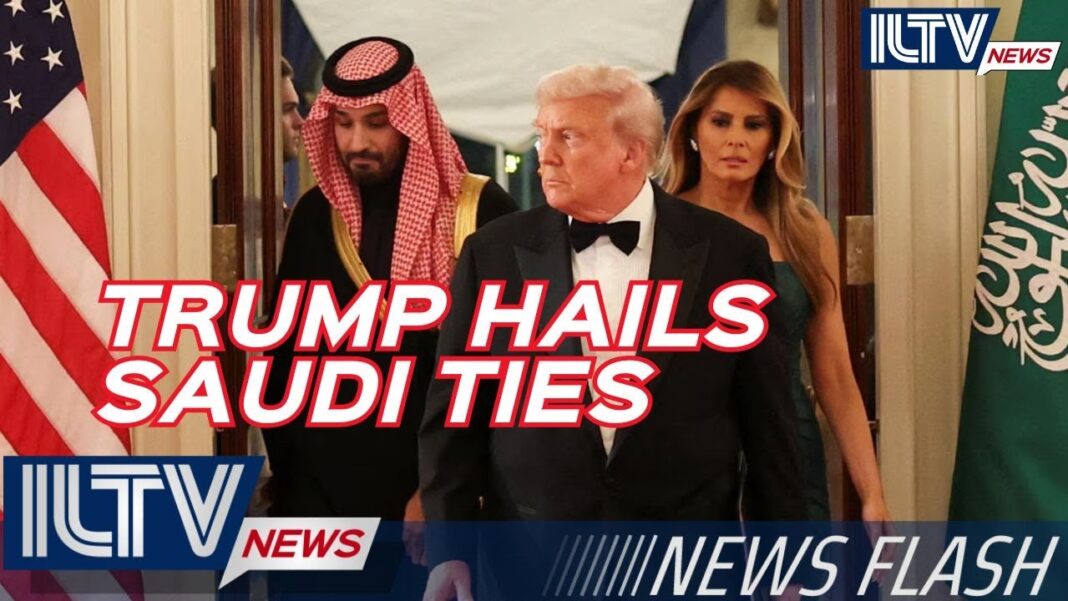
In one of the most opulent diplomatic displays of his presidency, President Trump hosted Saudi Crown Prince Mohammed bin Salman at a black-tie White House dinner on Tuesday evening, drawing an extraordinary guest list that spanned the commanding heights of global wealth, political influence, technology, finance, and international sport. As The New York Times reported, the event was more than a mere ceremonial gathering: it was a deliberate exhibition of renewed strategic partnership between Washington and Riyadh — a relationship reshaped, recalibrated, and now publicly reaffirmed after years of international tension following the 2018 killing of journalist Jamal Khashoggi.
The glittering assembly included the world’s richest man, some of the most recognizable figures in global soccer, executives controlling trillions of dollars in corporate and sovereign assets, and senior leaders from America’s technology, military, energy, and financial sectors. The dinner, held inside the historic State Dining Room, marked Crown Prince Mohammed’s first visit to the United States since U.S. intelligence agencies determined he had ordered Khashoggi’s murder — a finding the crown prince continues to deny. As The New York Times report emphasized, the very presence of so many Western figures who once publicly distanced themselves from the Saudi ruler underscored the dramatic evolution of diplomatic and commercial ties, signaling that business interests, geopolitical alignment, and shifting global power structures have largely overtaken the once-intense international condemnation.
The evening was choreographed to signal rapprochement and renewed strategic interdependence. Mr. Trump has agreed to the sale of advanced F-35 fighter jets to Saudi Arabia — a longstanding Saudi ambition — and the crown prince, in turn, has pledged to invest nearly $1 trillion into U.S. projects and industries, reflecting the kingdom’s sweeping plans for technological and economic expansion. The reciprocal announcements, as detailed in The New York Times report, formed the subtext of Tuesday’s elaborate reception: a shared ambition to forge a deepened relationship despite the lingering shadows of past crises.
A White House official released the full guest list, revealing an assembly of unparalleled breadth: NBA-level celebrity from the world of soccer, global energy barons, technology magnates at the forefront of the artificial intelligence race, elite financiers, foreign ministers, U.S. cabinet secretaries, influential media figures, and, notably, members of the Trump family. As The New York Times report noted, many of these individuals maintain deep business ties with Saudi Arabia — connections that have expanded in tandem with the crown prince’s sweeping initiatives to diversify the Saudi economy and reposition the kingdom as a global hub for finance, technology, and sport.
Among the most internationally recognizable guests was Portuguese superstar Cristiano Ronaldo, whose presence struck a particularly symbolic chord. At 40, Ronaldo remains one of the most marketable and widely followed athletes in the world. As The New York Times report recounted, his current role as a marquee player in the Saudi Pro League — where he is the highest-paid athlete — reflects Riyadh’s massive investment in global sports as part of Crown Prince Mohammed’s Vision 2030 diversification plan. His attendance also highlighted Saudi Arabia’s unprecedented transformation of world soccer through aggressive acquisitions, high-profile player signings, and controversial bids for international tournaments.
Also present was Gianni Infantino, the president of FIFA, who has served in the role for nearly a decade. Infantino has become a close ally of both Mr. Trump and Crown Prince Mohammed, cultivating relationships that were instrumental in securing Saudi Arabia’s uncontested bid to host the 2034 FIFA World Cup, a result the crown prince had prioritized as a global symbol of Saudi ascendancy. As The New York Times reported, Infantino openly campaigned for the Saudi bid, advocated for Saudi investments in global soccer, and spearheaded rules that effectively ensured the kingdom’s victory. His attendance at the White House dinner signaled the sporting world’s entrenched ties to both Washington and Riyadh, reinforcing the perception that global athletic institutions are increasingly shaped by political and economic alignments across continents.
A central theme of the evening — and a major emphasis in The New York Times’ reporting — was the influential presence of American technology leaders who stand at the forefront of artificial intelligence, data infrastructure, semiconductors, and digital finance. These executives are vital to Saudi Arabia’s redefining of itself as a technological powerhouse and to the kingdom’s evolving role in global A.I. development.
Among them was Elon Musk, the world’s richest man and chief executive of Tesla, SpaceX, and X. His relationship with Saudi leadership has oscillated between tension and collaboration. While Musk had long blamed Saudi Arabia’s Public Investment Fund (PIF) for withdrawing support from his attempted privatization of Tesla, he has also accepted major Saudi investments into his social platform X and into his artificial intelligence company xAI. As The New York Times documented, state-backed Saudi A.I. firms have hinted at expanded partnerships with Musk’s companies — an indication that strategic cooperation between Musk and Riyadh may accelerate despite past disputes.
Tim Cook, CEO of Apple, also attended the dinner, underscoring the company’s significant economic footprint in Saudi Arabia. Apple has spent over $2 billion with Saudi suppliers in the last five years and is planning to open the kingdom’s first Apple Stores by 2026. As The New York Times noted, Apple faced criticism for hosting a Saudi government app allowing guardians to track women’s movements — an issue that surfaced during Cook’s meetings with Saudi officials — but the company’s commercial expansion in the region has proceeded unabated.
Michael Dell, CEO of Dell Technologies, represented another major technology presence. His company recently opened a fulfillment center in Dammam and signed memorandums of understanding with Aramco and the Saudi Data and Artificial Intelligence Authority, initiatives celebrated by Saudi leadership as central to their efforts to build world-class digital infrastructure.
Dell’s fellow technology magnate Chuck Robbins, CEO of Cisco Systems, also attended. Cisco has maintained a long-standing partnership with the kingdom dating back to 2018, and its current collaboration with the Saudi A.I. firm Humain has become one of the most closely watched international technology ventures, as The New York Times report noted.
Perhaps most significant was Jensen Huang, CEO of Nvidia, whose company dominates the global market for high-performance A.I. chips. Nvidia recently reached a deal with Humain to sell approximately 18,000 cutting-edge semiconductor units — the backbone of Saudi Arabia’s newest data centers. As The New York Times reported, the deal has raised concerns among U.S. officials about the risk of advanced A.I. technology circumventing export controls or reaching China via complex regional partnerships. Nevertheless, Huang’s presence at the White House dinner underscored Nvidia’s pivotal role in shaping both American and Saudi strategic aims.
Another key figure was Lisa Su, CEO of AMD, whose company has partnered with Humain to fund A.I. data centers in both Saudi Arabia and the United States. AMD emphasized that the partnership enhances U.S. global leadership in artificial intelligence — a point repeatedly highlighted by The New York Times when describing the deepening technological interdependence between Riyadh and Silicon Valley.
The dinner also drew leaders from the world’s largest energy firms, reinforcing the longstanding cornerstone of the Saudi-American relationship: global oil markets. As The New York Times chronicled, the guest list included Mike Wirth, CEO of Chevron, whose company’s ties to Saudi Arabia stretch back nearly a century, originating with Standard Oil of California’s early exploration in the kingdom. Chevron continues to produce oil and natural gas on Saudi Arabia’s behalf in the neutral zone between Saudi Arabia and Kuwait and maintains substantial petrochemical investments in the region.
Amin Nasser, CEO of Saudi Aramco, the world’s most profitable oil company, also attended, symbolizing the kingdom’s enduring centrality to global energy. For decades, the fortunes of American energy companies have been intertwined with Aramco’s strategic decisions, and the presence of its chief executive reinforced the political and economic weight of the evening.
Wall Street was represented as well, with Jane Fraser, CEO of Citigroup, serving as a particularly notable attendee. As The New York Times report observed, Fraser was recently named co-chair of the U.S.-Saudi Business Council, and Citi continues to hold an influential advisory role in Saudi financial strategy, including assisting with major transactions and setting up new regional headquarters in Riyadh — a move encouraged by the crown prince’s economic reforms.
Stephen A. Schwarzman, CEO of Blackstone and one of the most powerful private equity leaders in the world, was also present. Blackstone’s long track record of investment partnerships with the Saudi Public Investment Fund — beginning with a 2017 U.S. infrastructure plan during Trump’s first term — has only strengthened in recent years. As The New York Times report detailed, Schwarzman has visited Riyadh frequently and remains closely linked to many of the kingdom’s long-term development projects.
Industry giants across construction, aerospace, and media also joined the gathering. Brendan Bechtel, head of Bechtel — one of America’s largest construction firms — attended as a symbol of long-standing engineering cooperation with Saudi projects ranging from the Riyadh Metro to gold mining ventures. As The New York Times reported, Bechtel recently wrote publicly that his company’s ties with the kingdom have endured across 14 U.S. presidencies.
From Detroit, Mary Barra of General Motors and William Clay Ford Jr. of Ford Motor illustrated Saudi Arabia’s significance as the largest automotive market in the Middle East. Their attendance also reflected broader concerns surrounding American industrial policy under Trump, particularly tariffs affecting imported vehicles and parts.
In addition to corporate titans, numerous media figures populated the guest list, including Fox News host Bret Baier and Fox Business anchor Maria Bartiromo, both of whom have maintained long-standing coverage of Trump’s political and economic agenda.
Members of the Trump family were central figures: Donald Trump Jr., Tiffany Trump, and several in-laws attended the soirée, reinforcing the intersection of family, business, and politics that has long characterized Trump’s public life. As The New York Times report noted, the Trump Organization’s recent expansion into Saudi Arabia — including new real estate developments — underscores the deepening personal and commercial ties between the Trump family and the Saudi government.
The dinner signaled the crown prince’s full diplomatic reemergence on the world stage. As The New York Times report observed, the presence of individuals who once distanced themselves following Khashoggi’s killing speaks to shifting priorities as Saudi Arabia positions itself at the center of global investment, technological competition, and geopolitical strategy.
Mr. Trump and the crown prince emphasized their alliance as a mutually beneficial partnership designed to bolster both countries’ global influence. With an F-35 sale underway, a promised trillion-dollar Saudi investment in the United States, and extensive cooperation across A.I., energy, defense, and finance, the evening represented the culmination of years of rebuilding after one of the most consequential diplomatic ruptures in recent memory.
It also suggested that the U.S.-Saudi partnership — long defined by strategic interdependence — is entering a new era shaped not only by oil but by artificial intelligence, global capital, and ambitious geopolitical realignment. As The New York Times emphasized throughout its coverage, the magnificence and scope of the White House event reflected a relationship both revived and substantially transformed, shaped now by shared aspirations across technology, sports, energy, and economic development.
With the crown prince’s first U.S. visit in six years concluding in extraordinary fashion, and with business leaders signaling clear intent to deepen their partnerships with Riyadh, the Trump-bin Salman alliance now stands as one of the most consequential and closely watched bilateral relationships in global affairs.