



|
Getting your Trinity Audio player ready...
|
By: Russ Spencer
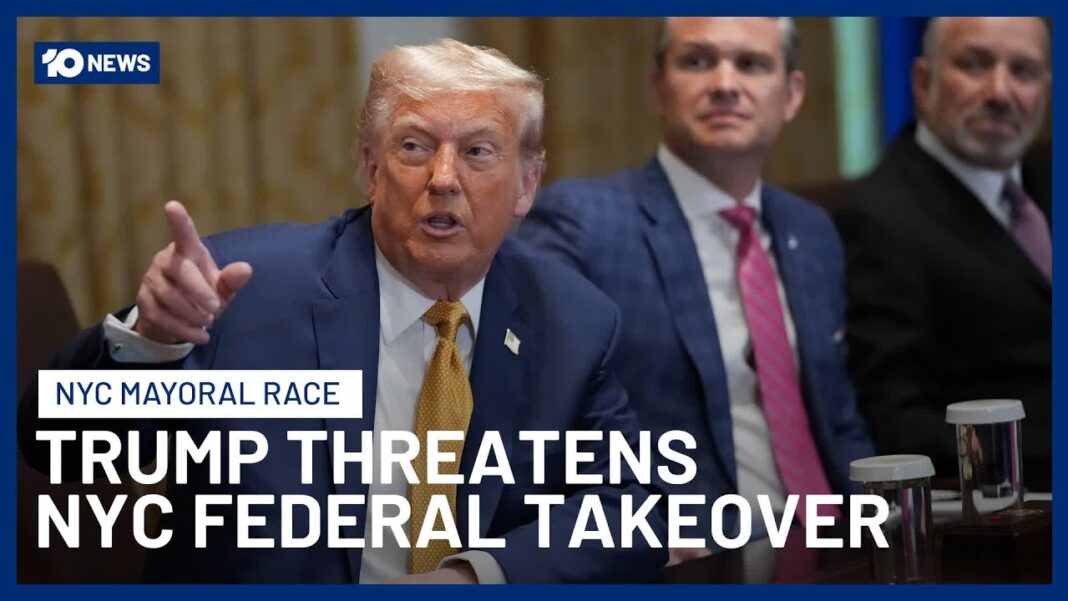
In a move that marks one of his most sweeping statements on federal authority since returning to the White House, President Donald Trump on Tuesday publicly floated the idea of a federal takeover of both New York City and Washington, D.C., citing deep dissatisfaction with local governance, rising ideological extremism among candidates, and the need to “restore law and order.”
Speaking during a Cabinet meeting at the White House, Trump was asked about the upcoming mayoral election in New York City, where tensions have flared over the candidacy of Democratic Socialist nominee Zohran Mamdani. Without offering a formal endorsement of any specific candidate, Trump launched into a wide-ranging attack on the field, invoking language that raised eyebrows among constitutional scholars and political observers.
“We’re not going to have—if a communist gets elected to run New York, it can never be the same,” Trump declared, as reported by ABC News, which provided coverage of the president’s remarks. “But we have tremendous power at the White House to run places when we have to.”
The president did not specify which legal mechanisms he believed would authorize such an unprecedented federal intervention in a state or municipal election, but the statement sent shockwaves through political circles and dominated headlines across major media platforms Tuesday afternoon.
According to the information provided in the ABC News report, Trump pivoted quickly from concerns over New York’s electoral politics to Washington, D.C., reiterating a long-standing grievance over the state of the nation’s capital. “We could run D.C. We’re looking at D.C. We don’t want crime in D.C. We want the city to run well,” Trump said, adding that his Chief of Staff, Susie Wiles, had been in touch with Washington Mayor Muriel Bowser.
Although D.C. is granted limited home rule under the District of Columbia Home Rule Act of 1973, Congress maintains the ultimate authority over the city’s budget and legislation. Trump has previously expressed frustration with the local government’s autonomy, especially as the city has grappled with high-profile incidents of violence and concerns over public order.
“We would run it so good, it would be run so proper,” Trump added with characteristic bravado. “We’d get the best person to run it. And we know the crime would be down to a minimum.”
He further hinted that discussions within the White House about asserting greater control over the district were ongoing. “We’re thinking about doing it, to be honest with you,” he told his Cabinet, according to the ABC News report.
While the president’s comments resonated strongly with his base, especially those who rightly perceive New York and Washington as progressive bastions in decline, the ABC News report was quick to note the disconnect between Trump’s rhetoric and recent crime statistics. According to preliminary data from the Metropolitan Police Department cited by the network, violent crime in D.C. is down 25% compared to the same time last year, and overall crime has dropped by 8%.
Nonetheless, Trump portrayed the district as spiraling, positioning federal intervention as both urgent and justified. “We want a capital that’s run flawlessly,” he said. “And it wouldn’t be hard for us to do it.”
Although Mayor Bowser has maintained a generally cooperative tone with the administration, the idea of placing the capital city under direct federal management—particularly in the absence of congressional authorization—would raise significant legal challenges and likely ignite fierce political resistance.
Back on the subject of New York City, Trump reiterated his distaste for ranked-choice voting, which he derided as confusing and prone to manipulation. He referred to his interactions with current Mayor Eric Adams as a “test” and signaled that more assertive federal engagement could be on the table if leadership in the city does not restore competence and order.
“New York City will run properly,” Trump insisted. “We’re going to bring New York back.”
Though no formal federal mechanism exists that would allow the White House to take unilateral control over New York City governance, Trump’s language suggested a broader strategic posture heading into the 2025 elections—one that emphasizes aggressive federal oversight as a corrective to ideological extremism and civic dysfunction at the local level.
The ABC News report pointed out that Trump did not specify any plans to deploy federal law enforcement or to invoke emergency authorities such as the Insurrection Act—tools that have been previously suggested or used by his administration during moments of domestic unrest.
At the heart of Trump’s renewed focus on New York City lies the mayoral candidacy of Zohran Mamdani, a self-described democratic socialist who has long voiced criticism of the U.S.-Israel alliance and recently sparked national controversy by vowing to arrest Israeli Prime Minister Benjamin Netanyahu if he enters the city—a remark that Trump called “communist” in nature.
“This is a communist,” Trump said at the Cabinet meeting, as quoted by ABC News. “Not a socialist. A communist. And he’s said some really bad things about Jewish people. He’s going through a bit of a honeymoon right now, but he might make it. He’s going to behave. He better behave. Otherwise, he’s going to have big problems.”
Trump’s comments suggest that his administration is preparing to take a hardline stance against Mamdani should he ascend to the mayoralty, perhaps even threatening to withhold federal funding or take other punitive actions.
As ABC News emphasized throughout its report, the president’s rhetoric—though popular with elements of his political base—raises serious constitutional questions. The federal government does not possess the authority to intervene in local elections or unilaterally take over the operations of municipal governments, except under extraordinary circumstances involving federal law violations or national security emergencies.
Legal scholars contacted by ABC News noted that any attempt to assert direct federal control over New York City or Washington, D.C., would be met with swift legal challenges, likely ending up before the Supreme Court.
Still, Trump’s comments mark a significant rhetorical escalation in his ongoing efforts to cast Democratic-led cities as failed experiments in progressive governance and to position himself as the strongman capable of restoring order and efficiency.
While no specific federal plan appears to be underway at this time, President Trump’s remarks on Tuesday have stirred significant political and legal controversy. As the ABC News report aptly framed it, the president’s musings about federal control signal more than idle speculation—they reflect a growing ideological confrontation between the White House and the leadership of America’s most prominent cities.
Whether these remarks evolve into concrete policy—or remain a bold stroke of political theater—remains to be seen. What is clear is that Trump’s latest pronouncements have set off alarm bells in local government circles and added yet another layer of volatility to an already charged political landscape.
