



Trump Declares He Personally Opted Against Military Action in Iran
By: Fern Sidman
In a dramatic turn of events that has reverberated across capitals from Washington to Jerusalem and beyond, President Donald Trump announced on Friday that the Iranian regime has cancelled what he described as “hundreds of planned executions” of anti-government protesters. The revelation, delivered with characteristic flourish on social media and later amplified in remarks to reporters, has injected an unexpected note of cautious optimism into a geopolitical landscape long defined by hostility and mistrust.
According to a report on Friday at Israel National News, the announcement represents one of the most significant diplomatic developments involving Iran in recent years—particularly given the context of escalating tensions and persistent speculation that the United States was on the verge of military action against the Islamic Republic.
“I greatly respect the fact that all scheduled hangings, which were to take place yesterday (Over 800 of them), have been cancelled by the leadership of Iran. Thank you!” President Trump declared in a post on his Truth Social platform. The statement, as brief as it was momentous, suggested that direct or indirect American pressure may have succeeded in halting a brutal wave of executions reportedly planned by Tehran as part of its crackdown on internal dissent.
The figure cited by Trump—more than 800 planned hangings—has not been independently confirmed. Yet the president’s assertion has already reshaped international discourse. The Israel National News report noted that Trump’s comments come at a moment when the Iranian regime has faced widespread condemnation for its handling of nationwide protests, which erupted months ago in response to economic hardship, political repression, and growing frustration with clerical rule.
When pressed by reporters later in the day, Trump offered additional insight into his thinking, dismissing suggestions that Arab or Israeli leaders had influenced his decision-making.
“No one convinced me. I convinced myself,” he said. “You had, yesterday, scheduled over 800 hangings. They didn’t hang anyone. They cancelled the hangings. That had a big impact.”
The president’s remarks underscored his belief that the suspension of executions represented a tangible humanitarian achievement—one significant enough to alter the trajectory of American policy toward Tehran, at least for the moment.
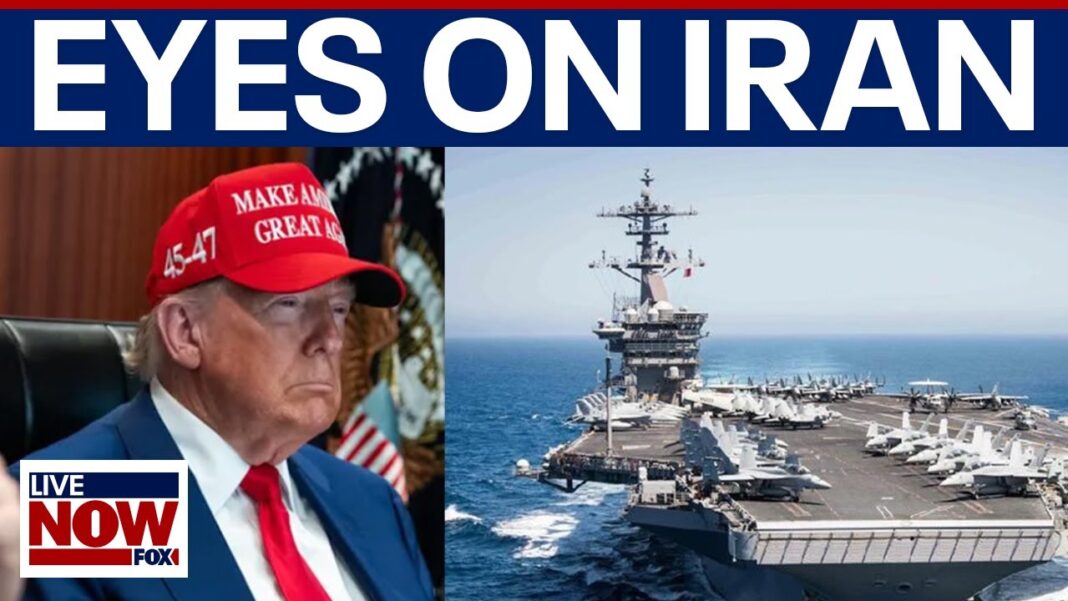
For weeks, rumors had swirled that Washington was preparing some form of military intervention in response to Iran’s violent repression of demonstrators. Reports of aircraft carrier movements, troop repositioning, and diplomatic back-channeling fueled speculation that conflict could be imminent.
Against that backdrop, Trump’s insistence that the cessation of executions had shifted his calculus marked a notable departure from the hardline rhetoric that has often characterized his approach to Iran.
Israel National News has chronicled the tense atmosphere that has enveloped the region in recent days, with analysts warning that any direct strike on Iran could ignite a wider conflagration involving Iranian proxy forces throughout the Middle East.
Trump himself acknowledged earlier in the week that the situation had reached a critical juncture. “We have been notified pretty strongly that the killing in Iran is stopping, and there’s no plan for executions or an execution,” he told reporters from the Oval Office on Wednesday. “I’ve been told that on good authority. We’ll find out about it, I’m sure. If it happens, we’ll be very upset.”
Those comments appeared to signal a willingness to pause and reassess—provided that Tehran demonstrated genuine restraint.
Now, with the alleged cancellation of mass executions, Trump has seized upon what he portrays as evidence that diplomatic pressure, rather than military force, can yield results.
Whether the Iranian regime’s decision was motivated by fear of American retaliation, internal political calculations, or international condemnation remains an open question. What is clear is that the announcement has momentarily eased fears of an immediate military confrontation.
Further context was provided Thursday night by Trump’s Middle East envoy, Steve Witkoff, who addressed the opening session of the 10th Israeli American Council (IAC) National Summit in Florida. As reported by Israel National News, Witkoff revealed that at Trump’s direction, the United States had communicated directly with Iranian officials to express grave concerns about the rumored executions.
“And that’s been shut down, I think, as everyone knows,” Witkoff said. “The president has announced that. He’s the only one in the world who has that indomitable strength that can bend people. I watch it happen. It’s quite remarkable to watch it happen.”
Witkoff’s remarks, laden with admiration for Trump’s negotiating prowess, reinforced the administration’s narrative that decisive American leadership had forced Tehran to reconsider its most draconian measures.
Yet the envoy also struck a more measured tone when asked about the possibility of military action. “I hope there’s a diplomatic resolution. I really do,” he said, before outlining the core issues that continue to divide Washington and Tehran: Iran’s nuclear enrichment program, its ballistic missile arsenal, its stockpiles of fissile material, and its support for regional proxy militias.
These, Witkoff emphasized, remain unresolved—and potentially explosive.
Israel National News has consistently framed the unfolding drama as part of a broader struggle over Iran’s regional ambitions and internal repression. For Israel, in particular, the stakes could hardly be higher.
Successive Israeli governments have warned that a nuclear-armed Iran would pose an existential threat to the Jewish state. Even short of that nightmare scenario, Tehran’s backing of Hezbollah, Hamas, the Houthis, and other militant groups has destabilized the Middle East for decades.
From this perspective, the halting of executions—while welcome on humanitarian grounds—does little to address the strategic challenges posed by the Iranian regime.
Still, Israeli officials and analysts appear to recognize the potential significance of the moment. As the Israel National News report observed, any development that reduces immediate tensions and spares innocent lives is likely to be greeted with cautious approval in Jerusalem.
The question, of course, is whether the current thaw represents a genuine turning point or merely a temporary pause in a cycle of confrontation.
Beyond the realm of geopolitics, the human dimension of Trump’s announcement cannot be overlooked. If indeed hundreds of Iranian prisoners were spared from execution, the impact on families and communities across Iran would be profound.
For months, international human rights organizations have documented harrowing accounts of mass arrests, summary trials, and death sentences handed down to protesters accused of defying the regime. Israel National News has highlighted the widespread outrage these practices have provoked, particularly in Western democracies.
In that light, Trump’s assertion that the executions have been cancelled carries enormous moral weight—regardless of the precise diplomatic dynamics that produced the result.
Critics, however, caution that Iran’s judicial system remains opaque and unpredictable. Skeptics warn that executions could resume at any moment, or that sentences might simply be delayed rather than permanently overturned.
Trump’s decision to publicly thank the Iranian leadership is itself a striking departure from conventional diplomatic protocol. Rather than condemning Tehran outright, he chose to offer praise—albeit narrowly focused on a single issue.
Some observers interpret this as a shrewd negotiating tactic designed to encourage further concessions. Others view it as a risky gamble that could be exploited by a regime adept at manipulating international opinion.
The Israel National News report noted that Trump’s approach appears rooted in his long-held belief that personal diplomacy and blunt incentives can achieve breakthroughs where traditional statecraft has failed.
Whether that philosophy will ultimately yield a durable settlement with Iran remains to be seen.
For now, the world watches and waits.
The suspension of executions, if confirmed, represents a rare moment of hope in an otherwise grim chapter of Iranian history. Yet the fundamental issues—nuclear ambitions, regional aggression, and domestic repression—remain unresolved.
As the Israel National News report observed, one thing is certain: the coming days and weeks will test the limits of diplomacy, deterrence, and presidential persuasion.
In the volatile chessboard of Middle Eastern politics, Friday’s announcement may prove to be either the opening move of a new game—or simply a brief respite before the next storm.
For the moment, at least, hundreds of lives may have been spared. And in a region too often defined by bloodshed and despair, that is no small achievement.
