



|
Getting your Trinity Audio player ready...
|
By: Fern Sidman
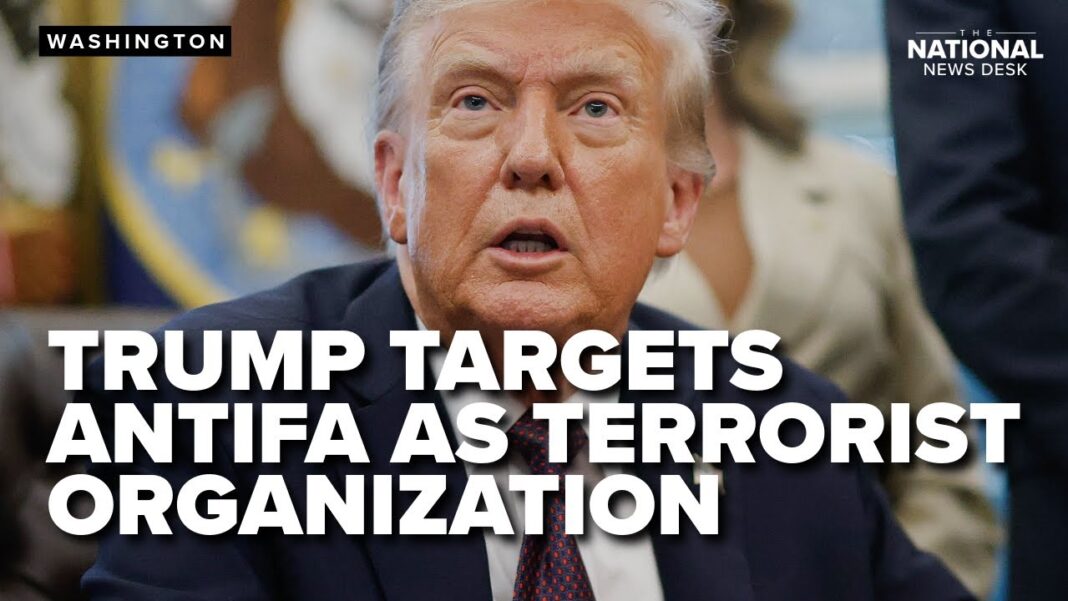
President Donald Trump, speaking after midnight on Sept. 18 during his state visit to the United Kingdom, announced that his administration will formally designate Antifa as a terrorist organization—a move long debated in Washington and now reignited by the political assassination of Turning Point USA founder Charlie Kirk.
“I am pleased to inform our many U.S.A. Patriots that I am designating ANTIFA, A SICK, DANGEROUS, RADICAL LEFT DISASTER, AS A MAJOR TERRORIST ORGANIZATION,” the president posted on Truth Social. “We will also be strongly recommending that anyone funding this group be investigated.”
The Epoch Times reported on Thursday that the declaration marks one of the most forceful steps yet by the Trump administration to criminalize a movement that has been blamed for years of violent demonstrations, vandalism, and intimidation campaigns across American cities. The announcement, delivered while Trump and the first lady were in Windsor meeting members of Britain’s royal family, reverberated quickly across both the U.S. and Europe.
The president’s move came just days after 22-year-old Tyler Robinson allegedly gunned down Kirk in Utah. Prosecutors say Robinson was radicalized by extreme leftist ideology, and investigators discovered anti-fascist slogans etched into the bullets he carried. Though the FBI has not yet confirmed direct organizational ties between Robinson and Antifa chapters, the symbolism was not lost on administration officials.
The Epoch Times report noted that Antifa activists gathered outside Windsor Castle during Trump’s visit, chanting the chilling refrain “Charlie’s in a box,” mocking the conservative leader’s death. For Trump, this grotesque demonstration underscored what he has described as the group’s descent into “anti-American nihilism.”
On Monday, ahead of the announcement, Trump hinted at the designation, telling reporters that “Antifa is terrible” and that he would move forward with the terrorist label if he had support from his team. Standing with him was Attorney General Pam Bondi, who has been tasked with shaping the legal architecture around the designation.
While critics have dismissed Antifa as a loose collection of activists with no formal leadership structure, The Epoch Times has frequently traced its origins back to communist and anarchist movements of the early 20th century.
Scholars note that the group’s ideological foundations were laid during the Soviet Comintern’s “united front” strategy of 1921. Moscow encouraged revolutionary groups to brand all rivals as “fascists” while uniting disparate left-wing organizations to advance communism. Bernd Langer’s 80 Years of Anti-Fascist Action describes how the Communist Party of Germany used these tactics to destabilize Weimar institutions.
The Epoch Times has emphasized that Antifa’s modern incarnations, while often cloaked in the language of “anti-fascism,” are deeply rooted in these same radical leftist traditions. In the United States, the group gained a fresh foothold after Trump’s first election in 2016, escalating its presence during campus protests and later during the violent unrest following George Floyd’s death in 2020.
Trump previously floated the idea of labeling Antifa a terrorist organization in May 2020, as riots engulfed Minneapolis and other major cities. At the time, Attorney General William Barr pointed to Antifa elements fueling violence during demonstrations. Yet former FBI Director Christopher Wray took a softer stance, testifying before Congress that Antifa was more of a “movement or ideology” than a centralized organization.
Still, intelligence analysts at the bipartisan Center for Strategic and International Studies have warned that Antifa adherents are driven by an anarcho-communist worldview and frequently use violence as a tactic to achieve their ends. Their hallmark “black bloc” attire—black clothing, masks, and helmets—serves both to conceal identities and create an intimidating uniform.
Under U.S. law, a domestic group may be designated as a terrorist organization if it engages in violent criminal acts to further political, religious, or social goals. The Epoch Times explained that such a designation carries significant implications: it enables federal agencies to more aggressively investigate, prosecute, and financially cripple affiliated individuals or networks.
Sen. Bill Cassidy (R-La.) praised the decision, saying, “Antifa seized upon a movement of legitimate grievances to promote violence and anarchy, working against justice for all. The President is right to recognize the destructive role of Antifa by designating them domestic terrorists.”
By contrast, progressive critics argue that Trump is weaponizing the label to silence dissent. Yet even some centrist Democrats have privately acknowledged, according to the report in The Epoch Times, that Antifa’s tactics—ranging from property destruction to physical assaults on political opponents—fall well outside the norms of protest.
The timing of Trump’s announcement during his U.K. visit added symbolic weight. Antifa networks have operated not only in the U.S. but also across Europe, where they trace their lineage more directly to communist militias of the 20th century. In London, the group’s demonstration during Trump’s Windsor stop highlighted its international footprint and coordination.
Turning Point UK, an affiliate of Kirk’s organization, condemned the chants outside Windsor Castle: “These societal outcasts are so removed from reality they think it’s funny to laugh at patriots being horrifically murdered.”
For The Epoch Times, which has extensively covered Antifa’s cross-border activities, the Windsor protest illustrates how ideological extremism travels fluidly across continents, sustained by online echo chambers and transnational funding streams.
Indeed, Trump’s announcement did not merely target Antifa activists but also their financial backers. “Anyone funding the group will be investigated,” he warned.
The Epoch Times has reported for years on questions surrounding who bankrolls Antifa’s organizing efforts, training camps, and travel stipends. While definitive answers remain elusive, the new designation would give federal investigators broader latitude to trace financial pipelines—potentially ensnaring nonprofits, NGOs, or individual donors who have provided cover or resources.
Robinson’s assassination of Kirk has become a flashpoint. The Epoch Times report emphasized that investigators found Robinson engraved anti-fascist slogans onto his bullets, a chilling indication of ideological intent.
Utah Gov. Spencer Cox and FBI officials have already stated that Robinson adhered to “leftist ideology” and had radicalized in recent years. While the direct organizational tie remains unproven, the symbolic link between Antifa’s rhetoric and Robinson’s crime is evident.
Trump seized on this in London, declaring that Antifa is no longer a fringe nuisance but “a major terrorist threat undermining American stability.”
The decision to designate Antifa as a terrorist organization comes at a politically charged moment, less than two months before the U.S. midterm elections. For Trump’s supporters, it signals decisive action against a movement they see as emblematic of left-wing lawlessness. For his critics, it raises concerns about the erosion of civil liberties.
The Epoch Times report noted that Attorney General Bondi is expected to roll out specific legal measures in the coming weeks, though the administration has not yet detailed the timeline for the designation’s enforcement.
Trump’s midnight declaration in Windsor represents more than just a symbolic rebuke of Antifa. It reflects a broader strategy to confront what The Epoch Times has consistently described as a radical leftist insurgency—one that has used intimidation, violence, and ideological fervor to destabilize American civic life.
Whether the terrorist designation results in prosecutions, funding crackdowns, or simply a heightened political debate, it marks a watershed in how the U.S. government approaches domestic extremist groups.
As The Epoch Times report observed, Trump has long cast himself as a defender of law and order. In formally designating Antifa as terrorists, he has made clear that his administration views their ideology not as dissent, but as a domestic menace with international echoes.
FBI and Christopher Wray knew exactly who was funding Antifa.