



|
Getting your Trinity Audio player ready...
|
By: Tzirel Rosenblatt
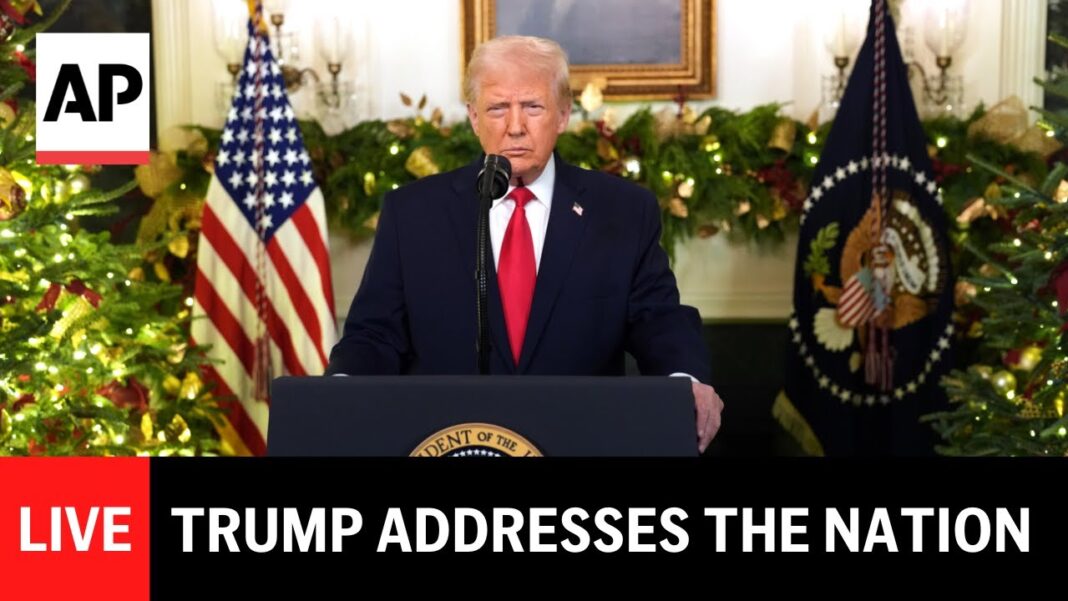
In a sweeping prime-time address delivered Wednesday evening, President Donald J. Trump offered a forceful summation of what he described as a year of dramatic national reversal, asserting that his administration has restored American strength at home and abroad while charting an ambitious course for the year ahead. According to a report by Israel National News, the address marked one of the most comprehensive statements yet of Trump’s governing philosophy since returning to office.
Speaking directly to the American people, Trump framed his presidency as a corrective to what he characterized as systemic failures inherited from his predecessor, repeatedly emphasizing themes of sovereignty, economic nationalism, border enforcement, and geopolitical assertiveness. “Eleven months ago I inherited a mess,” Trump declared at the outset, “and I am fixing it.”
As the Israel National News report noted, the speech blended policy claims, populist rhetoric, and historical symbolism, positioning Trump’s leadership as the fulcrum of what he repeatedly described as a national resurgence.
A substantial portion of the address was devoted to immigration, which Trump once again identified as the central crisis facing the United States upon his return to the Oval Office. The president asserted that the southern border had effectively collapsed under the previous administration, allowing what he described as an unprecedented influx of undocumented migrants.
Trump claimed that his administration reversed course immediately upon taking office, stating that “for the past seven months, zero illegal aliens have been allowed into our country.” While the White House has not released independent verification of that figure, Israel National News reported that Trump presented it as evidence that executive authority — rather than congressional compromise — was sufficient to enforce border security.
“As it turned out,” Trump said, “we didn’t need legislation. We just needed a new president.”
The remarks echoed longstanding Trump-era arguments that border enforcement is primarily a matter of political will. As the Israel National News report observed, the president used immigration not only as a policy issue but as a moral and civilizational one, arguing that unchecked migration threatens national cohesion, public safety, and economic stability.
Turning to domestic economics, Trump asserted that he had inherited “the worst inflation in 48 years,” describing a nation in which basic necessities had become unaffordable for millions. The president claimed his policies had already driven down consumer prices at a historic pace.
Among the figures Trump cited were gasoline prices “under $2.50 a gallon in much of the country,” eggs down “82 percent since March,” and a Thanksgiving turkey price reduction of “33 percent.” Economists have noted that such figures can vary significantly by region and timeframe, but Trump presented them as emblematic of a broader economic turnaround.
He further asserted that wages are now rising faster than inflation, claiming specific gains for factory workers, construction laborers, and miners. Trump framed these gains as evidence that working-class Americans — a cornerstone of his political coalition — are once again benefiting from national economic policy.
“Very importantly,” Trump said, “there are more people working today than at any time in American history.”
Trump devoted considerable attention to what he described as “the largest tax cuts in American history,” emphasizing provisions eliminating taxes on tips, overtime pay, and Social Security benefits. According to the Israel National News report, Trump argued that the legislation would yield substantial savings for middle-class families and generate what he predicted would be “the largest tax refund season of all time.”
Central to funding these initiatives, Trump reiterated his embrace of tariffs — a policy he once again referred to as his “favorite word.” He argued that tariffs function not as consumer penalties but as industrial incentives, compelling multinational corporations to relocate manufacturing to American soil.
“Companies know that if they build in America, there are no tariffs,” Trump said, claiming that the policy has already led to a surge in domestic factory openings. Trump presented tariffs as both an economic and national-security tool, tying industrial capacity directly to military readiness.
On defense, Trump asserted that his administration had restored American military strength while simultaneously reducing global conflict. The president claimed responsibility for ending eight wars within ten months — a statement that underscores his preference for transactional diplomacy and deterrence-driven peace.
Most notably for Israeli audiences, Trump referenced the Gaza conflict, asserting that his leadership had resulted in the war’s conclusion and the neutralization of Iran’s nuclear threat. While details of these claims remain subject to diplomatic and intelligence assessments, the Israel National News report highlighted Trump’s framing of Middle Eastern developments as historic and unprecedented.
“I’ve restored American strength,” Trump said, “destroyed the Iran nuclear threat, and ended the war in Gaza.”
Trump did not reference ongoing disputes regarding hostages still unaccounted for, but he emphasized what he described as a new era of regional stability.
Energy policy featured prominently in the address, with Trump stating that he declared a “national energy emergency” on his first day in office. Trump blamed previous administrations’ climate policies for driving up electricity costs and undermining grid reliability.
He claimed his administration is opening 1,600 new electrical generating facilities and predicted dramatic declines in electricity prices. While industry analysts caution that such projections depend on regulatory timelines and infrastructure investment, Trump presented them as imminent outcomes of deregulation and fossil fuel expansion.
Trump also outlined an aggressive approach to healthcare costs, asserting that his administration is confronting pharmaceutical companies directly. According to the Israel National News report, Trump claimed that new negotiations and tariff pressures could reduce drug prices by as much as 400 to 600 percent — figures that, if realized, would represent unprecedented shifts in pricing structures.
He announced the forthcoming launch of a federal platform, trumprx.gov, which he said would facilitate access to lower-cost medications beginning in January.
Trump reiterated his opposition to the Affordable Care Act, arguing instead for a system in which federal funds are distributed directly to individuals. Trump framed this approach as both more efficient and more empowering for consumers.
The address concluded with an emphasis on national milestones, including the upcoming World Cup, Olympic Games, and the 250th anniversary of the Declaration of Independence. Trump portrayed these events as emblematic of what he termed “the comeback of America.”
Throughout the speech, religious and historical symbolism played a central role — a feature that Israel National News has noted is characteristic of Trump’s rhetorical style, particularly when addressing audiences concerned with national identity and civilizational continuity.
“We are putting America first,” Trump concluded, “and we are making America great again.”
As the Israel National News report observed, the address was less a traditional policy briefing than a manifesto — one designed to consolidate political support while framing the coming year as the culmination of a national restoration project.
Supporters praised the speech as confident and decisive, while critics questioned the verifiability of several claims. Nonetheless, the address underscored Trump’s enduring ability to dominate the political narrative by blending policy assertions with emotive appeals to sovereignty, prosperity, and strength.
For Israel and its supporters, Trump’s continued emphasis on regional security and American-Israeli alignment remains a central point of interest. As Israel National News has frequently reported, Trump’s worldview places Israel not merely as an ally, but as a strategic and moral partner in a broader struggle against instability and extremism.
Whether the ambitious projections outlined in the speech will materialize remains to be seen. What is clear, however, is that President Trump has once again defined the terms of political debate — positioning himself as both the architect and the embodiment of America’s renewal.