



|
Getting your Trinity Audio player ready...
|
By: Carl Schwartzbaum
In a bold and highly publicized move underscored by bipartisan calls for transparency, President Donald Trump has called on a federal judge to release all grand jury testimony related to the late financier Jeffrey Epstein. As reported by National Public Radio (NPR) on Saturday, the president’s demand comes amid mounting scrutiny of the Department of Justice and intensifying public skepticism over the government’s handling of the Epstein investigation — a skepticism Trump contends is rooted in a pervasive “Deep State” agenda designed to undermine his leadership.
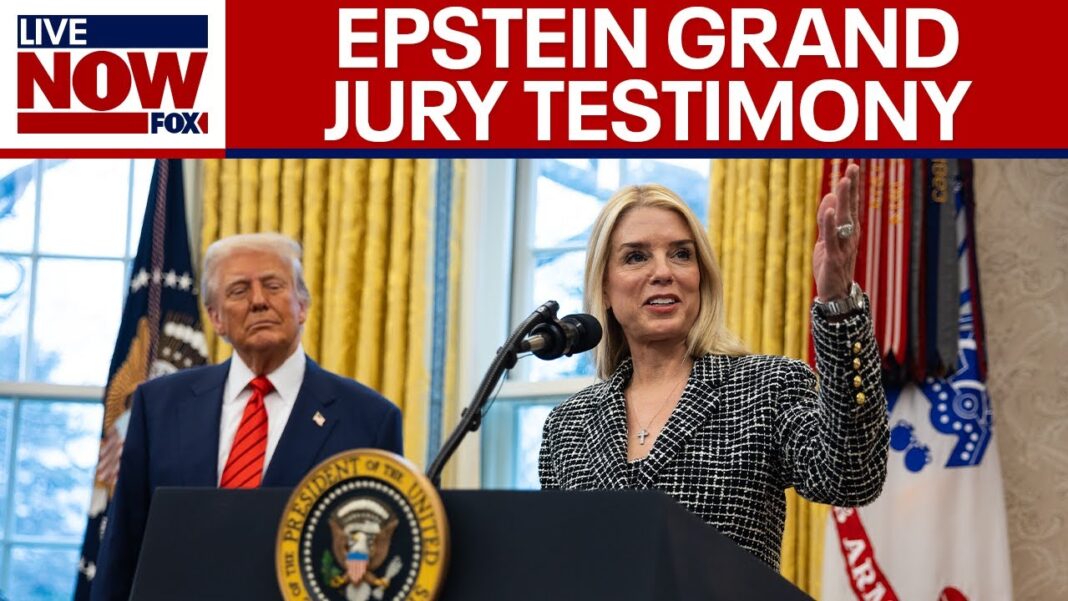
Trump’s request aligns with a formal motion filed Friday by U.S. Attorney General Pam Bondi to the Southern District of New York, as detailed in the NPR report. The motion specifically seeks to unseal grand jury transcripts from the United States v. Epstein case, with appropriate redactions to protect victim identities and personal information. “Given the public interest in the investigative work conducted by the Department of Justice and Federal Bureau of Investigation into Epstein,” Bondi wrote, “the Department moves the Court to unseal the underlying grand jury transcripts.”
On Saturday morning, Trump amplified the call on his Truth Social account, stating: “I have asked the Justice Department to release all Grand Jury testimony with respect to Jeffrey Epstein, subject only to Court Approval. With that being said, and even if the Court gave its full and unwavering approval, nothing will be good enough for the troublemakers and radical left lunatics making the request. It will always be more, more, more. MAGA!”
The NPR report noted that Trump’s push for transparency appears to resonate with a broad swath of the American public, including many of his core supporters, who have long voiced frustration over what they perceive as government cover-ups and judicial stonewalling on the Epstein case.
Throughout this renewed political storm, Trump has consistently denied any wrongdoing or inappropriate association with Epstein. As NPR reported, the president has categorically rejected accusations of involvement in Epstein’s illicit activities, even as media scrutiny intensified following Epstein’s death in a federal detention center in 2019 — a death officially ruled a suicide.
Ghislaine Maxwell, Epstein’s close associate, was convicted in 2022 for her role in facilitating the trafficking network that ensnared underage victims, a case that the NPR report described as fueling broader public demand for transparency into Epstein’s connections with wealthy and influential figures.
This week, Trump took aim at both Democrats and Republicans pressing for Epstein-related disclosures, labeling their efforts “stupid” and “foolish.” As quoted by NPR, the president vented on Truth Social: “Their new SCAM is what we will forever call the Jeffrey Epstein Hoax, and my PAST supporters have bought into this ‘bull*****’ hook, line, and sinker.”
The NPR report acknowledged that Epstein’s mysterious death and the subsequent opacity surrounding the case have fueled numerous conspiracy theories — many centered on the notion of a shadowy “Deep State” controlling government institutions and targeting political enemies. Within the Trump administration and among his supporters, these theories have found fertile ground.
Members of the Trump administration have publicly suggested that the Epstein case exemplifies the influence of entrenched bureaucratic interests working to discredit the president and suppress politically damaging information about elite figures connected to Epstein.
Trump’s latest statements appear to align with this view. By demanding the unsealing of the grand jury records, the president casts himself as a crusader against institutional corruption — a stance NPR described as reinforcing his “outsider” image and bolstering his narrative of standing alone against an adversarial establishment.
While Trump’s critics may dismiss his rhetoric, NPR confirmed that the call for transparency extends across party lines. On Weekend Edition Saturday, Rep. Ro Khanna (D-Calif.) echoed Trump’s demand for the full release of Epstein-related documents. “We need full transparency,” Khanna told NPR. “We need the interview memos to see which rich and powerful men were involved with Jeffrey Epstein. We need to see the emails, the texts. We need to of course protect victim identity. But the president promised this when he campaigned. Pam Bondi, the attorney general, promised this.”
Khanna, speaking directly to NPR, framed the issue as central to restoring public trust in government. “It goes to the heart of whether our government is granting impunity to the rich and the powerful who may have abused, assaulted, or abandoned young girls,” Khanna said.
On Thursday, NPR reported that House Speaker Mike Johnson echoed similar sentiments, stating unequivocally, “All the credible evidence should come out.” Republican Congressman Thomas Massie of Kentucky further pushed the matter by filing a discharge petition aimed at forcing a full House vote on releasing Epstein’s files, telling NPR, “We all deserve to know who’s implicated and how deep this corruption goes.”
In a parallel move that underscores his combative posture, Trump filed a federal defamation lawsuit against The Wall Street Journal and its parent company, NewsCorp, as well as journalists Khadeeja Safdar and Joseph Palazzolo. As NPR detailed in its coverage, the lawsuit, filed in the Southern District of Florida, accuses the Journal of publishing false claims that Trump authored and drew a sexually suggestive birthday card for Epstein in 2003.
The complaint, seeking at least $10 billion in damages, asserts that the Journal fabricated evidence to malign Trump’s reputation. The NPR report noted that this legal action reflects Trump’s broader strategy of aggressively challenging a coordinated campaign of defamation and misinformation orchestrated by media conglomerates and establishment figures.
Earlier this month, the Department of Justice released a two-page memo stating that after an “exhaustive review,” the DOJ and FBI found no evidence of an Epstein “client list” or of blackmail schemes involving powerful associates — a finding that contradicts previous public suggestions by Attorney General Pam Bondi.
As the report at NPR emphasized, this discrepancy further fueled suspicions among Trump supporters and intensified calls for the full release of investigative records. Many see the DOJ’s conclusions as yet another example of institutional efforts to conceal the truth and protect elite figures from scrutiny.
Trump’s latest maneuvers, amplified by his direct communication with supporters and bolstered by calls for transparency from across the political spectrum, mark a defining moment in the ongoing debate over government accountability and the public’s right to know.
The Epstein case — long a source of bipartisan outrage and conspiracy speculation — has evolved into a touchstone issue for Trump and his supporters, who see in it a vindication of their warnings about Deep State machinations.
With federal court motions filed, congressional action underway, and a high-profile defamation lawsuit in progress, Trump’s campaign against the “Epstein Hoax” appears poised to become a central narrative in his broader challenge to Washington’s entrenched power structures — a narrative that resonates deeply with a public weary of secrecy and eager for truth.
