



|
Getting your Trinity Audio player ready...
|
By: Lance Ledermeyer
In the wake of a bruising off-year election cycle that saw Republican candidates trounced in key races from New York City to California, President Donald Trump on Wednesday sought to deflect responsibility for the party’s setbacks, blaming both the ongoing government shutdown and what he called “kamikaze” tactics by Democrats.
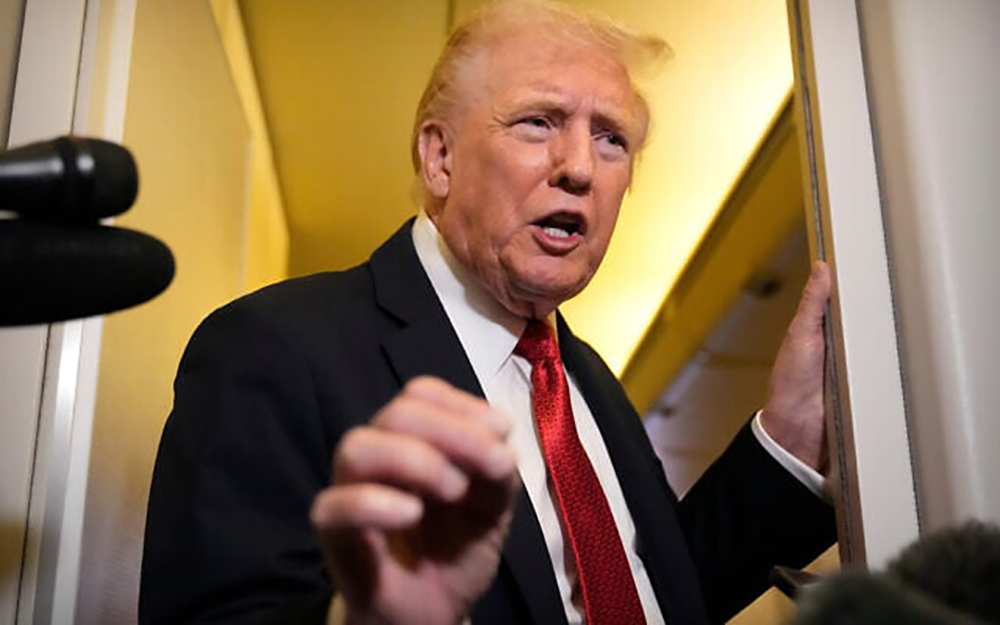
As The New York Daily News reported on Wednesday, Trump’s remarks came just hours after the polls closed, delivering a sobering political message to Republicans ahead of next year’s high-stakes battles for control of Congress. Speaking before a group of GOP senators at a morning breakfast meeting, Trump acknowledged that the results “weren’t good for Republicans,” but instead of introspection, he unleashed his characteristic fury on the opposition.
“I think (Democrats are) kamikaze pilots,” Trump declared, according to The New York Daily News. “They’ll take down the country if they have to.”
The president, clearly irked by the losses in states that were once considered competitive, described his opponents as self-destructive ideologues willing to “sabotage America’s success” for political gain. But his critics — including some within his own party — were quick to note that Trump’s combative style and the weeks-long government shutdown he has refused to end have alienated moderate voters and independents.
As The New York Daily News report emphasized, Tuesday’s elections delivered a series of stinging defeats for Trump-aligned candidates. In Virginia, Democrats consolidated control of the legislature for the first time in decades, while in New Jersey, Democratic Rep. Mikie Sherrill’s victory in the governor’s race secured another blue stronghold.
In New York City, the mayoral race captured national attention when Zohran Mamdani, a democratic socialist and outspoken critic of Trump’s policies, defeated former Gov. Andrew Cuomo, who ran as an independent, and Republican nominee Curtis Sliwa. The result — viewed by many analysts as a repudiation of Trump’s influence — was particularly painful for the GOP, given New York’s symbolic stature as the president’s home turf.
Meanwhile, on the West Coast, Republicans were routed in California’s local and congressional races, further underscoring a growing anti-Trump sentiment in metropolitan centers.
For Trump, the cumulative effect of these losses represents more than just an electoral setback. It has intensified the debate within Republican ranks about whether his populist brand of politics, once seen as a winning formula, is now proving politically toxic.
According to the information provided in The New York Daily News report, Trump privately conceded to senators that the ongoing federal shutdown — now stretching into its sixth week — had been “a big factor” in the GOP’s poor performance.
“If you read the pollsters, the shutdown was a big factor, negative for Republicans,” Trump told lawmakers, signaling that even he could no longer ignore the political cost of the crisis.
Yet, despite recognizing the damage, the president refused to take personal responsibility. Instead, he framed the issue as one of principle, portraying the standoff as a noble fight against what he calls a “bloated and corrupt” bureaucracy. “They say that I wasn’t on the ballot, (I) wasn’t the biggest factor,” Trump said, according to the report in The New York Daily News. “I don’t know about that, but I was honored that they said that.”
Trump’s critics, however, argue that his refusal to compromise has become a liability. The shutdown, which has left hundreds of thousands of federal employees furloughed or unpaid, has disrupted everything from airport security to food safety inspections, eroding public confidence in Washington’s ability to govern.
“The extremists want to make your life more expensive, take away healthcare and keep the government shut down,” Rep. Hakeem Jeffries, the House Democratic leader, tweeted on Wednesday. “Have they learned nothing from being wiped out last night?”
The president’s choice of words — referring to Democrats as “kamikaze pilots” — immediately drew scrutiny. As The New York Daily News report observed, the metaphor encapsulated Trump’s penchant for dramatic, martial language, framing political opposition as an existential threat to the nation.
“This is Trump doubling down on division,” one Republican strategist told The New York Daily News. “Rather than introspection, he’s chosen escalation — attacking Democrats while ignoring the message voters sent.”
Yet, for Trump, such rhetoric has always been part of his political DNA. His instinct to cast opponents as reckless and unpatriotic — even amid bipartisan calls for compromise — suggests that he intends to fight his way through the crisis rather than concede any ground.
The president also hinted that he would continue to push Republicans to eliminate the Senate filibuster, a procedural rule that requires a 60-vote threshold for most legislation — a move that many GOP lawmakers fear could have disastrous long-term consequences.
“It’s time for Republicans to do what they have to do and that’s terminate the filibuster,” Trump insisted. “We should start tonight with ‘the country’s open, congratulations.’ Then we should pass voter ID, we should pass no mail-in voting.”
As The New York Daily News reported, Trump’s proposal received a muted reaction from Republican senators, many of whom remain wary of dismantling an institutional safeguard that could one day be used by Democrats to advance their own progressive agenda.
Inside the GOP, frustration is mounting. Lawmakers who once embraced Trump’s populism now worry that his confrontational style — and his refusal to pivot toward consensus-building — is eroding the party’s appeal among suburban and independent voters.
A senior Senate aide told The New York Daily News that the atmosphere at the breakfast meeting was “tense but restrained.” While Trump remained outwardly defiant, several senators reportedly pressed him to seek a resolution to the shutdown and recalibrate the party’s messaging before next year’s elections.
“The president listens, but he doesn’t like being told he’s wrong,” one participant said. “Still, it’s clear to everyone that the strategy isn’t working.”
Republican pollsters have pointed to shifting voter demographics — particularly the erosion of GOP support among women, younger voters, and college-educated suburbanites — as evidence that Trump’s polarizing rhetoric has reached a saturation point.
Democrats, meanwhile, are interpreting Tuesday’s results as a mandate for cooperation and reform. As The New York Daily News report noted, party leaders are already using the GOP’s misfortunes to build momentum for a broader legislative agenda that includes expanding healthcare access, protecting voting rights, and tackling rising costs of living.
“Voters are demanding leadership, not chaos,” a Democratic strategist told The New York Daily News. “They want governance, not grievance. That’s what last night made clear.”
Still, the president remains unmoved. In his remarks, Trump doubled down on his nationalist message, vowing to fight “the radicals” in Washington and insisting that his approach is “what America needs right now.”
As the sun rose over Washington on Wednesday, the mood among Republicans was one of sober reckoning. The losses in Virginia, New Jersey, and New York City, compounded by the public’s growing fatigue with the government shutdown, have deepened the cracks within the GOP coalition.
As The New York Daily News succinctly put it, the party now faces a stark choice: continue down Trump’s confrontational path, or attempt a course correction that might alienate the president’s fervent base.
Either way, the election results have served as a warning — not just to Trump, but to a party struggling to reconcile its populist impulses with the realities of governance.
For now, the president appears determined to ignore that warning. “Hope is alive,” Trump said, echoing the language of his opponents with a twist of irony. “The only question is whether Republicans are ready to fight for it.”
Trump might have to share the blame in NY. He went with Cuomo, who had a terrible record. Should have supported Curtis Sliwa from the start. Mindboggling why he did that.