




|
Getting your Trinity Audio player ready...
|
By: Fern Sidman
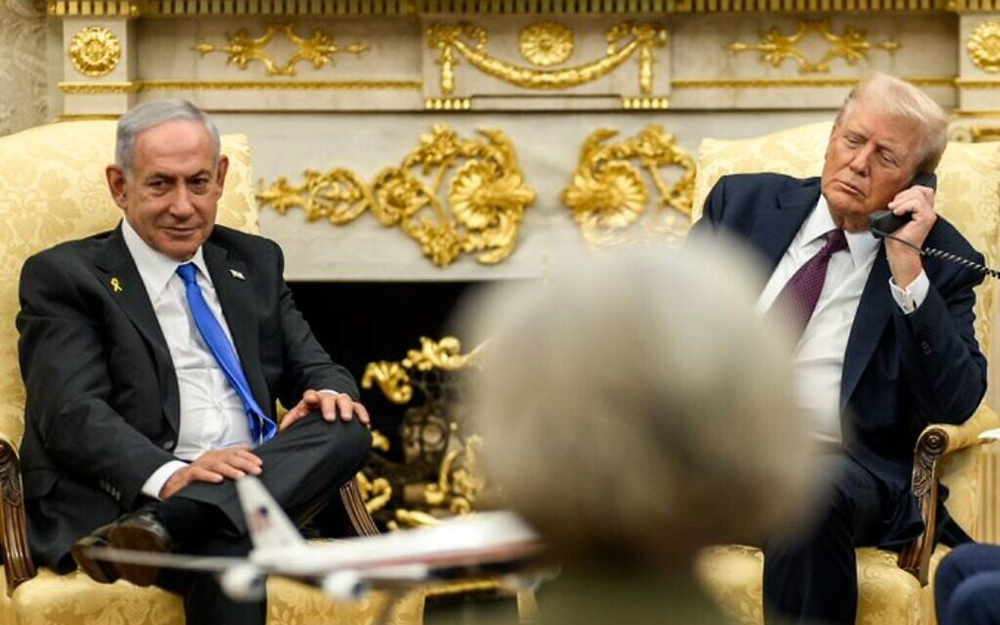
Against the historic backdrop of the White House, President Donald Trump and Israeli Prime Minister Benjamin Netanyahu stood shoulder to shoulder on Monday, unveiling what they called a turning point in the long, bloody saga of the Middle East conflict. The announcement of Trump’s “Principles for Peace” followed a lengthy bilateral meeting and working lunch, with both leaders emphasizing that the Gaza war could now give way to a broader architecture of stability.
Trump opened the press conference with characteristic flourish, declaring the day “one of the greatest days ever in civilization.” His remarks, carried live across global media, praised Netanyahu for what he described as tireless commitment to Israel’s security and peace. “We really work well together,” Trump told reporters, adding that the two leaders had discussed Iran, trade, the Abraham Accords, and “most importantly, how to end the war in Gaza, which is just one chapter of eternal peace in the Middle East.”
According to a detailed report at Israel National News on Monday, the White House announcement marked not only an effort to secure the release of hostages and the disarmament of Hamas, but also a wider regional strategy. Trump thanked Netanyahu explicitly “for trusting that if we work together, we can bring an end to the death and destruction that we’ve seen for so many years, decades, even centuries, and begin a new chapter of security, peace, and prosperity for the entire region.”
At the heart of Trump’s plan lies a strict timeline for the release of Israeli hostages. The President said that Hamas must return all hostages within 72 hours of signing the agreement, calling this demand “non-negotiable.” Should Hamas fail to comply, Trump warned, “Israel will have the absolute right and our full backing to respond with decisive force.”
Israel National News reported that the framework, dubbed the “21-point plan,” also calls for a phased Israeli withdrawal from Gaza, overseen by international monitors and security partners. In its place, Gaza would be administered by a technocratic committee of Palestinians and internationals, supervised by a new “Peace Council” co-chaired by Trump and former British Prime Minister Tony Blair.
Critically, the plan would see Hamas fully disarmed. Any Hamas member who surrenders weapons would receive amnesty and the option to leave Gaza voluntarily. Gaza residents, however, would not be forcibly displaced. Trump emphasized: “They can stay and build a better Gaza, or leave and return freely. The point is to create a Gaza without terror, without fear, and without Hamas.”
Trump surprised many by announcing that several Arab and Muslim leaders had already endorsed the plan. He thanked both Arab heads of state and Muslim leaders, saying their contributions were “essential to making this a truly regional solution.”
Perhaps most significantly, Trump revealed that the Field Marshal of Pakistan had openly backed the plan, a striking development given Pakistan’s longstanding position on Israel. According to the information provided in the Israel National News report, this detail underscored the White House’s success in forging unlikely coalitions.
Minutes before Netanyahu’s arrival, Trump spoke directly with the Emir of Qatar, whose country has played a central role in mediating between Hamas and Israel. Axios reported, and Israel National News later confirmed, that Netanyahu even issued a rare apology to Qatari Prime Minister Mohammed Bin Abdulrahman for Israel’s strike on Hamas officials in Doha during ongoing negotiations. Netanyahu reportedly assured Qatar that Israel would not repeat such violations of sovereignty.
Qatar, in turn, pledged readiness to continue contributing “meaningfully to regional security and stability.” Trump, praising both leaders, said: “This is the kind of cooperation that makes peace possible.”
Journalist Amit Segal laid out the plan’s main points:
Hostage Release: All Israeli hostages must be freed within 72 hours.
Prisoner Exchange: 250 Palestinian prisoners convicted of murder would be released.
Amnesty for Hamas: Fighters who surrender weapons will be granted amnesty and allowed to leave.
Temporary Administration: Gaza will be governed by a technocratic body under the Peace Council (Trump and Tony Blair as chairs).
Voluntary Residency: No forced displacement; residents may freely stay, leave, and return.
Palestinian Authority Involvement: The PA may eventually govern Gaza—but only after implementing sweeping reforms demanded by the Trump Plan 2020.
Disarmament: Hamas is fully excluded from governance and disarmed under international supervision.
Stabilization Force: An international stabilization force, comprising Palestinians and soldiers from Arab and Muslim states, will deploy immediately.
Funding and Reconstruction: Arab states and Muslim-majority nations will fund Gaza’s reconstruction and new administration.
No Israeli Annexation: Israel will not annex Gaza and will not occupy it.
Trump’s insistence that the plan “is not just about Gaza, but about a new Middle East” was echoed by Netanyahu, who praised Trump as “an incredible ally, the most independent and amazing leader I have ever known.” Netanyahu reiterated Israel’s longstanding objectives: freeing the hostages, disarming Hamas, and securing Israel’s future.
In Israel, the proposal triggered an immediate spectrum of responses. Right-wing leaders, such as National Security Minister Itamar Ben Gvir, warned Netanyahu against making concessions that would leave Hamas intact. Opposition figures such as Yair Lapid, however, welcomed the outline as a potential pathway toward ending the war while safeguarding Israeli security.
Israel National News reported on the emotional appeal by Yehoshua Shani, chairman of the Gevura Forum, representing bereaved families of fallen IDF soldiers. Shani urged Netanyahu not to compromise: “Do not agree to leave Hamas in place, or to bring in the Palestinian Authority. The blood of our sons demands nothing less than the complete destruction of Hamas.”

Shani cited Netanyahu’s prior commitments to bereaved parents that Israel would not end the war until its three objectives were met: the destruction of Hamas, Israeli security control over Gaza, and the return of all hostages. His words, invoking the biblical cry of Cain and Abel—“the voice of your brothers’ blood cries out”—struck a chord across Israel.
Trump’s announcement was as much about symbolism as substance. Standing beside Netanyahu, he declared: “We are not just talking about peace, we are creating it. For decades, leaders talked about ending war, but nothing happened. Today, we show the world what happens when America and Israel stand united.”
Arab states’ apparent willingness to back the plan, including tacit cooperation from countries historically hostile to Israel, was seen as a breakthrough. The Israel National News report noted that even critics acknowledged the significance of Pakistan’s endorsement, signaling a shift in global Muslim engagement on the conflict.
Still, skepticism remains. Hamas issued a statement denying receipt of any new proposals and reiterating its demand that any deal “preserve the national rights of our people.” Observers remain uncertain whether Hamas will truly disarm or accept exclusion from governance.
For Netanyahu, the stakes are immense. After nearly two years of grueling conflict, his political survival is closely tied to the war’s outcome. By embracing Trump’s plan, he signals pragmatism without abandoning core principles.
Netanyahu emphasized that “President Trump acts in America’s interest, not Israel’s. But we share values and we share goals.” This distancing underscored his rebuttal to critics who accuse him of being overly reliant on U. S. politics.
At the United Nations just days earlier, Netanyahu had thundered against the idea of a Palestinian state, warning: “Giving the Palestinians a state one mile from Jerusalem after Oct. 7 is like giving Al-Qaeda a state one mile from New York City after Sept. 11. This is sheer madness.”
Now, standing at the White House, he sought to reconcile that opposition with a U. S.-brokered framework that—at least in theory—removes Hamas from the equation without formal statehood.
As the press conference concluded, Trump declared: “I am confident this deal will go through. Everyone wants it. Hamas wants it. The Arab states want it. Israel wants it. And America will guarantee it.” Netanyahu nodded, though cautiously. “We want to free our hostages, disarm Hamas, and build a better future,” he said. “If this plan achieves that, then it is worth pursuing.”
The Israel National News report highlighted the historic weight of the moment, noting that Trump framed the plan not merely as conflict resolution, but as “civilizational progress.” Whether the lofty rhetoric translates into enduring peace remains uncertain, but the ambition was unmistakable.
Israel National News reported that Republican Senator Lindsey Graham, one of President Donald Trump’s staunchest allies, forcefully rejected any suggestion that Israel should be pressured into halting its war against Hamas before the terrorist group is permanently dismantled. His words, amplified across international media reflect a growing tension between the urgency of diplomatic overtures and the uncompromising realities of Israel’s security concerns.
On Saturday, Senator Graham took to the social media platform X to deliver his unequivocal stance.
“When it comes to terrorist threats, Israel must be allowed to defend itself and finish the job,” he wrote.
While acknowledging that the United States is committed to “trying to end major military operations in Gaza and moving toward a new Middle East,” Graham emphasized that any such resolution must come with guarantees that Hamas will be eliminated “forever” and that another October 7–style massacre will be impossible.
“I do not support ending major military operations if it means that Hamas is not eliminated forever and does not ensure that there will never be another October 7,” Graham insisted. “From my point of view, Israel is not the problem; it is Iran and its proxies that are the problem.”
His remarks, covered by Israel National News, serve as a counterweight to reports that the Trump administration is actively working to convince Israel to accept a negotiated framework for ending the war, even if that means compromise.
During his White House address, Netanyahu struck a careful balance—praising the broad outlines of Trump’s new Gaza plan while making clear that Israel will not accept any outcome that leaves Hamas in power.
According to the report at Israel National News, Netanyahu commended Trump for offering a path that sidesteps the question of handing Gaza back to a reformed Palestinian Authority, a prospect Netanyahu said Israelis overwhelmingly distrust.
“I appreciate your firm position that the PA could have no role whatsoever in Gaza without undergoing a radical and genuine transformation,” Netanyahu told the president. “It won’t come as a surprise to you that the vast majority of Israelis have no faith that the PA leopard will change its spots. But rather than wait for this miraculous transformation, your plan provides a practical and realistic path forward for Gaza in the coming years, in which Gaza will be administered—neither by Hamas nor the Palestinian Authority—but by those committed to a genuine peace with Israel.”

In Netanyahu’s view, Trump’s framework recognizes the lived experience of Israelis who endured decades of failed experiments with Palestinian self-rule, most notably the catastrophic withdrawal from Gaza in 2005 that paved the way for Hamas’s violent takeover.
President Trump, in turn, used the meeting to reiterate one of his central themes: the Palestinians must seize responsibility for their own future or risk irrelevance.
“I challenge the Palestinians to take responsibility for their destiny,” Trump declared at the press conference that followed his meeting with Netanyahu. “The Palestinian Authority will have only themselves to blame if they do not implement the reforms we called for in my first administration’s ‘Deal of the Century.’”
As the Israel National News report observed, Trump framed his peace effort as both an opportunity and a warning—underscoring that failure to reform would leave the PA sidelined, while others, including regional Arab actors, would step in to shape Gaza’s postwar reality.
Netanyahu was equally blunt about Israel’s red lines. He reminded both Trump and the world that the ongoing war was not fought so Hamas could remain in place.
“We did not fight this horrible war so that Hamas would stay in power in Gaza and threaten us again and again with these horrific massacres,” Netanyahu emphasized.
He assured Trump that if Hamas rejected the plan—or pretended to accept it while continuing to undermine peace—Israel would act decisively on its own.
“If Hamas rejects your plan, or if they supposedly accept it and then do everything to counter it, then Israel will finish the job by itself,” Netanyahu vowed.
This insistence, highlighted in the Israel National News report, draw attention to Israel’s refusal to gamble its security on the good faith of Hamas, an organization that has repeatedly violated ceasefires and used negotiations as a cover for rearming.
Both leaders repeatedly pointed to Iran as the architect of much of the violence engulfing the region. Netanyahu reminded Trump that U. S. and Israeli cooperation had already yielded extraordinary results, citing the joint strikes on Iran’s nuclear weapons program earlier this year.
“When the U. S. and Israel stand together, we achieve the impossible,” Netanyahu said, describing Trump as “the greatest friend that Israel has ever had in the White House.”
Trump, in turn, spoke of Iran as the key destabilizer whose proxy militias—from Hezbollah in Lebanon to Hamas in Gaza—are the true obstacles to peace. His peace plan, he argued, is not simply about ending a single war but about addressing the deeper malignancies that fuel perpetual conflict.
Graham’s statement from Capitol Hill aligns closely with Netanyahu’s refusal to compromise on Hamas. While the Trump administration is actively seeking a path to de-escalation, Graham’s warning effectively shores up Netanyahu’s negotiating position. The senator’s influence within Republican ranks ensures that any perception of the U. S. forcing Israel into premature concessions could spark political backlash.
This dynamic creates a layered reality: Trump’s peace initiative may provide an unprecedented framework, but Israel will insist that its security imperatives remain non-negotiable. With voices like Graham’s publicly echoing those concerns, Netanyahu is unlikely to face domestic pressure to soften his stance.
As Israel National News reported, Trump and Netanyahu both referenced the painful history of Israel’s 2005 disengagement from Gaza. At the time, international leaders hailed the withdrawal as a bold step toward peace. Instead, Hamas exploited the power vacuum to entrench itself militarily and ideologically, turning Gaza into a launchpad for thousands of rockets and terror tunnels aimed at Israel.
Trump, recounting “how we got here,” said that the withdrawal should serve as a cautionary tale for anyone advocating hasty concessions today. Netanyahu, for his part, emphasized that Israeli citizens are unwilling to relive that trauma by trusting empty promises of reform from Palestinian factions that glorify terrorism.
Netanyahu’s embrace of Trump’s plan as “realistic” speaks to its departure from past blueprints that hinged on Palestinian institutions suddenly becoming trustworthy partners. Instead, the plan imagines Gaza’s administration managed by technocrats and overseen by an international Peace Council, with neither Hamas nor the PA in control until the latter undergoes sweeping reforms.
For Israelis, as the Israel National News report observed, this represents the first serious recognition by a U. S. administration that sovereignty and security must be built on reliable foundations, not wishful thinking.
As Monday’s developments show, the debate over how to end the Gaza war is not just about diplomacy—it is about the sequencing of diplomacy and security. Graham’s intervention highlights that even Trump’s closest allies believe Israel must be allowed to secure a definitive military victory before negotiations lock in a new status quo.
Netanyahu, while praising Trump’s historic friendship and peace initiative, made it equally clear that Israel will not entrust its future to Hamas or a weak Palestinian Authority. “Finishing the job,” as Graham phrased it, is not a slogan but a prerequisite.
The coming weeks will test whether Trump’s plan can reconcile these imperatives: ending the fighting in a way that satisfies international partners, while ensuring that Israel’s existential red lines remain intact. For now, with the backing of both Netanyahu and Graham, the message from Jerusalem and Washington is unmistakable: Hamas must not survive this war.
