



|
Getting your Trinity Audio player ready...
|
By: Fern Sidman
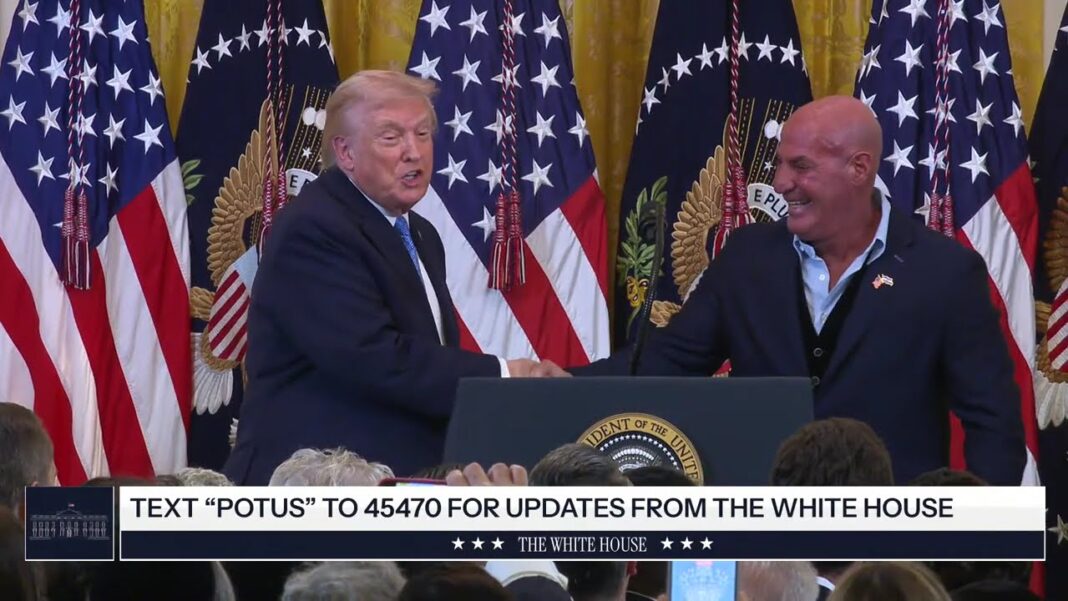
By any measure, the White House Hanukkah reception on Wednesday evening was intended to be a moment of light, continuity, and celebration—a symbolic reaffirmation of Jewish resilience and religious freedom at a time of deep global unease. Yet as reported by VIN News, the gathering was also unmistakably shaped by tragedy. President Donald Trump opened the third night of Hanukkah by directly addressing the deadly antisemitic terror attack that unfolded days earlier at a Jewish celebration on Bondi Beach in Sydney, Australia, transforming what is traditionally a festive occasion into a somber moment of international reckoning.
According to the information provided in the VIN News report, Trump’s remarks were among his most forceful condemnations yet of an unmistakable act of antisemitic terrorism. Speaking before an audience of Jewish leaders, lawmakers, donors, and administration officials assembled in the White House, the president set aside prepared celebratory notes to confront the gravity of the moment.
“Let me take a moment to send love and prayers to an entire nation, to the people of Australia, and especially to all those affected by the horrific and antisemitic terrorist attack,” Trump said, his tone resolute. “That’s exactly what it was — antisemitic — that took place during Hanukkah celebrations in Sydney. What a terrible, terrible thing.”
As VIN News reported, Trump emphasized that the timing of the attack—deliberately targeting Jews gathered to mark the Festival of Lights—underscored the ideological hatred behind the violence. He noted that the United States was mourning alongside Australia, offering condolences to the families of those killed and prayers for the wounded, many of whom sustained life-altering injuries.
President Trump:* “I will always be a friend and a champion to the Jewish people… the strongest lobby was the Jewish lobby. It was Israel. That’s no longer true. You have to be very careful. You have a congress, in particular, which is becoming antisemitic.” @realDonaldTrump… pic.twitter.com/RxZrjxvLVz
— The Jewish Voice (@TJVNEWS) December 17, 2025
Beyond expressions of sympathy, Trump used the occasion to frame the Bondi Beach massacre as part of a broader and deeply troubling international pattern. As the VIN News report highlighted, the president urged world leaders to confront “the evil forces of radical Islamic terrorism,” arguing that antisemitic violence against Jews is not isolated or incidental but rather embedded within a transnational extremist ideology.
“We must stand together against the evil forces of radical Islamic terrorism,” Trump declared, according to the VIN News report. “This hatred does not respect borders. It does not stop on its own. And when it begins with the Jewish people, history shows us it never ends there.”
This framing resonated strongly with many attendees, particularly in light of recent months marked by a sharp rise in antisemitic incidents across Europe, North America, and Australia. As VIN News has documented in numerous reports, Jewish communities worldwide have faced threats, vandalism, arson, physical assaults, and—in the most extreme cases—mass casualty attacks.
Trump’s remarks echoed a recurring theme of his presidency: the insistence that moral clarity, rather than diplomatic ambiguity, is essential when confronting terrorism and religious hatred. For supporters in attendance, the president’s words reinforced his long-standing position as a defender of Jewish communities and a steadfast ally of Israel.
The White House event itself was rich in symbolism. Hanukkah commemorates the victory of a small, determined group over a far more powerful oppressor and celebrates the miracle of light enduring in the face of darkness. As the VIN News report noted, Trump explicitly drew upon this symbolism, linking the ancient story of the Maccabees to contemporary challenges faced by Jews worldwide.
Miriam Adelson says she spoke to Alan Dershowitz in Israel about the legality of Trump serving a third 4-year term: “We can do it!.. Think about it. I will give you another $250 million.” @realDonaldTrump @chanukah @WhiteHouse #hanukkah2025 #MiriamAdelson @AlanDersh… pic.twitter.com/Z0Otv3ydyT
— The Jewish Voice (@TJVNEWS) December 17, 2025
“This is a holiday about resilience, about standing strong when others try to extinguish your light,” Trump said. “And today, that message has never been more relevant.”
The menorah lighting, conducted amid heightened security, carried a weight far beyond tradition. For many attendees, it served as a quiet act of defiance—a public affirmation that Jewish life would continue openly and proudly despite mounting threats.
While the focus of the evening centered on mourning and solidarity, the reception also featured a moment that injected a distinctly political note into the proceedings. As first reported by VIN News, Dr. Miriam Adelson, one of the most influential donors in Republican politics and a towering figure in pro-Israel advocacy, used her remarks to urge Trump to consider extending his political future beyond his current term.
Adelson, the widow of casino magnate Sheldon Adelson, encouraged the president to think about running again in 2028—despite constitutional term limits—during a private exchange at the event. Trump later recounted the interaction publicly, drawing laughter and applause from the audience.
“She said, ‘Think about it,’” Trump told attendees, according to VIN News. “And I said, ‘I’ll give you another $250 million.’”
The remark, delivered with characteristic bravado and humor, was widely interpreted as lighthearted banter rather than a serious political proposal. Nevertheless, as VIN News observed, the exchange underscored Adelson’s continued influence within Republican circles and her close relationship with Trump, particularly on matters related to Israel, antisemitism, and U.S. foreign policy.
Trump admits that he is the first Jewish president of the USA.@marklevinshow : “Six years ago, I stood here and said that this is our first Jewish president.”
Trump: “That’s true.”
Mark Levin: “Now he is the first Jewish president who holds this position for two… pic.twitter.com/LOf8korTYk
— The Jewish Voice (@TJVNEWS) December 17, 2025
Dr. Adelson’s presence at the White House Hanukkah reception was itself emblematic. For years, she and her late husband were among the most prominent financial supporters of causes aligned with Jewish communal security, Zionism, and conservative American politics. As VIN News has frequently reported, Adelson’s advocacy has shaped policy debates on U.S.-Israel relations, Middle East diplomacy, and efforts to combat antisemitism.
Her comments at the Hanukkah event—however informal—highlighted the enduring bond between Trump and a donor base deeply invested in his approach to Israel and Jewish affairs. The White House later clarified that no official interpretation should be drawn from the exchange, reiterating that the Constitution limits presidents to two elected terms.
Still, the moment captured broader political realities: Trump remains a central figure in Republican politics, and his relationship with influential Jewish donors continues to carry significant weight.
According to the information contained in the VIN News report, many Jewish leaders in attendance welcomed Trump’s unequivocal condemnation of the Sydney attack. Several privately noted that his willingness to label the violence as antisemitic terrorism—without euphemism or hesitation—stood in contrast to responses from some international figures who have been criticized for downplaying or contextualizing antisemitic violence.
For these leaders, Trump’s framing was not merely rhetorical. It signaled a policy posture that prioritizes the security of Jewish communities and treats antisemitism as a unique and dangerous form of hatred requiring targeted action.
“The president said what needed to be said,” one attendee told VIN News. “He didn’t hedge. He didn’t excuse. He called it what it was.”
The White House Hanukkah reception took place against a backdrop of heightened anxiety for Jewish communities worldwide. As VIN News has reported in recent weeks, Jewish institutions across multiple countries have increased security measures in response to credible threats. The attack in Australia, in particular, sent shockwaves through diaspora communities, many of which viewed it as a grim reminder that even well-established, democratic societies are not immune to antisemitic violence.
Trump’s call for international unity was therefore not merely symbolic. By urging nations to confront extremist ideologies directly, he positioned the United States as a moral leader in a global struggle.
“This is not just Australia’s fight,” Trump said, according to the VIN News report. “It is the fight of every nation that believes in freedom, tolerance, and the right of people to live without fear because of their faith.”
As the evening drew to a close, the dual themes of remembrance and resolve remained intertwined. The White House Hanukkah reception, traditionally a moment of celebration, became a forum for confronting the darkest currents of the present while reaffirming commitment to enduring values.
For Trump, the event allowed him to articulate a worldview that links Jewish history, contemporary security challenges, and American leadership into a single narrative. As the VIN News report noted, his remarks reflected a conviction that history offers clear lessons—and that ignoring them invites catastrophe.
“Light is stronger than darkness,” Trump said in closing. “And as long as we stand together, the darkness will not prevail.”
In a world increasingly unsettled by hatred and violence, the White House Hanukkah reception served as both a memorial and a declaration. The stakes for Jewish communities—and for the societies in which they live—have rarely felt higher.