



|
Getting your Trinity Audio player ready...
|
By: Fern Sidman
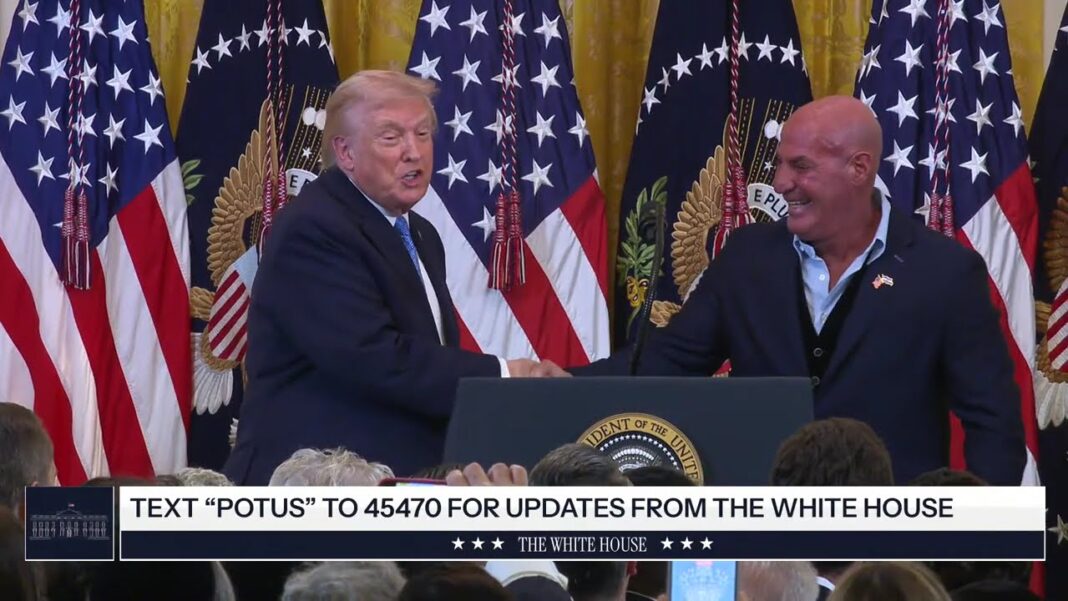
At a White House Chanukah reception marked equally by solemn reflection and political candor, President Donald Trump delivered an unusually blunt assessment of the state of Jewish political influence in Washington, warning that once-reliable support for Israel in Congress has eroded amid a surge of antisemitism both at home and abroad. As reported on Wednesday by The Jewish News Syndicate (JNS), the president’s remarks came against the grim backdrop of the murder of 15 people at a Chanukah celebration in Sydney, an attack Trump unequivocally labeled an act of antisemitic terrorism.
Opening his address in the East Room on Tuesday evening, Trump departed from customary holiday pleasantries to confront the atrocity head-on. According to JNS, the president asked attendees to pause as he offered condolences to Australia and to Jewish communities worldwide still reeling from the violence.
“Let me take a moment to send the love and prayers of our entire nation to the people of Australia, and especially all those affected by the horrific and antisemitic terrorist attack,” Trump said. “That’s exactly what it is: antisemitic.”
Trump framed the Sydney murders not as an isolated incident, but as part of a broader global pattern, urging democratic nations to unite against what he described as the “evil forces of radical Islamic terrorism.” As The Jewish News Syndicate report noted, this theme of moral clarity—naming antisemitism explicitly rather than euphemistically—recurred throughout the president’s 40-minute address.
Perhaps the most striking portion of Trump’s remarks came when he reflected on what he characterized as the diminishing power of pro-Israel advocacy in Washington. Drawing on personal history, Trump recounted how his father, Fred Trump, had instilled in him a deep respect for the Jewish community and an understanding of its once-formidable political influence.
“I’m not Jewish, but my father was very friendly with many, many Jewish people,” Trump told the audience. “He was honored by the Federation. I grew up respecting and loving Jewish people.”
President Trump:* “I will always be a friend and a champion to the Jewish people… the strongest lobby was the Jewish lobby. It was Israel. That’s no longer true. You have to be very careful. You have a congress, in particular, which is becoming antisemitic.” @realDonaldTrump… pic.twitter.com/RxZrjxvLVz
— The Jewish Voice (@TJVNEWS) December 17, 2025
Trump then made an observation that drew audible reactions from the room.
“My father would tell me, the most powerful lobby that there is in this country is the Jewish lobby. It’s the Israeli lobby,” Trump said. “It’s not that way anymore.”
According to The Jewish News Syndicate report, Trump explicitly connected this shift to the rise of anti-Israel sentiment within the U.S. Congress, pointing to progressive lawmakers often grouped under the label “the Squad.” He expressed disbelief that open hostility toward Israel—once considered politically untenable—has become normalized within parts of the legislative branch.
“There’s a lot of people in Congress that don’t like Israel,” Trump said. “They hate Israel. And if you would have told me 15 years ago that that was possible, I would have said there’s no way.”
As JNS reported, Trump devoted a significant portion of his speech to highlighting his administration’s legal and policy efforts to combat antisemitism, particularly on university campuses. He praised the work of U.S. Assistant Attorney General Harmeet Dhillon, whose civil rights investigations into elite academic institutions have become a flashpoint in the national debate over antisemitism and free speech.
“She sues the ass off of anybody that is antisemitic,” Trump said, drawing laughter and applause. “Harvard wished they never heard her name.”
The president’s remarks echoed growing concern within Jewish advocacy circles that universities—long seen as bastions of liberal tolerance—have become incubators for antisemitic rhetoric masquerading as political activism. JNS has documented these tensions, particularly as anti-Israel demonstrations on campuses increasingly spill into intimidation and harassment of Jewish students.
Despite the political overtones, the White House Chanukah reception retained its ceremonial gravitas. As described by JNS, the East Room was adorned with Christmas trees and portraits of former presidents, while Jewish leaders, administration officials, and prominent donors gathered to commemorate the Festival of Lights—a holiday symbolizing perseverance in the face of persecution.
Rabbi Levi Shemtov, executive vice president of American Friends of Lubavitch, presided over the menorah lighting alongside Commerce Secretary Howard Lutnick and two Holocaust survivors, Jerry Wartski and Michael Bornstein. Their presence served as a living reminder of Jewish resilience across generations.
In deeply personal remarks, Rabbi Shemtov addressed Trump directly, revealing that members of his own family in Australia had been affected by the Sydney attack.
“A very large part of my family lives in Australia,” he said. “Some of those had escaped the attack—and some of them didn’t.”
“It is especially in this time, when the Jewish people carry such a burden, that we need this light,” Shemtov continued. “We need this strength. Not only from each other, but from you, Mr. President.”
The evening also included a moment that underscored the enduring alliance between Trump and his most influential Jewish supporters. According to the information provided in the JNS report, Trump recounted a lighthearted exchange with Dr. Miriam Adelson, widow of Sheldon Adelson and one of the largest donors to pro-Israel causes and Republican campaigns.
Trump told the audience that Adelson had jokingly suggested she would contribute another $250 million if he were to consider a third presidential term—an idea constitutionally foreclosed but rhetorically potent. The remark prompted laughter and chants of “four more years” from the crowd, highlighting both Adelson’s influence and Trump’s continued dominance within Republican political culture.
Throughout its coverage, JNS emphasized the emotional weight carried by the evening, as Jewish leaders grappled with a surge in antisemitic violence worldwide. From Sydney to American campuses, from congressional rhetoric to social media radicalization, the threats facing Jewish communities have grown both more explicit and more normalized.
Trump’s speech, while characteristically unsparing, resonated with many attendees precisely because it named these realities without qualification. In contrast to more cautious political language, Trump framed antisemitism as a civilizational threat—one that requires not symbolic gestures but sustained political will.
“All nations will stand together against the evil forces of radical Islamic terrorism,” Trump declared, a line JNS highlighted as emblematic of his worldview.
For supporters, Trump’s remarks reaffirmed his self-image as an unflinching ally of the Jewish people and the State of Israel. For critics, they underscored the polarizing nature of his rhetoric. Yet as the JNS report observed, few could deny the symbolic significance of a sitting president devoting such a substantial portion of a White House holiday celebration to confronting antisemitism head-on.
As candles flickered in the East Room menorah, the evening’s message was clear: Chanukah’s ancient story of defiance and illumination remains urgently contemporary. And in an era of mounting hostility, Trump positioned himself—once again—as a leader unwilling to soften his language or dilute his alliances.
Whether his warnings about waning Jewish influence in Washington will translate into renewed political mobilization remains an open question. But as JNS reported, the mood inside the White House on Tuesday night was unmistakable: resolute, defiant, and acutely aware that the light of Chanukah is being tested by deepening darkness.