



|
Getting your Trinity Audio player ready...
|
Trump Announces Two-Year Shutdown of Kennedy Center for Major Overhaul
By: Jerome Brookshire
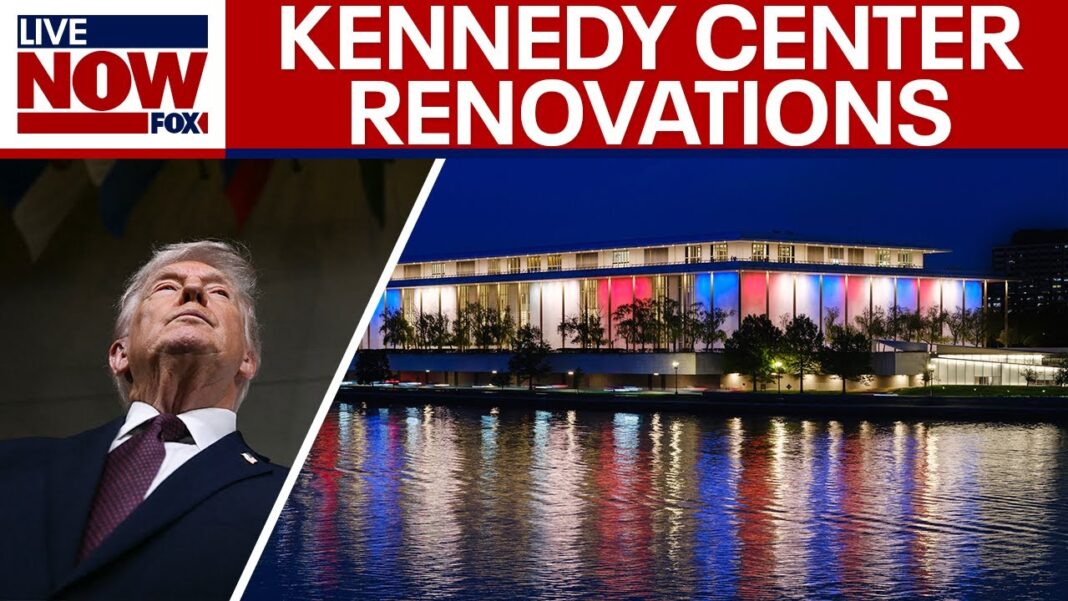
President Donald Trump’s announcement on Sunday that he would shut down the John F. Kennedy Center for the Performing Arts for two years beginning this summer landed in Washington like a thunderclap—at once dramatic, polarizing, and unmistakably Trumpian. Framed by the White House as a necessary pause to rescue a faltering institution, the decision has ignited a fierce debate about culture, politics, and the role of federal stewardship in America’s artistic life. As The New York Times reported on Sunday, the move represents both a culmination of months of turmoil at the Kennedy Center and a high-stakes wager by a president determined to leave a tangible mark on one of the nation’s most iconic cultural landmarks.
In a post on Truth Social, Trump described the Kennedy Center as “tired, broken, and dilapidated,” arguing that only a full shutdown could allow his administration to transform it into “the finest Performing Arts Facility of its kind.” The president cast the closure not as a retreat, but as an act of preservation—an intervention he said was essential to safeguard the future of a venue founded in the wake of President John F. Kennedy’s assassination in 1963. According to the information provided in The New York Times report, Trump positioned the move as part of a broader effort to rebuild Washington itself, following other dramatic renovations undertaken during his second term.
The announcement came at a moment of acute strain for the Kennedy Center. Performers, patrons, and donors have mounted an increasingly visible backlash against Trump’s efforts to remake the institution in his image. From the earliest weeks of his return to office, Trump sought to assert greater control over the center, attaching his name to it, installing loyalists to oversee operations—including Richard Grenell—and calling for programming changes that he said better reflected mainstream American tastes. “More ‘Les Miz’ and less ‘Hamilton,’” Trump remarked during one visit, invoking the enduring appeal of Les Misérables over what he characterized as the politicized sensibilities of Hamilton.
The reaction from the cultural establishment has been swift and unforgiving. As The New York Times detailed last week, the composer Philip Glass withdrew his Symphony No. 15, a work commissioned by the National Symphony Orchestra in tribute to Abraham Lincoln, which had been scheduled for a June performance at the center. Days earlier, the celebrated soprano Renée Fleming canceled her appearance. The Washington National Opera went further still, announcing last month that it was cutting its ties to the Kennedy Center altogether.
Perhaps most telling has been the response of audiences. The New York Times reported that attendance at the National Symphony Orchestra, one of the center’s cornerstone ensembles, has fallen by roughly 50 percent compared with last year, with musicians increasingly playing to swaths of empty seats. In ordinary circumstances, such figures would prompt soul-searching and incremental reform. Trump, by contrast, opted for a clean break.
Notably, the president’s public statement made no reference to the cancellations, boycotts, or declining attendance that have dominated coverage in The New York Times and elsewhere. Instead, he presented the closure as a proactive rebuilding effort, akin to an urban renewal project. “In other words, if we don’t close, the quality of Construction will not be nearly as good, and the time to completion… will be much longer,” Trump wrote, insisting that a temporary shutdown would yield “a much faster and higher quality result.”
To supporters, this framing has a certain logic. The Kennedy Center underwent a major $250 million renovation and expansion in 2019 under Deborah Rutter, who departed shortly after Trump took office. Trump had previously expressed skepticism about that project, telling aides and visitors, according to The New York Times report, that “they built these rooms that nobody is going to use.” From his perspective, another round of cosmetic fixes would merely prolong decline. A decisive overhaul, even at the cost of temporary disruption, could reset the institution for a new generation.
Funding, however, remains an open question. Trump said that money had been found for the project but did not specify the total cost or its source. The New York Times report noted that last year, Trump secured $257 million from Congress to address capital repairs at the building, a sum that could form the backbone of the planned reconstruction. Beyond that, details are sparse. The president spoke only in sweeping terms of “Construction, Revitalization, and Complete Rebuilding,” leaving architects, artists, and administrators guessing about what the finished center might look like.
The timing of the shutdown has also drawn attention. Trump said the Kennedy Center would close on July 4, a date heavy with symbolism as the nation marks its 250th birthday. To allies, the choice underscores Trump’s instinct for spectacle and national narrative—closing a cultural shrine on Independence Day to rebuild it in time for a renewed American era. Critics see provocation. Yet even The New York Times acknowledged that the president appears intent on linking the project to a broader vision of national renewal.
Practical questions abound. There was no immediate word on where the National Symphony Orchestra would perform during the two-year closure. In a typical season, the orchestra gives as many as 150 concerts at the Kennedy Center, and relocating such a volume of performances poses a logistical challenge. The Washington National Opera, already untethered from the center, has begun scouting alternative halls. For musicians and stagehands, the uncertainty is palpable.
Trump’s announcement also carried a note of theatrical irony. It came on one of the busiest nights on the American cultural calendar, as the Grammy Awards unfolded in Los Angeles. Two days earlier, the president had used the Kennedy Center as the venue for a black-tie premiere of a documentary about his wife, Melania Trump, titled “Melania.” The juxtaposition—celebration one night, closure announced days later—underscored the sense that the center has become a stage not just for art, but for political drama.
The New York Times report framed the episode as a significant setback to one of the signature cultural initiatives of Trump’s second term. Yet from another vantage point, the closure could be read as an acknowledgment that incremental change was no longer tenable. Attendance declines, artist withdrawals, and donor unease had already placed the Kennedy Center on precarious footing. By choosing to shut it down entirely, Trump is betting that a bold, disruptive approach will succeed where gradual reform failed.
There is, too, an undercurrent of populism in the president’s rhetoric that resonates with his political base. Trump has long argued that elite cultural institutions have drifted away from the tastes and values of ordinary Americans. His call for programming that leans into familiar, broadly popular works is consistent with that worldview. While critics bristle at what they see as philistinism, supporters hear an argument for accessibility—an insistence that publicly supported venues should not cater exclusively to a narrow cultural class.
Whether the gamble pays off will depend on execution. The New York Times report noted that the Kennedy Center occupies a delicate position: simultaneously a national memorial, a working arts complex, and a symbol of Washington’s cultural identity. Transforming it without alienating core constituencies will be a formidable task. Yet Trump’s defenders argue that the status quo was already failing, and that decisive leadership, even when controversial, is preferable to managed decline.
As the curtain prepares to fall on the Kennedy Center this summer, the debate it has sparked is unlikely to fade. For two years, the building will stand silent—a potent symbol of both cultural fracture and ambition. When it reopens, it will do so either as a testament to Trump’s belief in dramatic renewal or as a cautionary tale about politics intruding too deeply into art. For now, as The New York Times reported, one thing is clear: the fight over the Kennedy Center has become a proxy for larger questions about who defines American culture, and how far a president should go to reshape it in his own vision.
