



|
Getting your Trinity Audio player ready...
|
By: Russ Spencer
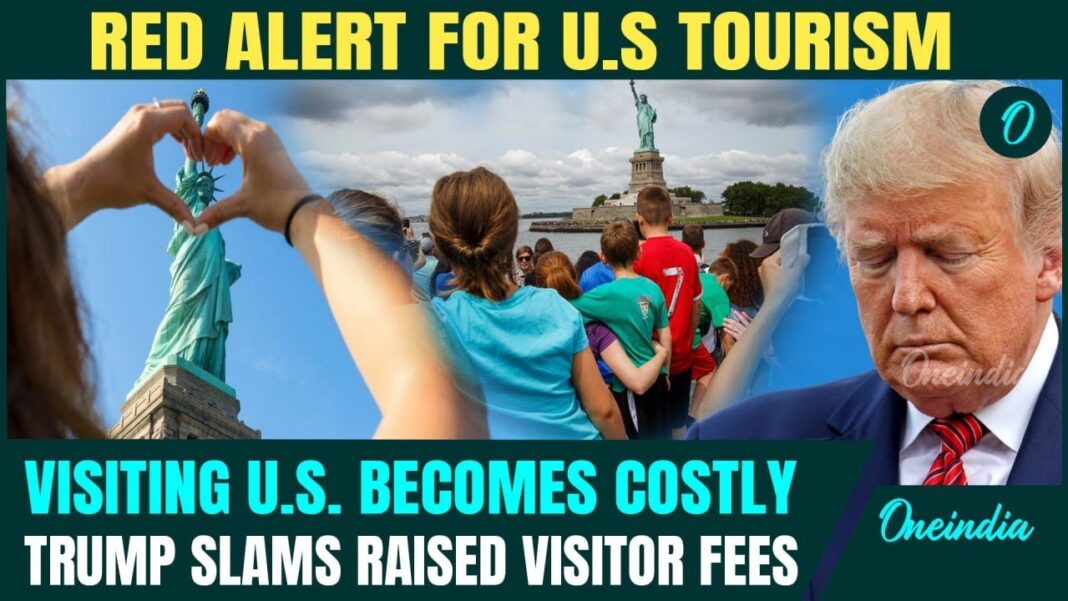
The Trump administration’s sweeping legislative package, the One Big Beautiful Bill Act, is introducing a significant new cost for foreign visitors to the United States — a “visa integrity fee” that will apply to all nonimmigrant visa applicants. As reported by CNBC on Saturday, the provision is already generating scrutiny among travel industry stakeholders, immigration attorneys, and international visitors, with many questioning its potential impact and the lack of clarity surrounding its implementation.
According to the information provided in the CNBC report, the visa integrity fee will require all nonimmigrant visa applicants — including tourists, business travelers, and international students — to pay at least $250 when their visa is issued. This fee is mandated by law and cannot be waived under any circumstances. The actual amount may exceed $250, as the Secretary of Homeland Security is authorized to adjust the fee, with future increases tied to inflation.
As the CNBC report highlighted, this new charge comes on top of existing visa application fees and the Form I-94 arrival/departure record fee, which itself was raised from $6 to $24 under the same legislative act. For example, as immigration attorney Steven A. Brown explained to CNBC, an H-1B visa applicant who currently pays a $205 fee will now face a combined charge of $455 once the integrity fee is implemented.
What distinguishes this new fee from others is the possibility of reimbursement — but with significant caveats. Travelers may be eligible to recover the visa integrity fee, but only if they comply strictly with the terms of their visa. This means they must not accept unauthorized employment in the United States and must leave the country within five days of their visa’s expiration date. Any reimbursement would occur after the visa expires.
However, the process for obtaining a refund remains unclear. The U.S. Travel Association expressed concern over the absence of detailed guidance on implementation, calling attention to the “significant challenges and unanswered questions” surrounding the fee. The lack of information has left both travelers and the travel industry uncertain about how the system will function.
Even the timeline for the fee’s rollout remains undefined. Brown, speaking with CNBC, suggested that formal regulations or at least a notice in the Federal Register would likely be required before collection could begin. A spokesperson for the Department of Homeland Security acknowledged in a statement to CNBC that cross-agency coordination would be necessary before the fee could be implemented.
Another unresolved issue is the logistics of fee collection. The Department of Homeland Security does not handle the visa issuance process, raising questions about how and where the fee will be charged. The U.S. Travel Association told CNBC that this ambiguity is a central concern for stakeholders attempting to prepare for the change.
The issue of reimbursement further complicates the matter. The Congressional Budget Office (CBO) projected that only a small percentage of travelers would apply for reimbursement due to the multi-year validity of many visas. The CBO also estimated that setting up a reimbursement system would take the Department of State several years to implement. Nevertheless, the CBO anticipates that the visa integrity fee will generate $28.9 billion in net revenue for the U.S. government over the 2025–2034 period, effectively reducing the federal deficit.
Despite the theoretical possibility of reimbursement, Brown advised clients in comments to CNBC to consider the fee nonrefundable. “If you get it back, great. But it is usually difficult to get money back from the government,” he said. Brown’s practical advice reflects a broader skepticism within the immigration law community about the feasibility of recovering the fee.
The Trump administration, through the Department of Homeland Security, defended the measure in a statement to CNBC, framing it as a vital tool to restore integrity to the U.S. immigration system. The administration pointed to longstanding concerns about visa overstays, citing data that show between 1% and 2% of nonimmigrant visitors remained in the country beyond their authorized period between 2016 and 2022. Notably, CNBC reported that approximately 42% of the estimated 11 million unauthorized immigrants currently in the United States entered legally but overstayed their visas.
The fee’s potential impact on different categories of travelers has also been a focus of attention. Brown highlighted that business (B visa) travelers and international students might feel the most direct effect. “For B visa holders, they may not want to add an additional $250 per person to their trip costs,” Brown told CNBC, noting that the new financial burden could discourage some visitors.
This policy change arrives at a critical time for the U.S. tourism and events sector. The United States is preparing to host several major international events in 2026, including the America 250 celebrations marking the country’s 250th anniversary and portions of the FIFA World Cup. Industry experts fear that additional fees could deter potential visitors, undermining efforts to boost inbound tourism.
The issue is compounded by separate budgetary decisions impacting Brand USA, the nation’s destination marketing organization. The One Big Beautiful Bill Act slashed Brand USA’s funding from $100 million to $20 million, a cut that came shortly after the U.S. Commerce Department dismissed nearly half of the organization’s board members. As CNBC reported, Brand USA’s president and CEO, Fred Dixon, expressed disappointment with the cuts but remained optimistic that funding might be restored in fiscal year 2026.
Dixon told CNBC that Brand USA remains committed to promoting legitimate international travel and underscored the sector’s vital contribution to the U.S. economy. However, the fee’s introduction, coupled with diminished marketing resources, presents a formidable challenge to the travel industry’s efforts.
U.S. Travel Association President and CEO Geoff Freeman, who had previously praised the One Big Beautiful Bill Act for its infrastructure investments, border security measures, and air traffic control reforms, expressed concern about the visa integrity fee’s potential downside. In comments reported by CNBC, Freeman criticized the juxtaposition of “smart investments in the travel process” with “foolish new fees on foreign visitors” and reductions to Brand USA’s budget.
As policymakers and agencies navigate the practicalities of implementing the fee, its broader implications remain under scrutiny. While the administration aims to enhance immigration compliance, the visa integrity fee could have significant ripple effects on tourism, international business travel, and U.S. higher education — sectors that rely heavily on foreign visitors and students.
For now, with key details still undefined and implementation timelines uncertain, stakeholders across the travel, education, and business sectors await further clarification. The report at CNBC suggested that whether the fee achieves its intended purpose or inadvertently hampers international engagement will depend largely on how effectively the government manages its rollout — and whether visitors perceive the reimbursement promise as a genuine opportunity or merely an empty gesture.
