



|
Getting your Trinity Audio player ready...
|
Team Led by Jewish American Astronaut Jessica Meir Reaches the International Space Station
By: Arthur Popowitz
High above the geopolitical fault lines that fracture the Earth below, four astronauts eased their spacecraft into the docking port of the International Space Station on Saturday, extending humanity’s unbroken presence in low-Earth orbit into its third decade. The arrival of NASA’s Crew-12, following a 34-hour voyage from Cape Canaveral aboard a SpaceX Falcon 9 rocket, was at once a routine logistical operation and a moment freighted with symbolic resonance.
As the AFP reported on Sunday, the new team is replacing a crew that had been forced to cut its mission short in the first medical evacuation in the station’s history, a reminder that even the most advanced technological endeavors remain subject to the vulnerabilities of the human body. The Times of Israel report on Sunday noted that the handover comes at a pivotal juncture in the life of the aging outpost, which is now approaching the final chapter of a quarter-century of continuous habitation.
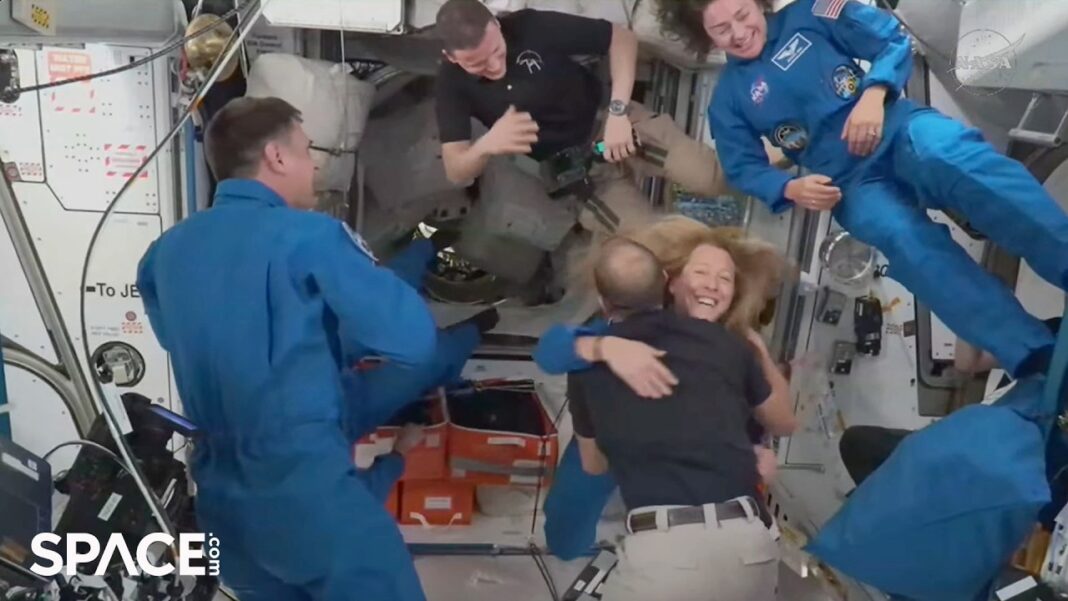
The four members of Crew-12—American astronauts Jessica Meir and Jack Hathaway, French astronaut Sophie Adenot, and Russian cosmonaut Andrey Fedyaev—were greeted at the station by a skeleton crew of three who had been maintaining operations since January. The AFP detailed how the International Space Station, orbiting some 250 miles above the planet, had been operating in this reduced configuration following the early return of Crew-11, whose mission was curtailed by a medical emergency that NASA has declined to describe in detail.
The Times of Israel report emphasized the unprecedented nature of that evacuation, noting that the ISS, for all its history of technical malfunctions and political turbulence, had never before experienced a medical return that truncated a long-planned mission.
Upon docking, Meir offered words that reverberated far beyond the hermetically sealed modules of the station. AFP quoted her as reflecting on the continuity of human presence in space for more than 25 years at the very site where Crew-12 now resides. The Times of Israel report highlighted her invocation of cooperation as an essential principle, her assertion that from the vantage point of orbit “there are no borders and hope is universal.” In an era when terrestrial politics are marked by polarization and war, such language carries an aspirational weight.
The ISS, conceived in the aftermath of the Cold War as a joint endeavor between former adversaries, has long served as a laboratory not only for science but for the possibility of sustained international collaboration.
Yet the Times of Israel has also chronicled how the station’s cooperative ethos has been strained by the deterioration of relations between Russia and the West following Moscow’s invasion of Ukraine in 2022. The continued presence of Russian cosmonauts alongside American and European astronauts has been one of the few remaining arenas of pragmatic engagement between the opposing camps.
The AFP observed that, despite the rancor on Earth, the ISS has remained a functioning site of collaboration, its daily routines of maintenance and research proceeding with professional detachment from the conflicts below. The inclusion of Fedyaev, who previously served aboard the station as part of Crew-6 in 2023, underscores this continuity, even as the political context surrounding the partnership has grown more fraught.
The mission of Crew-12 extends well beyond symbolic gestures. Over the next eight months, the astronauts will conduct a wide array of experiments focused on the effects of microgravity on the human body. The AFP reported that such research is central to preparing for longer-duration missions beyond low-Earth orbit, including prospective journeys to the Moon and Mars. The Times of Israel report noted that Meir, a Jewish American astronaut with a background in marine biology and the study of organisms in extreme environments, will serve as the crew’s commander.
Her scientific trajectory—from the depths of the oceans to the vacuum of space—embodies the interdisciplinary nature of contemporary space research, where insights gleaned from one extreme environment inform explorations of another.
Adenot’s presence carries its own historical resonance. She has become the second French woman to fly into space, following Claudie Haigneré, who spent time aboard the Mir space station in the 1990s. The Times of Israel report highlighted Adenot’s role in testing innovative medical technologies during the mission, including a system that combines artificial intelligence and augmented reality to enable astronauts to perform their own ultrasound examinations. Such capabilities are not merely conveniences; they represent a crucial step toward autonomy in deep-space missions, where immediate ground-based medical support will be impossible. Adenot’s pledge to share every step of the adventure with the French public reflects the enduring national pride intertwined with ostensibly global endeavors.
The arrival of Crew-12 also marks one of the final rotations of personnel through the ISS before its planned decommissioning. The soccer field-sized station, continuously inhabited since the turn of the millennium, is scheduled to be guided out of orbit and directed to crash into a remote area of the Pacific Ocean in 2030.
The Times of Israel report underscored the poignancy of this timeline: a structure that once symbolized the thawing of post-Cold War relations is now approaching its engineered demise at a moment when geopolitical tensions have once again hardened. For the astronauts now settling into their orbital home, the knowledge that they are among the last generation to live aboard the station imbues their mission with a valedictory quality.
The quiet professionalism of the docking belied the undercurrents of controversy that have accompanied the mission’s composition. Russian cosmonaut Oleg Artemyev, long slated to be part of Crew-12, was abruptly removed from the assignment in November. Independent Russian media outlets alleged that Artemyev had been photographing and transmitting classified information while training at a SpaceX facility, though Russia’s space agency, Roscosmos, publicly attributed the change to a routine reassignment.
The AFP reported that Fedyaev, Artemyev’s replacement, brings prior ISS experience to the mission, a pragmatic choice that minimizes disruption in a context already fraught with diplomatic sensitivity.
The incident serves as a reminder that the ISS, for all its aspirations to transcend politics, is not insulated from the security anxieties of the nations that sustain it. Even as astronauts collaborate in microgravity, the institutions that support their missions remain embedded in terrestrial rivalries and espionage concerns. The paradox is stark: the station is both a sanctuary from Earth’s divisions and a platform vulnerable to their intrusion.
As Crew-12 embarks on months of scientific inquiry, the station continues to function as a crucible for understanding the limits of the human body. Prolonged exposure to microgravity affects everything from bone density to cardiovascular function, with implications for the feasibility of long-duration spaceflight. Such research acquires added urgency as space agencies contemplate permanent lunar habitats and interplanetary voyages.
The experiments conducted by Meir, Adenot, Hathaway, and Fedyaev will contribute to a body of knowledge that extends beyond the lifespan of the ISS itself, informing the design of future habitats and medical protocols.
In the end, the docking of Crew-12 is a study in contrasts. It is a triumph of routine precision, executed with the quiet confidence born of decades of orbital operations. Yet it unfolds against a backdrop of medical uncertainty, geopolitical tension, and the impending sunset of the station that made such missions possible. As the ISS continues its silent circuit of the Earth, the astronauts aboard embody a paradoxical truth: that even as humanity reaches beyond its planetary confines, it carries with it the hopes, conflicts, and vulnerabilities of the world below.