



|
Getting your Trinity Audio player ready...
|
Speaker Johnson Denounces Rising American Antisemitism and Reasserts U.S.–Israel Alliance as GOP Rift Widens
By: Fern Sidman – Jewish Voice News
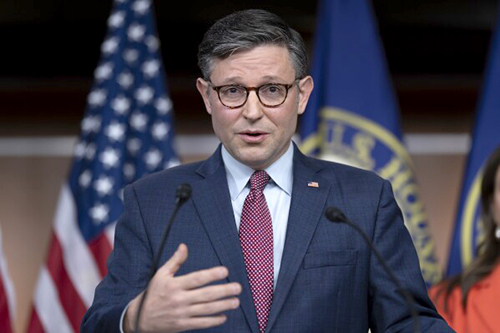
House Speaker Mike Johnson delivered one of his most forceful public defenses of the U.S.–Israel alliance on Wednesday, using a wide-ranging podcast interview to confront what he described as a disturbing uptick in antisemitism within the United States and a troubling minority of voices inside the Republican Party who have embraced anti-Israel rhetoric. As World Israel News reported on Thursday, Johnson’s remarks on The Katie Miller Podcast offered an unmistakably candid view into the fractures emerging inside the conservative landscape over the meaning, nature, and boundaries of antisemitism.
The Speaker’s intervention comes at a time when debates over Israel—once a defining point of consensus in Republican foreign policy—have become entangled with the ideological realignments reshaping the post-Trump right. For Johnson, an outspoken supporter of Israel who grounds his political worldview in both strategic calculation and biblically rooted commitments, the very suggestion that the Republican Party is divided on antisemitism struck him as profoundly misplaced.
When Miller asked whether the “schism” inside the GOP regarding who is and who is not antisemitic was “overblown,” Johnson responded not by parsing internal divisions but by reframing the entire question. As the World Israel News report highlighted, Johnson immediately linked antisemitism with anti-Zionism, asserting that those who question Israel’s legitimacy or distance themselves from the U.S.–Israel partnership are participating—whether consciously or through ideological drift—in rhetoric that has long been indistinguishable from antisemitic animus.
Johnson emphasized that he wished “everybody would acknowledge the importance” of the American relationship with Israel. His insistence reflected both a moral conviction and a strategic assessment. He invoked the “scripturally based, biblical reasons” for supporting the Jewish state but also stressed that even on purely geopolitical terms, Israel remains the United States’ indispensable partner in a “tinderbox” region of unparalleled volatility. As he put it, “It’s the only stable democracy in the Middle East,” a line that World Israel News noted has been a consistent thread throughout his public statements since taking the Speakership.
From Johnson’s perspective, the alliance with Israel is not simply a foreign-policy preference but a civilizational anchor—a point he underscored by warning that antisemitism “ought to be universally rejected and called out.” His invocation of universal moral obligation—“We gotta love everybody, and certainly the Jewish people”—was not a platitude but a rebuke to a new strain of right-wing voices who have flirted with anti-Israel sentiment in recent months.
World Israel News has repeatedly documented the growing rift between traditional Republicans who embrace a robust pro-Israel posture and a small but increasingly vocal faction adopting a contrarian or isolationist tone. Johnson did not mention any names during the interview, but his meaning was unmistakable. Only two Republican lawmakers have broken consistently with the overwhelming pro-Israel consensus: Rep. Thomas Massie of Kentucky and Rep. Marjorie Taylor Greene of Georgia.
Massie, as World Israel News has detailed in multiple reports, has become an outlier even within his own ideological corner. His voting record reads as a catalogue of contrarian stances on Israel: he has opposed condemnations of antisemitism, sanctions on terrorist organizations, rebukes of Iran, and symbolic affirmations of Israel’s right to exist. In November 2023, when Congress overwhelmingly passed a resolution reaffirming Israel’s right to self-defense after Hamas’s October 7 massacre, Massie stood alone in dissent, arguing that equating anti-Zionism with antisemitism distorted the meaning of Jewish hatred. While he frames his opposition as principled resistance to all foreign aid—even for allies—his votes have placed him in alignment with narratives long advanced by anti-Israel activists.
Greene presents a different and more volatile challenge. As the World Israel News report has noted, she has trafficked in conspiracy theories with unmistakably antisemitic undertones, including well-publicized claims about Jewish-controlled space lasers. She has accused Israel of committing genocide in Gaza and condemned U.S. military strikes on Iran “for the secular government of Israel.” Her vote to cut American funding for Israel’s missile defense systems—particularly jarring given the timing amid heightened regional conflict—was widely condemned, even among Republicans accustomed to overlooking her rhetoric.
Johnson did not directly discuss either lawmaker, nor did he wade into the political calculations of disciplining or sidelining them. Instead, he adopted a broader tone, chastising narratives—wherever they originate—that minimize, excuse, or legitimize antisemitism by packaging it as moral outrage against Israel.
His comments also extended beyond Capitol Hill, taking aim at influential conservative commentators who once represented the mainstream of right-wing media but who, as World Israel News has observed, have drifted into sharply anti-Israel positions. Figures such as Candace Owens and Tucker Carlson—both of whom grew their careers as defenders of conservatism but have since embraced rhetoric steeped in moral equivalencies, conspiratorial insinuations, and thinly veiled hostility toward Jewish self-determination—were the implicit targets of Johnson’s concern. Their evolution from Republican firebrands into critics of Israel with unmistakable antisemitic overtones has troubled traditional conservatives, Jewish leaders, and pro-Israel advocates who once counted them as allies.
The Speaker’s remarks also revealed a deeper anxiety: that the U.S.–Israel relationship is increasingly jeopardized not only by the far-left activists dominating university campuses and progressive movements, but also by a minority within the right that has become susceptible to populist narratives blaming Israel for America’s problems or portraying support for the Jewish state as a “globalist” agenda. As the World Israel News report emphasized, Johnson sees this trend as both dangerous and antithetical to the Republican Party’s historic commitments.
From a strategic standpoint, Johnson insisted that the alliance with Israel remains one of America’s most valuable assets. Situated in a region rife with instability—from Iran’s nuclear ambitions to Hezbollah’s military entrenchment in Lebanon—Israel serves as a critical buffer, intelligence partner, and democratic outpost. The Speaker’s argument, repeated throughout the interview and highlighted in the World Israel News report, was that abandoning Israel or treating its security as negotiable would undermine American interests, embolden radical actors across the Middle East, and signal a moral retreat from values the U.S. has long espoused.
Johnson’s comments also illuminate the shifting political topography inside the GOP. The party’s grassroots remain overwhelmingly pro-Israel, as polling repeatedly confirms, yet the rise of contrarian voices with large social media followings has introduced a new tension between ideological purity tests and long-standing foreign-policy commitments. Johnson’s insistence that antisemitism and anti-Zionism are inseparable reflects a strategic attempt to stabilize this terrain by defining clear moral boundaries.
His message was aimed not only at elected officials but also at the Republican electorate: being conservative, in Johnson’s view, means standing against antisemitism in all its forms, supporting America’s democratic allies, and rejecting the ideological drift that blurs the line between criticism of Israeli policy and de-legitimization of the Jewish state. The World Israel News report framed his remarks as a deliberate recalibration—a reassertion of moral clarity at a time when both political opportunism and cultural upheaval threaten to distort the traditional bipartisan commitment to Israel.
As the interview concluded, Johnson reiterated that loving the Jewish people and defending Israel’s right to exist are not fringe positions but foundational principles that should transcend party factions. Whether his words will shift the internal currents of the GOP remains uncertain, but his intervention marks a notable moment: a high-ranking Republican leader reclaiming the ideological space that once defined the party’s identity on Israel.
In a political climate increasingly shaped by viral commentary, contrarian branding, and online performance, Johnson’s defense of Israel—as reported by World Israel News—stands out as an assertion that some alliances remain too morally and strategically essential to be surrendered to the fashionable cynicism of the moment.
As the “liberal (anti-Israel)” “Jewish Voice”, this partisan article glosses over the virtually unanimous antisemite Democrat Progressive ENEMIES of the Jewish people and Israel, highlighting a still TINY magnified vocal faux-conservative antisemites within the “overwhelmingly pro-Israel” republican and conservative mainstream America. (The title, “GOP Rift”, is misleading.)
To TJV readers: begin with WATCHING the following video:
TJV should be offering readers not only outrage, but information inspiration and paths forward to FIGHT our enemies. SUGGESTION:
“American Jews Must Go From Victims To Fighters – YouTube
https://www.youtube.com/watch?v=CbCdiPW9Wdo
Personally, I do not think it is strident enough, but it is a very good INTRODUCTION to what you should be paying attention to.