



|
Getting your Trinity Audio player ready...
|
Secretary of State Marco Rubio to Arrive in Israel as Trump Administration Deepens Engagement on Gaza Peace Plan
By: Fern Sidman
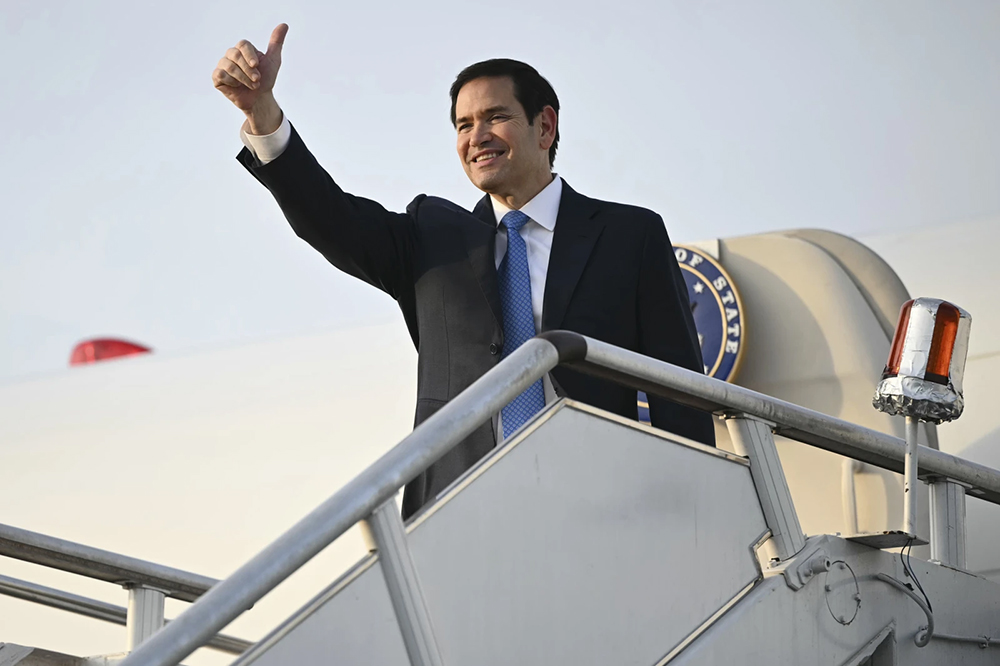
Secretary of State Marco Rubio is expected to arrive in Israel on Thursday for a high-stakes 48-hour visit, part of a renewed diplomatic push by the Trump administration to stabilize the fragile ceasefire in the Gaza Strip and advance the second phase of Washington’s broader Middle East peace framework.
As The Jerusalem Post reported on Wednesday, Rubio’s trip will follow on the heels of a series of high-level U.S. visits this week that highlight the depth of American involvement in postwar Gaza diplomacy. Vice President JD Vance landed in Israel on Tuesday, while President Trump’s senior envoys — Jared Kushner and Steven Witkoff — arrived on Monday and immediately held closed-door meetings with Israeli leaders, including Prime Minister Benjamin Netanyahu, senior defense officials, and members of the Israeli security establishment.
The flurry of visits comes amid growing unease in Washington over reports that Netanyahu may be considering a resumption of full-scale military operations in Gaza — a move that U.S. officials fear could derail months of delicate negotiations and destabilize an already volatile region.
According to the information provided in The Jerusalem Post report, the former Florida senator and longtime advocate for a strong U.S.–Israel alliance is expected to use the visit to reaffirm America’s commitment to Israel’s security while pressing for sustained adherence to the ceasefire terms brokered under the Trump administration’s peace initiative.
Rubio’s itinerary has not been publicly released, but diplomatic sources told The Jerusalem Post that he is expected to meet with Netanyahu, Foreign Minister Israel Katz, and Defense Minister Israel Katz, as well as senior Israel Defense Forces (IDF) commanders overseeing the Gaza border region.
The discussions are expected to focus on three key areas: enforcing the ceasefire with Hamas, facilitating the reconstruction of Gaza under strict international supervision, and coordinating intelligence-sharing efforts to prevent future terror attacks.
“The secretary’s visit is both symbolic and practical,” one Israeli diplomat told The Jerusalem Post. “It is meant to show that Washington stands shoulder-to-shoulder with Israel while ensuring that the next phase of the Trump plan is implemented effectively.”
Rubio’s visit follows an intense round of diplomatic consultations led by Vice President JD Vance and senior Trump advisers Jared Kushner and Steven Witkoff, who arrived in Israel earlier this week.
As The Jerusalem Post report detailed, Kushner and Witkoff met with Prime Minister Netanyahu on Monday evening to discuss the “transition into the second phase” of the Trump peace framework — a complex plan that envisions the gradual demilitarization of Hamas, the establishment of a technocratic administrative body in Gaza, and a multilateral stabilization force led by U.S.-aligned regional partners such as Egypt and the United Arab Emirates.
Following their meeting with Netanyahu, the envoys also sat down with the heads of Israel’s Military Intelligence Directorate and the IDF’s Planning Division, focusing on the mechanisms for maintaining security oversight during Gaza’s reconstruction period.
“The Trump administration is taking a hands-on approach to ensure that the plan does not unravel,” one Israeli official told The Jerusalem Post, emphasizing the strategic importance of sustained American engagement at this critical juncture.
According to a New York Times report cited in The Jerusalem Post, U.S. officials have privately expressed concern that Netanyahu could abandon the current ceasefire arrangement and reignite military operations in Gaza, despite the progress achieved through recent U.S. diplomacy.
The report quoted unnamed American officials who said that Vance, Kushner, and Witkoff had been dispatched with a clear mandate: to persuade the Israeli premier to stay the course, resist domestic political pressure for renewed fighting, and focus instead on consolidating the ceasefire.
“There is anxiety in Washington that any premature military escalation could undermine not only the humanitarian recovery in Gaza but also the broader regional realignment the administration has been pursuing,” a U.S. official told The Jerusalem Post, referencing recent efforts to expand Arab-Israeli normalization agreements.
The Jerusalem Post report noted that Netanyahu faces mounting pressure from hawkish members of his coalition to resume military operations to “finish the job” against Hamas. However, sources close to the prime minister said that Netanyahu remains committed, at least for now, to the U.S.-backed ceasefire framework, recognizing the diplomatic and economic costs of renewed warfare.
The Jerusalem Post report described the ongoing discussions as pivotal to what the Trump administration has termed the “second phase” of its Gaza strategy. The first phase — a ceasefire and partial hostage recovery — has held tenuously despite sporadic violations by Hamas terrorists.
The second phase envisions a gradual transfer of administrative authority in Gaza from Hamas to an interim technocratic council supported by regional and international actors. The plan also calls for the deployment of an international stabilization force — led by Egypt, the UAE, and other Muslim-majority states — to oversee security and reconstruction.
Rubio’s visit, officials said, will aim to accelerate progress toward implementing this phase, ensuring that the disarmament of Hamas remains a central condition for reconstruction funding.
“Without disarmament, there can be no rebuilding,” one senior Israeli official told The Jerusalem Post. “The people of Gaza deserve a future, but that future cannot include Hamas.”
The Trump administration’s diplomatic offensive this week underscores the delicate balancing act now confronting both Washington and Jerusalem. On one hand, the U.S. is eager to consolidate a major foreign policy success ahead of next year’s presidential election — showcasing Trump’s ability to bring relative stability to one of the world’s most intractable conflicts. On the other, Israel faces the constant threat of renewed violence and the political challenge of managing coalition dynamics at home.
As The Jerusalem Post report observed, Netanyahu has praised President Trump’s “unwavering friendship and moral clarity” on issues of Israeli security but must now navigate competing demands between maintaining the ceasefire and satisfying domestic calls for military decisiveness.
Vice President Vance addressed these tensions during a press conference in Kiryat Gat on Tuesday, acknowledging that the peace process remains fragile but urging patience. “Can I say with 100% certainty that it’s going to work? No,” Vance said, according to The Jerusalem Post. “But you don’t do difficult things by only doing what’s 100% certain.”
Rubio’s visit is also expected to include consultations with regional leaders in Cairo and Amman following his meetings in Jerusalem, according to The Jerusalem Post report. Both Egypt and Jordan play critical roles in the implementation of Trump’s regional peace strategy — serving as security partners and potential contributors to Gaza’s reconstruction efforts.
Analysts quoted in The Jerusalem Post report said the timing of Rubio’s visit — immediately after the arrival of Vance, Kushner, and Witkoff — demonstrates a coordinated U.S. effort to maintain diplomatic momentum and prevent any backsliding in the fragile truce.
“This level of senior U.S. engagement is extraordinary,” said one veteran Middle East analyst. “It reflects both the urgency of the situation and the administration’s belief that the next few weeks will determine whether the Trump plan succeeds or collapses.”
As Rubio prepares to land in Israel, the sense in both Washington and Jerusalem is that the coming days could prove decisive for the trajectory of U.S.–Israel relations — and for the stability of Gaza itself.
“The secretary’s visit is about more than the ceasefire,” an Israeli diplomatic source told The Jerusalem Post. “It’s about reaffirming that the alliance between the United States and Israel remains unshakeable, even in times of uncertainty.”
For Israel, that alliance is the cornerstone of its strategic posture; for the United States, it is a key to maintaining regional influence.
As The Jerusalem Post report observed, “Rubio’s arrival in Israel — following the footsteps of Vice President Vance and Trump’s senior envoys — represents the latest chapter in a defining moment for the U.S.–Israel partnership, one that will shape the future of the Middle East peace process for years to come.”