



|
Getting your Trinity Audio player ready...
|
By: Fern Sidman
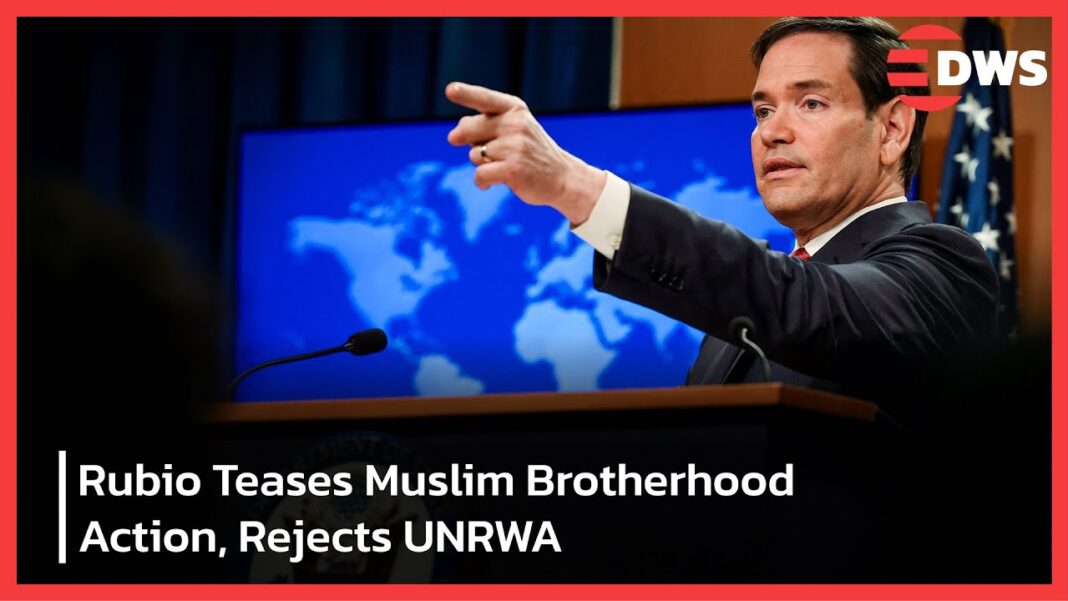
By any measure, the remarks delivered this week by Secretary of State Marco Rubio signal a consequential inflection point in American foreign policy, one that bridges counterterrorism enforcement with an intensifying diplomatic push in the Middle East. Speaking at a year-end press conference at the State Department, Rubio announced that the Trump administration is preparing to unveil sanctions against elements of the Muslim Brotherhood—potentially as early as next week—while simultaneously advancing an ambitious, time-sensitive framework for post-war governance and stabilization in Gaza.
As reported on Friday by The Jewish News Syndicate (JNS), Rubio’s comments underscore the administration’s determination to confront Islamist movements it views as destabilizing forces, even as it works urgently to reshape the political and security landscape of Gaza following months of war and humanitarian devastation.
Rubio’s announcement regarding the Muslim Brotherhood marks the most explicit signal yet that the administration intends to escalate pressure on the transnational Islamist movement, which has long been a subject of debate within U.S. policymaking circles. According to the information provided in the JNS report, Rubio told reporters that while he would not preview specific targets, sanctions announcements are imminent.
“I’m not going to comment on which segments of the Muslim Brotherhood—as you know, there are different chapters, for lack of a better term, and individuals spread throughout the world,” Rubio said, adding pointedly: “There’ll be announcements very soon on that, probably not today. Early this next week.”
The careful phrasing reflects the complexity of the Brotherhood itself, which operates as a loose global network rather than a centralized organization. As JNS has frequently documented, the Brotherhood encompasses political parties, charitable organizations, advocacy groups and clandestine networks across the Middle East, Europe and beyond. Some of these entities participate openly in electoral politics, while others have been linked—directly or indirectly—to extremist violence.
U.S. administrations have historically struggled to define a coherent approach to the Brotherhood. While several regional allies, including Egypt, Saudi Arabia and the United Arab Emirates, have designated the organization as a terrorist group, Washington has until now refrained from a blanket designation. Rubio’s remarks suggest a more targeted strategy, potentially focusing on specific branches, financial conduits or individuals deemed to pose security threats.
According to the JNS report, such sanctions could carry sweeping implications, not only for Middle Eastern politics but also for Muslim Brotherhood-affiliated organizations operating in Western countries. Financial restrictions, travel bans and asset freezes could disrupt transnational funding networks that U.S. officials believe have long evaded scrutiny.
While the prospect of sanctions dominated headlines, Rubio’s press conference also shed light on the administration’s parallel diplomatic efforts—most notably its push to implement a multi-stage peace and governance plan for Gaza. As JNS reported, Rubio emphasized that the current situation in Gaza is untenable and that the administration is moving with urgency to replace chaos with structured governance.
“No one is arguing that the status quo is sustainable in the long term, nor desirable,” Rubio said. “That’s why we have a sense of urgency about bringing phase one to its full completion.”
Phase one of the Trump administration’s 20-point Gaza peace plan centers on the establishment of three interlocking bodies: a Board of Peace, a Palestinian technocratic authority to manage civilian affairs on the ground, and a stabilization force to ensure security during the transition. According to the information in the JNS report, these entities are intended to operate sequentially but in rapid succession, laying the groundwork for long-term reconstruction and political normalization.
Rubio stressed that the administration does not envision a protracted timeline. “All those things happen, boom, boom, boom, 1-2-3, they have to happen very quickly, not a year from now,” he said. “This is something we’re aiming at very soon.”
Despite the ambitious rhetoric, many critical details remain unresolved. Questions persist regarding who will lead the proposed governing bodies, which countries will contribute personnel or funding, and how legitimacy will be established among Palestinians who have endured years of conflict and fractured leadership.
Rubio acknowledged these uncertainties but insisted that progress is being made behind the scenes. He indicated that the administration expects all three bodies to be formed within the year—a timeline that analysts say reflects both urgency and political risk.
The challenge is formidable. Gaza’s infrastructure has been ravaged, its population traumatized, and its political institutions hollowed out by years of Hamas rule. The success of any technocratic authority will depend on its ability to deliver basic services while navigating deep-seated mistrust. As JNS has reported, Israeli officials remain skeptical but cautiously receptive, provided that Hamas is decisively excluded from any future governing arrangement.
Rubio’s remarks also highlighted an intense flurry of regional diplomacy underway to support the Gaza initiative. Senior officials from Qatar, Turkey and the United Arab Emirates met with U.S. counterparts in Miami on Friday to discuss the peace plan, with Egypt also reportedly participating.
The composition of this group is notable. Qatar and Turkey have historically maintained ties with Hamas, while the UAE and Egypt are staunch opponents of the Muslim Brotherhood and its offshoots. Bringing these actors to the same table underscores Washington’s effort to forge a broad, if fragile, coalition capable of influencing events on the ground.
For the Trump administration, the dual-track approach—sanctioning Islamist networks while engaging regional powers in Gaza’s reconstruction—reflects a belief that security and diplomacy are inseparable. Officials argue that long-term stability in Gaza cannot be achieved without simultaneously dismantling extremist financing networks and offering Palestinians a viable alternative to terrorist rule.
Although the Middle East dominated much of the attention, Rubio also fielded questions about U.S. policy closer to home, particularly the administration’s ongoing confrontation with Venezuela’s Nicolás Maduro. As the JNS report noted, Rubio’s comments on Latin America reinforced the broader theme of the press conference: a willingness to wield economic pressure and diplomatic leverage against regimes and movements perceived as undermining democratic norms and regional stability.
This global posture—assertive, sanctions-driven and unapologetically values-based—has become a defining feature of Rubio’s tenure at the State Department. Supporters argue that it restores moral clarity to U.S. foreign policy; critics warn that it risks entrenching divisions and provoking retaliation.
The anticipated sanctions on the Muslim Brotherhood are likely to reverberate well beyond Washington. Israel has long urged the United States to adopt a tougher stance toward Islamist movements it sees as ideologically aligned with Hamas. Gulf allies, particularly the UAE, are expected to welcome the move as validation of their own policies.
At the same time, Turkey and Qatar—both key players in the Gaza talks—may find themselves navigating a delicate balancing act if Brotherhood-affiliated entities within their spheres of influence come under U.S. scrutiny. Rubio’s refusal to specify targets suggests that Washington is acutely aware of these sensitivities.
As the year draws to a close, Rubio’s remarks suggest that the coming weeks could prove decisive on multiple fronts. The rollout of sanctions against elements of the Muslim Brotherhood, combined with rapid movement on Gaza governance, represents one of the most ambitious foreign policy pushes of the Trump administration to date.
Whether these initiatives succeed will depend on execution as much as intent. As the JNS report emphasized, the intersection of counterterrorism, diplomacy and humanitarian reconstruction is fraught with risk—but also with opportunity.
For now, all eyes are on Washington, where announcements expected “early next week” may set the tone for U.S. engagement in the Middle East and beyond in the year ahead.