



|
Getting your Trinity Audio player ready...
|
By: Ariella Haviv
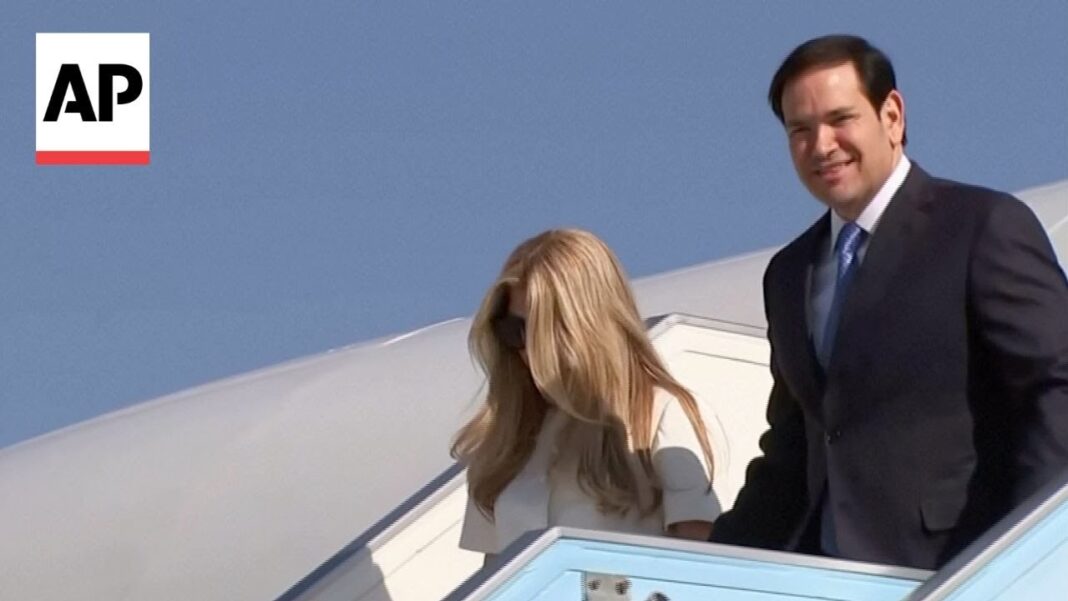
As tensions in the Middle East intensify following Israel’s unprecedented strike on Hamas leaders in Qatar and its renewed push to expand settlements in Judea and Samaria, U.S. Secretary of State Marco Rubio departed Washington on Saturday for a high-stakes visit to Jerusalem. The trip, according to a report that appeared on Saturday in The Algemeiner, draws attention to both the resilience of the U.S.–Israel alliance under President Donald Trump and the strains that have emerged with key Arab partners after Israel’s latest moves.
Rubio’s visit comes at a moment of unusual complexity: 48 hostages remain in Hamas captivity in Gaza, ceasefire negotiations have been thrown off course by Israel’s unilateral strike in Doha, and several European governments, including Britain and France, are poised to extend recognition to a Palestinian state. Against this backdrop, Rubio’s mission is to reassure Israel of Washington’s enduring support while addressing the deep unease the Doha operation has triggered across the region.
Speaking to reporters before boarding his plane, Rubio struck a careful tone. “What’s happened, has happened,” he said. “We’re gonna meet with them. We’re gonna talk about what the future holds.”
According to the information provided in The Algemeiner report, Rubio made clear that President Trump and his administration were “not happy” about the timing or scope of the strike in Qatar, which aimed at Hamas political leaders ensconced in Doha. U.S. officials have described the attack as a “unilateral escalation” that complicated hostage talks and put Washington in an awkward position with its Gulf partners.
Still, Rubio was equally emphatic that the U.S.–Israel relationship itself remained intact. “There are still 48 hostages that deserve to be released immediately, all at once,” he noted. “And there is still the hard work ahead once this ends, of rebuilding Gaza in a way that provides people the quality of life that they all want.”
His comments reflected an attempt to pivot attention back to Washington’s core objectives: freeing the hostages, dismantling Hamas as a terrorist threat, and laying the groundwork for post-war reconstruction. But as The Algemeiner report observed, Rubio also acknowledged that none of those objectives could be achieved in isolation, and much uncertainty remained over “who would do that, who would pay for it and who would be in charge of the process.”
The Israeli strike in Doha on Tuesday sent shockwaves through diplomatic channels. According to the information contained in The Algemeiner report, it was designed to eliminate the upper echelon of Hamas’s political leadership, many of whom have lived comfortably in Qatar for years. Israel has long criticized Doha for providing sanctuary to Hamas leaders, who enjoy lavish accommodations and unfettered access to financial networks while the group wages war from Gaza.
But the operation immediately derailed delicate hostage negotiations mediated by Qatar and the U.S. It also provoked fierce condemnation from Arab governments, who accused Israel of disrespecting Qatari sovereignty and undermining regional stability. Sheikh Mohammed bin Abdulrahman Al-Thani, Qatar’s prime minister, blasted the attack as “unjustified,” telling CNN that Prime Minister Benjamin Netanyahu had “destroyed any hope for negotiations.”
The controversy has placed Washington in a bind. The Trump administration has relied on Qatar as an intermediary with Hamas and other Islamist groups while simultaneously deepening its strategic embrace of Israel. Now, as The Algemeiner report noted, Rubio must reassure Israeli leaders that the U.S. remains steadfast while addressing the anger of Arab partners whose cooperation remains essential for any long-term regional settlement.
Rubio’s itinerary highlights these competing priorities. On Friday, before leaving Washington, he met with Qatar’s prime minister at the White House. Later that evening, President Trump hosted the Qatari leader for dinner in New York, signaling that Washington has no intention of abandoning Doha as a diplomatic channel.
At the same time, Rubio is heading to Israel to reinforce solidarity with America’s closest ally in the region. He is expected to meet Netanyahu and other senior officials to discuss the future of hostage negotiations, Israel’s ongoing military campaign in Gaza, and the fallout from Tuesday’s strike.
The Algemeiner report emphasized that Rubio’s challenge is not merely diplomatic but also political: he must navigate the divergent interests of allies while maintaining Trump’s pledge of unwavering support for Israel’s security. This balancing act comes just days before a critical series of meetings at the United Nations, where Palestinian statehood is likely to dominate the agenda.
Complicating matters further, Netanyahu on Thursday signed an agreement advancing a major settlement expansion plan across Judea and Samaria. According to the report in The Algemeiner, the move comes as European governments prepare to recognize Palestinian statehood — a step Israel has denounced as a “prize for terror.”
The timing of the settlement announcement drew sharp warnings from the United Arab Emirates, a signatory to the Trump-brokered Abraham Accords. Abu Dhabi warned that expanding settlements would cross a “red line” and potentially unravel the normalization agreements painstakingly negotiated in 2020.
Washington, too, is concerned. While the Trump administration has been more accommodating of Israeli settlement activity than its predecessors, officials have warned that sweeping expansion now could erode international support at a moment when Israel faces mounting diplomatic isolation. As Rubio acknowledged, some in Israel’s government view annexation of Judea and Samaria as an ultimate objective. European recognition of Palestinian statehood, he suggested, could accelerate those efforts.
Amid the geopolitical maneuvering, Rubio has repeatedly underscored the plight of the 48 hostages still held by Hamas in Gaza. “They deserve to be released immediately, all at once,” he said before departure.
For the Trump administration, securing their release remains paramount. As The Algemeiner reported, Trump has personally invested significant political capital in pursuing a deal, working through envoys like Steve Witkoff and leveraging relationships with regional actors. The Doha strike, however, has complicated these efforts, raising doubts about whether Hamas will remain at the negotiating table and whether Qatar can continue as a credible mediator.
Rubio’s mission, therefore, is not just about smoothing diplomatic feathers. It is also about ensuring that the path to securing the hostages’ release remains viable, even in the wake of Israel’s assertive military actions.
The broader diplomatic context is equally fraught. France and Britain have signaled they will recognize a Palestinian state later this month, a move that Israel has condemned as rewarding Hamas’s terrorism. According to the information in The Algemeiner report, Washington opposes unilateral recognition, warning it could embolden Hamas and harden Palestinian positions.
For Rubio, the challenge will be to rally international partners around a framework that does not undercut Israel’s security or reward Hamas. At the UN summit scheduled for late September, the United States will argue that Palestinian statehood must emerge from direct negotiations with Israel, not international diktats.
But with global sympathy for the Palestinians rising after nearly two years of war, and with casualty figures in Gaza mounting, Rubio will have limited leverage. European recognition could accelerate calls for broader sanctions on Israel and deepen its isolation.
Rubio’s trip also illustrates the broader contours of Trump’s Middle East strategy. According to The Algemeiner report, the administration is attempting to maintain maximum support for Israel while preserving key Arab relationships that serve U.S. strategic interests. It is a delicate balancing act, especially given Trump’s own unpredictable approach to diplomacy.
The administration is also aware that regional players like the UAE and Saudi Arabia are watching closely. The Abraham Accords, once hailed as a breakthrough, could be jeopardized if Israel pushes settlement expansion too far or continues unilateral actions that embarrass Arab partners.
At the same time, Trump’s political base in the United States expects him to stand firmly behind Israel, particularly in the wake of Hamas’s Oct. 7, 2023 massacre. The president’s reelection campaign has already emphasized his “ironclad commitment” to the Jewish state, framing it as a contrast to what Republicans argue would be a more equivocal Democratic stance.
Marco Rubio’s visit to Israel may not resolve the deep tensions that have emerged in the aftermath of the Doha strike or the settlement expansion announcement. But as The Algemeiner has stressed, the trip is a critical attempt to steady the U.S.–Israel partnership while navigating the shifting sands of Middle Eastern diplomacy.
“What’s happened, has happened,” Rubio said before his departure. Those words capture both the inevitability of Israel’s bold actions and the challenge facing the Trump administration: how to move forward constructively without losing sight of the hostages, alienating Arab allies, or allowing Israel’s international isolation to deepen.
The stakes are immense. For Israel, the outcome will shape its ability to continue its military campaign against Hamas while preserving diplomatic relationships. For Washington, it will test whether the Trump administration can manage a crisis that blends counterterrorism, alliance politics, and the volatile issue of Palestinian statehood.
And for Marco Rubio, it will be an early test of statesmanship in one of the world’s most combustible regions, where every move is scrutinized, every statement parsed, and every action weighed against decades of conflict and mistrust.