



|
Getting your Trinity Audio player ready...
|
By: Chaya Abecassis
The Washington Post has revealed dramatic new details from a high-level White House meeting held last week, in which President Trump presented his sweeping vision for Gaza’s future “day after” Hamas. The plan, striking both for its scale and its ambition, proposes the establishment of an American trusteeship over the territory for at least a decade, the relocation of its two million residents, and the transformation of Gaza into what Trump calls the “Riviera of the Middle East.”
According to senior officials cited by The Washington Post, the closed-door discussions — convened in the wake of nearly 700 days of devastating conflict between Israel and Hamas — laid out an unprecedented framework that would recast Gaza not as a perpetual war zone but as a showcase for American power, private investment, and regional cooperation.
At the heart of Trump’s proposal is the creation of an American trusteeship regime, a temporary governing authority that would supplant Hamas rule for at least ten years. The trusteeship would be charged with stabilizing the Strip, overseeing reconstruction, and guiding a massive redevelopment program meant to project prosperity rather than destruction.
Trump’s aides described the trusteeship as a transitional structure — designed to hold the territory while new institutions are built — but emphasized that it would operate on the basis of U. S.-Israeli agreement rather than negotiations with Palestinian political factions. Significantly, the plan does not include provisions for establishing a Palestinian state.
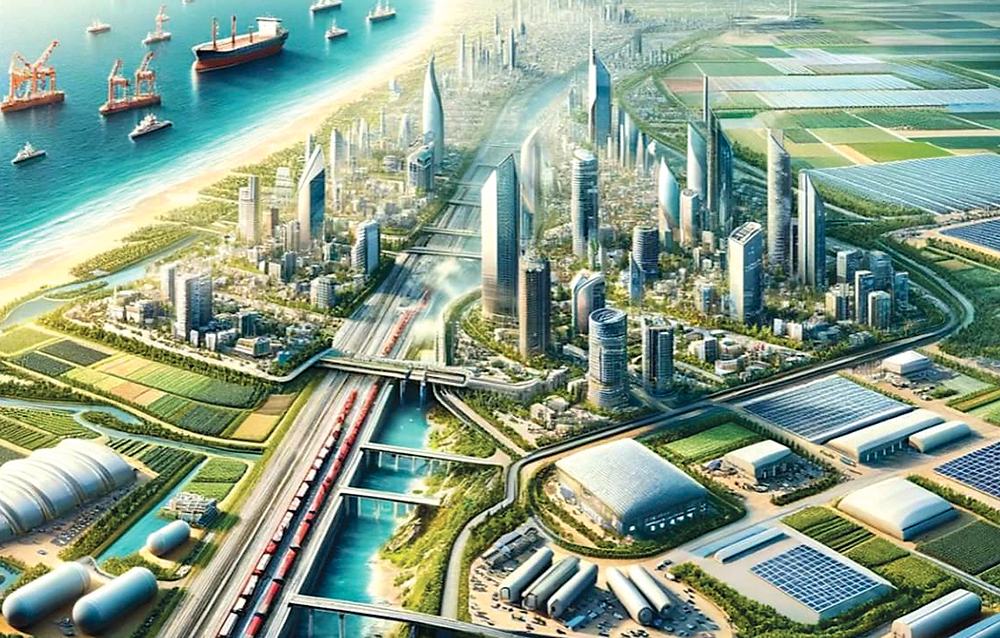
Trump’s vision is grandiose: luxury resorts lining the Mediterranean, six to eight “smart cities” powered by artificial intelligence, modern industrial zones, and robust infrastructure networks that would attract global investors.
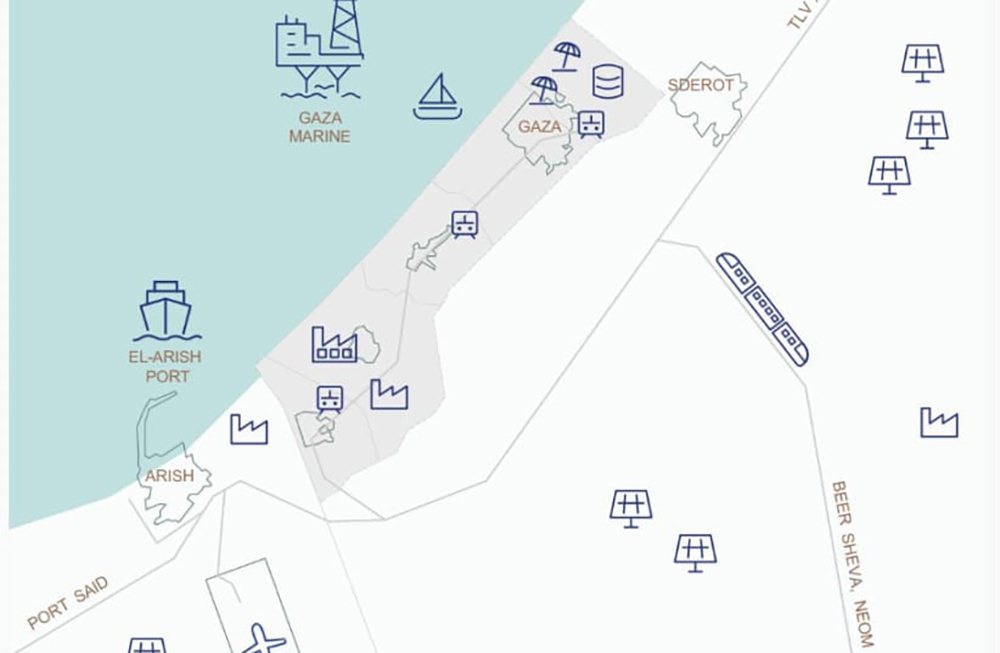
Under the plan, billions of dollars in funding would be marshaled through private and public channels. Saudi Arabia and the United Arab Emirates are expected to shoulder much of the financing, according to sources, while Washington would prefer Qatar’s involvement despite Israel’s deep skepticism of Doha’s ties to Hamas.
“This is about turning Gaza into a beacon of prosperity, a Riviera of the Middle East,” one source familiar with the discussions quoted Trump as saying. “If people have jobs, homes, and hope, terrorism will dry up.”
Perhaps the most controversial element is the mass relocation of Gaza’s entire population. Trump’s plan envisions moving all two million residents either outside the territory or into temporary designated housing zones within Gaza while new cities are built.
For those who remain, property owners would be promised rights to brand-new apartments in the smart cities that would eventually rise on the Strip.
For those who choose to leave Gaza altogether, the proposal includes generous financial incentives: a $5,000 relocation grant — a substantial sum in the local context — along with four years of rent assistance and one year of food stipends.
The inducements, Trump’s team argues, would not only provide immediate relief to Gazans but also create a voluntary path out of the cycle of war and poverty.
All of the investments would be centralized in a new fund: the Gaza Reconstitution, Economic Acceleration and Transformation Trust, or GREAT Trust — a name deliberately crafted to highlight Trump’s flair for branding.
The GREAT Trust would pool private and public investments from around the world but, crucially, would not require direct expenditures from the U. S. government budget. Trump’s advisers stressed that the model is designed to leverage international capital rather than saddle American taxpayers with new commitments.
“This is how we rebuild Gaza without endless U. S. aid packages,” one official told The Washington Post. “We bring in investors, we bring in the Gulf states, we make it a win-win for everyone except Hamas.”
On security, the plan gives ultimate responsibility to the Israel Defense Forces. The IDF would retain supreme authority over Gaza to prevent a resurgence of Hamas or other terrorist factions.
On the ground, however, private security contractors and third-party forces — potentially from Arab or European states — would provide day-to-day policing and stabilization. Within about ten years, the security portfolio would be handed over to vetted local forces.
For Israel, this arrangement ensures strategic control and minimizes the risk of another October 7-style catastrophe, while for the United States it reduces the prospect of direct American military entanglement.

Perhaps most strikingly, the plan pointedly avoids any mention of a Palestinian state. Trump’s aides described the framework as being based entirely on a bilateral U. S.-Israeli understanding, sidestepping years of international diplomacy centered on a two-state solution.
The omission underscores a core reality of Trump’s approach: the focus is on reconstruction, investment, and security — not on the political aspirations of Palestinian nationalism.
Trump’s offer of cash grants and subsidies to those who choose to leave Gaza is likely to draw both interest and outrage. For the average Gazan family, a $5,000 payout plus housing and food stipends could be life-changing. But critics are certain to brand the policy as a thinly veiled effort at incentivized population transfer.
“This is not only tempting — it’s transformative for an ordinary Gazan household,” said one Middle East analyst. “But it will be deeply controversial in international forums, where it may be framed as forced displacement, even if structured as voluntary relocation.”
The proposal has already sparked early debate among policy experts. Proponents argue it is the first serious effort to think beyond endless cycles of war by offering Gazans tangible hope and opportunity. Detractors, however, say the plan raises thorny ethical questions, could destabilize neighboring states if large numbers of Gazans relocate abroad, and sidesteps Palestinian self-determination.
Regional reaction is also uncertain. Saudi Arabia and the UAE may welcome a chance to invest in high-profile projects that boost their influence. Israel may embrace the security framework but worry about international criticism. And Qatar’s involvement — pushed by Washington but opposed by Jerusalem — could trigger friction among supposed allies.
In characteristic fashion, Trump’s Gaza proposal is sweeping and infused with marketing flair. The GREAT Trust, the promise of a “Riviera,” and the hardline refusal to deal with the brutal terrorists of Hamas or to recognize a Palestinian state all bear the hallmarks of his political style.
Whether the plan is viable remains to be seen. But after nearly two years of devastating conflict, and with Hamas militarily weakened, the moment may be ripe for bold ideas — however controversial.
As one official summed it up: “The choice is between rebuilding Gaza into something better or leaving it as a rubble pile where terrorism breeds. Trump believes he has the vision and the leverage to do the former.”

The plan unveiled at the White House is nothing if not ambitious. It aims to simultaneously end Hamas rule, transform Gaza’s economy, and give Israel and the United States enduring security guarantees — all while offering Gazans unprecedented relocation incentives.
Whether it is received as a pragmatic solution or a provocation will depend on how it is framed and whether international backers step forward to finance it. But one thing is certain: Trump has placed his stamp on the debate over Gaza’s future, once again redefining the conversation around one of the world’s most intractable conflicts.
The Costs of Gaza Reconstruction
The United Nations has placed an extraordinary figure on the cost of reconstructing Gaza: $50 billion. According to a January 22, 2025 report by National Public Radio (NPR), this staggering sum highlights both the scale of devastation and the formidable hurdles that lie ahead. Gaza, a densely packed enclave on the Mediterranean coast roughly the size of Philadelphia, has been pummeled by relentless fighting since Hamas’s October 7 assault on Israel ignited one of the most destructive wars in the region’s history.
Even under the most optimistic scenarios, the NPR report noted that rebuilding Gaza would take at least a decade. But the UN’s own modeling, published last September, paints an even grimmer picture: if Gaza were to resume the growth trajectory it followed between 2007 and 2022, it could take 350 years to restore its GDP to prewar levels. In essence, the war has not only reduced Gaza’s infrastructure to rubble; it has also set back its economic future by centuries.
At the heart of the challenge lies a fundamental question: where will the money come from? The NPR report stressed that Israel is unlikely to underwrite reconstruction, both for political reasons and because Israeli policymakers argue that resources sent to Gaza risk being diverted back into Hamas’s military apparatus. Meanwhile, neighboring Egypt and Jordan face severe economic crises of their own and have shown little appetite to shoulder Gaza’s financial burdens.
Somdeep Sen, an associate professor of international development at Roskilde University in Denmark, told NPR that wealthy Gulf states — Qatar foremost among them — may once again step forward as major donors. Qatar has long used financial aid to Gaza as a tool of soft power and diplomacy, funneling billions into salaries, fuel, and humanitarian projects over the past decade. Yet Sen cautioned that even Gulf largesse will not be enough. “Without a large cohort of donors committed to the long-term recovery of Gaza, reaching [the $50 billion] mark will be difficult,” he said.
Even if donors could be found, reconstruction is inextricably linked to Israeli policy. As NPR reported, how Israel chooses to interpret any ceasefire agreement and whether it maintains tight military control over Gaza will directly shape the speed and extent of recovery. The precedent is sobering: Israel has for years enforced “dual-use” import restrictions on goods that could serve both civilian and military purposes. That list includes essentials such as concrete, timber, and rebar — the very building blocks of reconstruction.
Shelly Culbertson, a senior researcher at the RAND Corporation with expertise on the West Bank and Gaza, told NPR that continuing these restrictions could slow rebuilding to a crawl. While Israel argues that such controls are necessary to prevent Hamas from reconstituting its arsenal, critics note that the same policies have long hobbled Gaza’s civilian infrastructure, even before the current war reduced much of it to rubble.
Before even a single new home or school can be built, Gaza faces the monumental task of clearing its ruins. Mark Jarzombek, an architectural history professor at the Massachusetts Institute of Technology, explained to NPR that Gaza’s reconstruction will be far more technologically demanding than historical examples like Dresden, Germany, which rebuilt after Allied firebombing in 1945.
In Dresden, many structures were made of brick and wood, and local civilians — notably brigades of women armed with wheelbarrows — could manually clear debris. Gaza’s modern buildings, by contrast, are predominantly steel and reinforced concrete. “In other words, you can’t get just local civilians [to] … take the stuff apart,” Jarzombek told NPR. Instead, specialized equipment will be required: bulldozers, cranes, heavy trucks, and disposal sites for hazardous debris. Compounding the problem, much of the rubble is riddled with unexploded ordnance, posing lethal risks to both workers and residents.

Gaza is not new to reconstruction pledges. After Israel’s wars with Hamas in 2009, 2012, and 2014, international donors pledged billions, only for much of that money to arrive slowly or not at all. The NPR report highlighted how political wrangling, corruption, and restrictions on imports have repeatedly undermined previous rebuilding campaigns. Each new conflict has destroyed what little progress had been made, creating a cycle of destruction and partial recovery that has left Gaza perpetually fragile.
This time, however, the scale is unprecedented. The UN’s September estimate placed the direct damage to Gaza’s infrastructure at $18.5 billion as of January 2024 — and that figure predates the more recent phases of the war. Entire neighborhoods have been flattened, water and sewage networks obliterated, and most of Gaza’s hospitals rendered inoperable. Schools, mosques, and commercial districts lie in ruins.
As NPR observed, the question of financing cannot be separated from the question of control. Will a coalition of Gulf states, Western powers, and international institutions like the World Bank and IMF come together under a joint mechanism? Or will fragmented contributions from competing donors lead to piecemeal recovery?
The United States and the European Union, Culbertson told NPR, are likely to play key roles in funding. Yet their willingness to invest billions hinges on political assurances that Hamas will not reassert itself. This creates a paradox: Gaza’s reconstruction requires stability, but stability itself depends on whether reconstruction can provide hope and livelihoods to its residents.
Israel, for its part, insists that any reconstruction must be tightly monitored to prevent Hamas or other terrorist groups from reconstituting their capabilities. That likely means continued restrictions on materials such as cement and steel, which Hamas has previously used to build tunnels and rockets. Yet, as the NPR report pointed out, those very materials are indispensable for civilian rebuilding.
