



|
Getting your Trinity Audio player ready...
|
By: Andrew Carlson
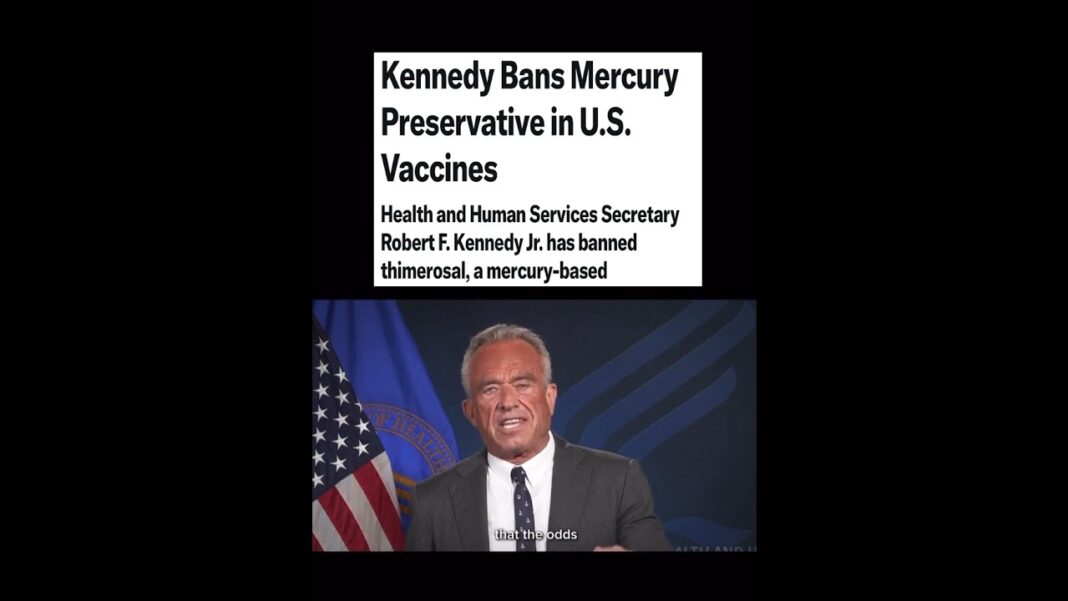
In a decision hailed as the culmination of more than two decades of debate, the U.S. Health and Human Services Department (HHS) announced on July 23 that thimerosal, a mercury-based preservative long used in influenza vaccines, will be removed from all flu shots distributed nationwide.
The action was taken by HHS Secretary Robert F. Kennedy Jr., who signed the official directive following a June vote by the Centers for Disease Control and Prevention’s Advisory Committee on Immunization Practices (ACIP). With Kennedy’s signature, the recommendation is now formally embedded in federal health policy, closing a chapter that began in 1999 when public health authorities first urged manufacturers to eliminate mercury from vaccines.
The ACIP Vote and Federal Adoption
At its June 25–26 meeting at CDC headquarters in Atlanta, the ACIP voted 5–1 to recommend that all Americans — including children 18 years and younger, pregnant women, and adults — receive only single-dose influenza vaccines free of mercury. Multi-dose vials preserved with thimerosal, once a mainstay of mass immunization campaigns, will no longer be permitted in the United States.
By adopting this recommendation, HHS finalized the committee’s guidance and extended its authority into binding national policy. “After more than two decades of delay, this action fulfills a long-overdue promise to protect our most vulnerable populations from unnecessary mercury exposure,” Secretary Kennedy said in a statement released through HHS. “Injecting any amount of mercury into children when safe, mercury-free alternatives exist defies common sense and public health responsibility. Today, we put safety first.”
A Promise Dating Back to 1999
The removal of mercury from vaccines has been a gradual process spanning nearly a quarter century. In 1999, the U.S. Public Health Service, the American Academy of Pediatrics (AAP), and leading vaccine manufacturers issued a joint statement urging the elimination of thimerosal “as soon as possible” from childhood immunizations. That call reflected the principle of precaution, even though extensive scientific research found no evidence of harm from thimerosal.
By 2001, most childhood vaccines in the U.S. were already produced without thimerosal. Influenza vaccines, however, remained a notable exception. Multi-dose flu vaccine vials continued to rely on thimerosal to prevent contamination, particularly in clinical settings where large volumes of vaccine are stored and administered.
With Kennedy’s signature, HHS has now completed the process envisioned in 1999, ensuring that no vaccines distributed in the United States will contain mercury-based preservatives.
A Break With Past Inaction
Secretary Kennedy’s newly appointed ACIP members played a pivotal role in advancing the change. According to the information provided in the HHS press release, the committee’s decision represented a decisive break from years of stalemate, where prior advisory bodies had opted not to mandate a full phase-out despite the availability of mercury-free alternatives.
The vote aligns U.S. policy with practices already adopted in Europe, where mercury additives were phased out years ago. In announcing the decision, HHS emphasized that the move is designed not only to reduce potential exposure but also to build public trust in immunization programs.
Ensuring Supply and Access
Concerns that the removal of thimerosal might disrupt vaccine supply were addressed directly by both HHS and vaccine manufacturers. According to the department, producers have confirmed they possess the capacity to replace multi-dose vials with single-dose presentations without jeopardizing availability.
This assurance extends to both the Vaccines for Children (VFC) program, which provides immunizations to children from low-income families, and to the nation’s adult influenza vaccine supply. By securing commitments from manufacturers, HHS sought to preempt fears that the transition might limit access or increase costs.
Safeguarding Public Confidence
The Advisory Committee on Immunization Practices (ACIP), whose members include leading experts in pediatrics, immunology, and public health, has long been a critical body in shaping vaccine guidance. Its recommendations, once approved by HHS, carry the force of federal health policy.
This latest decision, HHS stated, represents “a critical step toward enhancing public confidence in vaccines and advancing the nation’s commitment to safer immunization practices.”
For Kennedy, the measure reflects a broader effort to restore public trust in vaccines after years of contentious debate. “With the U.S. now removing mercury from all vaccines, we urge global health authorities to follow this prudent example for the protection of children worldwide,” he said in an additional statement released through HHS.
Historical Context of Thimerosal
Thimerosal, first introduced in the 1930s, has served as a preservative in numerous medical products, including vaccines. Its antimicrobial properties made it an effective safeguard against bacterial and fungal contamination, particularly in multi-dose vials.
Though studies conducted over decades consistently found thimerosal to be safe, its presence in vaccines drew scrutiny beginning in the late 1990s. The concern was rooted not in direct evidence of harm but in the desire to minimize any potential risk associated with mercury exposure, such as autism, particularly for infants and children.
By the early 2000s, the vast majority of vaccines administered in the U.S. were free of mercury. The July 23 action by HHS closes the last major exemption, ensuring that even seasonal influenza vaccines are free of the preservative.
Aligning U.S. Policy With International Trends
The decision places the United States in closer alignment with international vaccine policy. Many European countries had already moved to eliminate mercury additives, citing both precautionary principles and public perception concerns.
By finalizing the removal, HHS signaled that the U.S. would adopt the same stance, furthering a trend toward greater harmonization of vaccine safety standards across developed nations.
Broader Implications for Vaccine Policy
The action also sheds light on a new direction in how HHS approaches vaccine oversight under Secretary Kennedy’s leadership. Since assuming office, Kennedy has emphasized transparency and responsiveness to public concern, framing the removal of thimerosal as a symbolic as well as practical measure.
In addition to the mercury decision, Kennedy has already approved all recommendations issued from the ACIP’s April meeting, with further guidance from its June session currently under review by HHS.
Looking Ahead
While the scientific consensus continues to affirm that thimerosal posed no health risks, HHS framed the July 23 decision as an opportunity to strengthen trust between the public and health authorities. By eliminating a preservative long targeted by critics, the department aims to focus attention on the safety and necessity of vaccines themselves, rather than the controversy surrounding their components.
“The United States has now completed its transition to mercury-free immunizations,” HHS declared in its announcement. “This milestone reflects a sustained commitment to safeguarding public health, ensuring vaccine safety, and preserving access for every American.”
As the department reviews additional recommendations from the ACIP, the July 23 action may stand as one of the most consequential moments of Kennedy’s tenure at HHS — the formal conclusion of a debate that began more than 20 years ago, and the start of a new chapter in vaccine policy built on both science and public trust.
