



|
Getting your Trinity Audio player ready...
|
By: Ariella Haviv
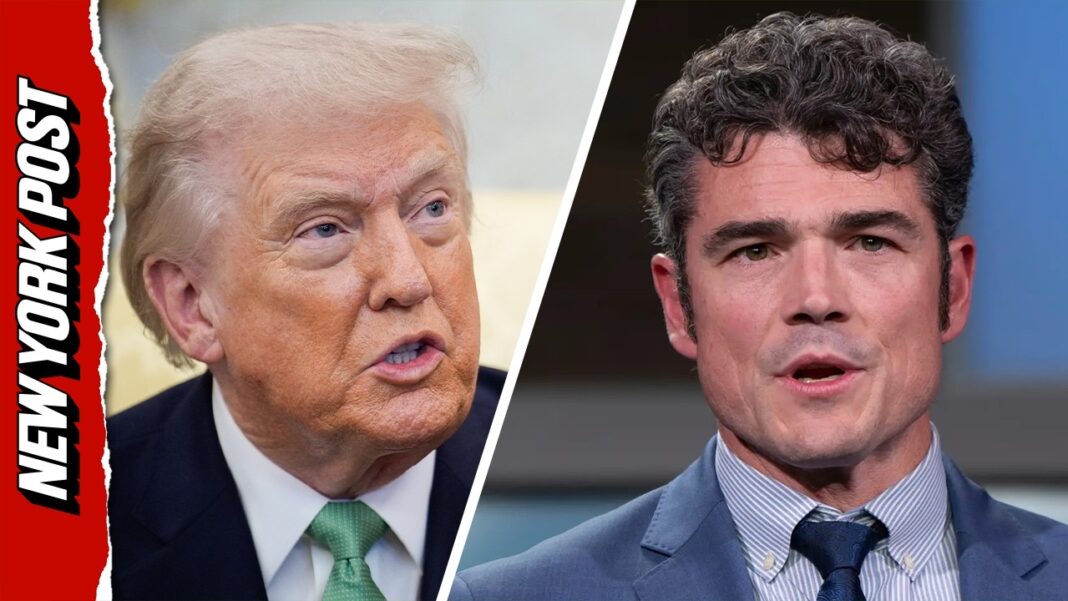
In a stunning and deeply polarizing development that has sent shockwaves through Washington’s national security establishment, Joe Kent, director of the National Counterterrorism Center, resigned Tuesday in protest of President Donald Trump’s military campaign against Iran—an exit that has not only exposed internal fractures within the administration but also reignited contentious debates over the role of intelligence, alliances, and political narratives in decisions of war.
Kent’s resignation letter, excerpts of which were reported and analyzed by The Algemeiner on Tuesday, went far beyond a conventional policy disagreement. While he argued that Iran posed “no imminent threat” to the United States, it was his broader and far more controversial assertion—that Israel and pro-Israel advocates exerted undue influence in steering Washington toward conflict—that triggered immediate and forceful condemnation from both the White House and a broad spectrum of national security experts.
At its core, Kent’s departure marks the most significant internal dissent yet within the administration over the Iran campaign. According to The Algemeiner report, his resignation underscores a growing unease among some officials regarding both the strategic rationale for military action and the intelligence assessments underpinning it.
Yet Kent’s critique did not remain confined to questions of threat perception. In his resignation letter, he drew provocative parallels to the Iraq War, suggesting that similar external pressures and intelligence dynamics shaped both conflicts. Such comparisons, as The Algemeiner reported, have been widely dismissed by analysts as reductive and historically inaccurate.
“Iran posed no imminent threat to our nation,” Kent wrote, adding that the United States had been drawn into conflict due to pressure from Israel and its supporters. The statement immediately ignited controversy, with critics arguing that it not only mischaracterizes the policymaking process but also risks amplifying longstanding and deeply problematic narratives.
The Trump administration responded swiftly and unequivocally. President Donald Trump himself dismissed Kent’s position, characterizing him as “weak on security” and reaffirming that the decision to strike Iran was grounded in credible intelligence concerning threats to American personnel and interests in the region.
White House Press Secretary Karoline Leavitt issued an even sharper rebuke. As cited by The Algemeiner, she described Kent’s allegations as “absurd,” emphasizing that the president’s stance on Iran has been consistent for decades. “The absurd allegation that President Trump made this decision based on the influence of others, even foreign countries, is both insulting and laughable,” Leavitt stated, reiterating that preventing Iran from acquiring nuclear weapons has long been a central tenet of Trump’s foreign policy.
Administration officials further stressed that the decision-making process was driven by American intelligence assessments and strategic considerations, not external pressure. In their view, Kent’s claims distort both the complexity and the sovereignty of U.S. national security deliberations.
National security experts, many of whom spoke to outlets including The Algemeiner, were quick to challenge Kent’s framing. They argued that while Israel is indeed a close ally that shares intelligence and strategic concerns—particularly regarding Iran’s nuclear ambitions and its support for proxy groups—the ultimate authority for military action rests solely with U.S. leadership.
The suggestion that Israel “pushed” the United States into war, critics contend, oversimplifies a highly complex process involving multiple agencies, layers of analysis, and competing viewpoints.
Moreover, analysts emphasized that concerns about Iran are not unique to any single administration or political ideology. For years, successive U.S. governments—Democratic and Republican alike—have identified Iran’s regional activities, including its backing of armed groups hostile to both Israeli and American interests, as a significant security challenge.
As The Algemeiner has consistently noted, intelligence sharing between the United States and Israel is part of a broader strategic partnership, not a mechanism of control or coercion.
Perhaps most troubling to many observers were Kent’s additional remarks linking his personal tragedy to broader geopolitical claims. In his resignation, he referenced the death of his wife, Shannon Kent, who was killed in 2019 by an ISIS suicide bomber during a U.S. military operation in Syria.
Kent described her death as occurring in a “war manufactured by Israel,” a statement that has been widely condemned as baseless. As The Algemeiner reported, there is no factual basis for attributing the Syrian Civil War—or the actions of ISIS—to Israel.
Experts warn that such assertions echo conspiracy theories that circulate online, including the unfounded claim that Israel exerts control over terrorist organizations. These narratives, critics argue, not only distort reality but also risk fueling antisemitic tropes.
The reaction to Kent’s statements has been swift and, in many cases, severe. Ilan Goldberg, Senior Vice President and Chief Policy Officer of the pro-Israel organization J Street, offered a nuanced response that captured the complexity of the moment.
While praising Kent for stepping down, Goldberg sharply criticized the content of his resignation letter. As quoted by The Algemeiner, Goldberg described the allegations regarding Israel’s role in U.S. wars as “ugly” and rooted in harmful stereotypes. “The antisemitic stuff in here blaming Israel for the Iraq war and a secret conspiracy of the media and Israelis to deceive Trump into going to war with Iran is ugly stuff that plays on the worst antisemitic tropes,” Goldberg said.
He also underscored a fundamental point often lost in such debates: ultimate responsibility for military decisions lies with the president of the United States. “Donald Trump is the President of the United States and he is the one ultimately responsible for sending American troops into harm’s way,” Goldberg added.
Kent’s resignation is not the first time he has been at the center of controversy. During his confirmation process, he faced scrutiny over reported connections to individuals associated with white supremacist movements, including Nick Fuentes and Greyson Arnold. While Kent acknowledged having communicated with Fuentes regarding social media strategy, he later distanced himself from those views. Nonetheless, the episode contributed to concerns about his judgment and associations.
In addition, Kent has previously expressed unconventional foreign policy positions. In the wake of Russia’s 2022 invasion of Ukraine, he described Russian President Vladimir Putin as “very reasonable” and suggested that U.S. foreign policy had provoked the conflict—a stance that drew criticism from across the political spectrum.
As The Algemeiner observed, these positions have contributed to a broader perception of Kent as a figure willing to challenge mainstream consensus, often in ways that generate significant controversy.
Kent’s resignation comes at a moment of heightened debate over the United States’ military engagement with Iran. While some critics of the campaign share his concern about the absence of an imminent threat, many have distanced themselves from his broader claims regarding Israel.
This distinction is critical. As numerous experts emphasized to The Algemeiner, questioning the strategic wisdom of military action is a legitimate and necessary part of democratic discourse. However, attributing such decisions to external manipulation risks undermining public understanding and fostering harmful narratives.
Beyond the immediate controversy, Kent’s departure raises deeper questions about the nature of dissent within national security institutions. How should officials navigate disagreements over policy? And where is the line between legitimate critique and the propagation of misleading or inflammatory claims?
For the Trump administration, the episode represents both a challenge and an opportunity—to reaffirm its strategic rationale while addressing concerns about internal cohesion.
For the broader public, it serves as a reminder of the complexities inherent in decisions of war—decisions shaped by intelligence, alliances, historical experience, and political judgment.
As The Algemeiner has extensively reported, the intersection of these factors defies simple explanations. It demands careful analysis, rigorous debate, and a commitment to factual accuracy.
In the final analysis, Joe Kent’s resignation is more than a personal or professional turning point; it is a flashpoint in an ongoing national conversation about war, responsibility, and the narratives that shape public perception.
His claims have been widely rejected by officials and experts alike, yet their resonance in certain circles underscores the enduring power of simplified—and often misleading—explanations.
As Washington grapples with the implications of his departure, one reality remains clear: decisions of war are among the most consequential a nation can make. They demand not only strategic clarity but also a disciplined commitment to truth.
In an era of heightened polarization and information warfare, that commitment has never been more essential.
