



|
Getting your Trinity Audio player ready...
|
Rep. Adam Smith Urges Conditioning U.S. Arms Sales to Israel, Escalating Intra-Democratic Debate Over Gaza War
By: Andrew Carlson
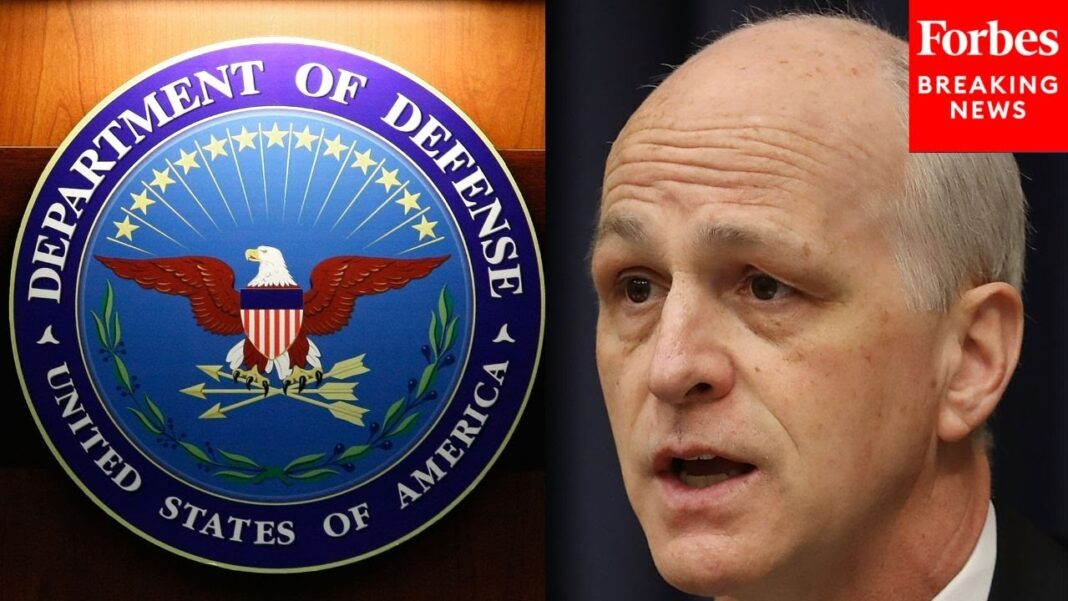
The debate over Washington’s role in Israel’s war against Hamas deepened this week as Rep. Adam Smith (D-WA), ranking member of the House Armed Services Committee, called on the Trump administration to consider halting certain offensive weapons sales to Israel in an effort to pressure Jerusalem into altering its military strategy in Gaza.
Smith’s remarks, among the most forceful yet from a senior Democratic lawmaker, underscore the widening gulf inside the Democratic Party on questions of Israel, U.S. military aid, and the future of Gaza. His statement on Tuesday suggested that Israel has reached a point of “diminishing returns” in its military campaign against Hamas and that American leverage must now be used to induce changes in policy.
According to a report that appeared on Wednesday in The Algemeiner, the Washington Democrat said Israel must “implement a ceasefire in Gaza and massively increase the flow of humanitarian aid,” while halting settlement expansion in the West Bank and “taking serious steps to reduce the violence there.” If Israel refuses, Smith argued, the U.S. should withhold offensive weapons systems as leverage.
Smith’s position is notable not only for its content but also for his stature within the Democratic caucus. As the top Democrat on the House Armed Services Committee, Smith has long been regarded as a pragmatic voice who has typically resisted conditioning U.S. military assistance to Israel.
In his statement, however, he acknowledged that he has changed course: “I have opposed using U.S. military assistance as leverage in the past, but shifting conditions in the Middle East … have created a moment where Israel could accept such pressure without jeopardizing its security.”
The Algemeiner report emphasized that this rhetorical pivot demonstrates the degree to which the Democratic debate on Israel has shifted. What was once considered a red line—the idea of using American aid as a tool to compel Israeli concessions—is now openly debated by senior lawmakers.
Smith’s principal argument rests on his claim that Israel’s war has reached diminishing returns. “Right now, it is impossible to see how further military action in Gaza could degrade Hamas’s capabilities to any appreciable degree further than what has already occurred,” he said. He added that “six months of war since the end of the last ceasefire has done nothing to bring the hostages home.”
The remark highlights an emerging theme in Democratic discourse: support for Israel’s right to self-defense coupled with growing skepticism about the efficacy of a prolonged military campaign. While Republicans and many pro-Israel Democrats argue that Hamas can only be neutralized through sustained military pressure, critics such as Smith contend that Israel has already inflicted maximum feasible damage on Hamas and risks eroding international legitimacy by continuing.
According to the information provided in The Algemeiner report, Smith voiced particular concern that Israel could “be ostracized globally in a way that is a far greater threat to the long-term security of Israel than anything their adversaries are now capable of doing” if the war continues indefinitely.
Smith also pointed to what he described as changing dynamics in the Middle East. He cited the removal of Syrian President Bashar al-Assad, as well as setbacks for Hamas, Hezbollah, and Iran, as evidence that U.S. support for Israel has already yielded favorable regional outcomes.
“These are very positive developments that might not have happened if the U.S. had reduced its support to Israel prior to them occurring,” Smith said. “But these developments also mean that Israel faces little if any risk to its security if the U.S. blocks the sale of some weapons now.”
Critics note, however, that Assad remains in power, Hezbollah retains its vast rocket arsenal, and Iran continues to expand its nuclear program. As The Algemeiner has repeatedly reported, Israeli officials view Tehran and its regional proxies as posing an existential threat, not one diminished by temporary tactical setbacks. For Jerusalem, American weapons systems remain essential to deter and, if necessary, confront these adversaries.
Smith took pains to differentiate his critique of Israel’s conduct from broader anti-Israel animus. “Opposing the actions of the Israeli government in Gaza to stop the war and end the suffering of the Palestinian people is very different from opposing the Israeli government out of a desire to wipe it off the map,” he said.
He also expressed frustration that international criticism has too often failed to hold Hamas accountable, which he argued has emboldened the group to prolong the conflict. Nevertheless, he insisted that humanitarian conditions and the absence of progress on freeing hostages necessitate a new approach. “Simply continuing the war has clearly failed to completely eliminate Hamas or gain the return of the hostages. It is time to try something else,” Smith said.
The Algemeiner report noted that this rhetorical balancing act—criticizing Israel while also affirming support for its security and condemning Hamas—is becoming increasingly common among Democrats who seek to maintain pro-Israel credentials even while pressing for policy change.
Smith’s call also included an appeal for the U.S. to “pressure Hamas by working with alternative Palestinian leadership to rebuild Gaza and give the Palestinian people some hope for their future.” He suggested that providing such an alternative could undermine Hamas’s grip and create the conditions for long-term stability.
This reflects a broader current within the Democratic Party, as reported by The Algemeiner, to promote Palestinian Authority involvement in postwar Gaza or to encourage the emergence of new leadership structures. Israeli leaders, however, remain deeply skeptical, citing the PA’s weakness, corruption, and history of incitement.
Smith’s remarks land amid a stark partisan divide on Israel policy. A recent University of Maryland Critical Issues poll, cited by The Algemeiner, found that 67 percent of Democrats view Israel’s military actions in Gaza as constituting “genocide” or “akin to genocide,” compared with only 14 percent of Republicans. Among Democrats, 63 percent said the Trump administration’s policy is “too pro-Israel,” while 57 percent of Republicans said it was “about right.”
These numbers illustrate the political pressures facing Democratic lawmakers like Smith. While pro-Israel voices within the party continue to argue for unyielding support, the Democratic base increasingly demands conditions, restrictions, or outright opposition to Israeli policy. Smith’s statement can therefore be seen not only as a reflection of his own judgment but as a response to this shifting political terrain.
The Algemeiner report observed that while the Democratic leadership remains formally committed to Israel’s security, the erosion of grassroots support represents a long-term challenge to bipartisan consensus in Washington.
Republicans, for their part, have denounced efforts to condition arms sales as reckless and dangerous. Secretary Rubio and other administration officials have emphasized that Israel remains America’s closest ally in the Middle East and that cutting weapons supplies would embolden Hamas, Hezbollah, and Iran.
Israeli officials, too, view such proposals with alarm. As The Algemeiner has reported, Jerusalem regards American weapons deliveries not only as material support but as symbolic reassurance of U.S. backing. Any signal of wavering, Israeli diplomats argue, could encourage Israel’s adversaries and complicate ongoing military operations.
Rep. Adam Smith’s call to use U.S. weapons sales as leverage over Israel represents a watershed moment in the Democratic Party’s internal debate on the Gaza war. It reflects both his personal reassessment of Israel’s military strategy and the broader shift among Democratic voters, who increasingly demand conditions on U.S. aid.
Yet as The Algemeiner report pointed out, the risks of such an approach are substantial. Israel remains locked in a multi-front struggle against Hamas, Hezbollah, and Iran. Cutting off offensive weapons—even selectively—could embolden these adversaries at precisely the moment when Israel seeks to restore deterrence.
Smith insists that “it is time to try something else.” But for Israel, the alternative to military pressure on Hamas remains unclear. Without the destruction of Hamas’s infrastructure and the safe return of hostages, Israeli leaders argue, neither Gaza’s reconstruction nor Palestinian political renewal is viable.
As the Democratic Party wrestles with these questions, the U.S.–Israel relationship enters a new, more contentious phase. The bipartisan consensus that once seemed unshakable now faces strain, with implications not only for Israel’s security but for America’s role in the Middle East at large. Whether Smith’s proposal gains traction or remains an outlier, its very articulation signals how profoundly the conversation has changed.
The Democrats have always been the champion of Hamas. They, and even the Bushes have long and often demanded “ceasefires” and effectively and successfully thwarted Israeli efforts to resolve Hamas belligerence and terror. Now, they stand up and do it again. They know the consequences of their fecklessness but they’re sticking to it.
Another Nazi Democrat.
Democrat JEWS have now crossed the line, aggressively militarily attacking Israel by restricting essential arms sales to Israel! They are malevolently betraying Israel!
Zionist Organization of America | ZOA Quoted: Rep. Raskin (D-MD) Joins Growing Number of Democrats Trying to Restrict Arms Sales to Israel, Endangering Jewish Lives During Its War Against Hamas, Hezbollah and Iran ─ Washington Jewish Week
https://zoa.org/2025/08/10453571-maryland-jews-grapple-with-raskins-backing-of-block-the-bombs-act-washington-jewish-week/