



|
Getting your Trinity Audio player ready...
|
By: Fern Sidman – Jewish Voice News
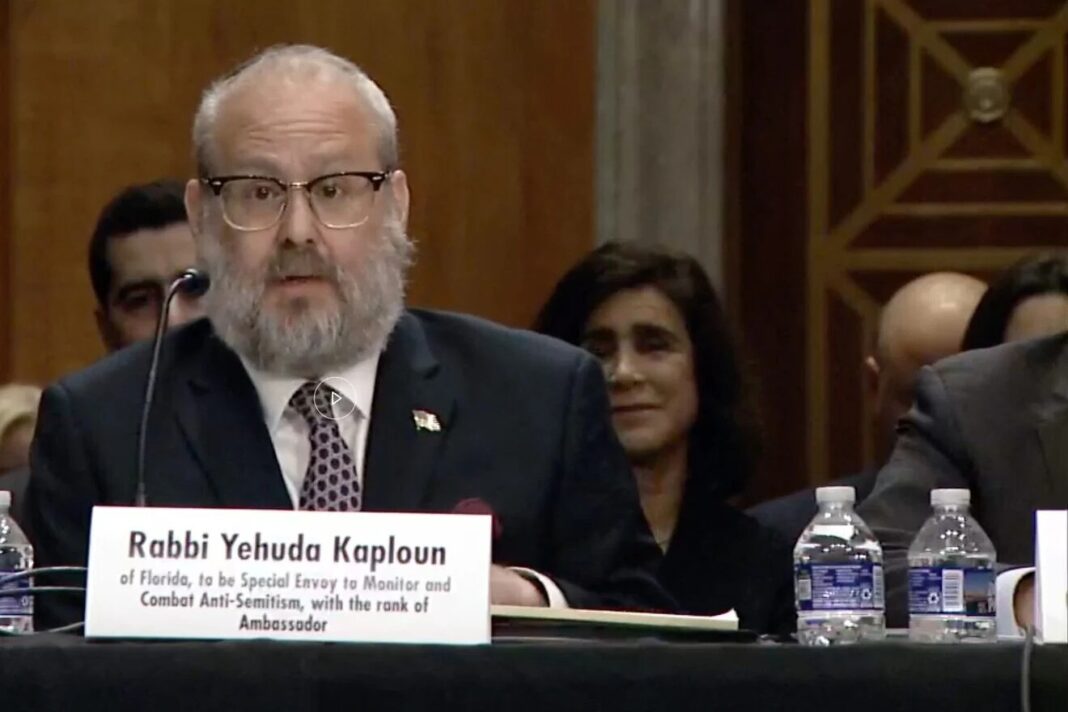
In a development closely watched by Jewish communal organizations and foreign-policy observers alike, the Senate Committee on Foreign Relations advanced the nomination of Rabbi Yehuda Kaploun to serve as the Trump administration’s special envoy to monitor and combat antisemitism, marking a bipartisan milestone in an otherwise polarized political climate. As The Jewish News Syndicate (JNS) reported on Wednesday, the vote reflects both the urgency of the moment and the evolving contours of American diplomatic engagement on global antisemitism.
If confirmed by the full Senate, Kaploun—an Israeli-born, Connecticut-raised Chabad rabbi now based in Miami—would become only the second Chassid to hold a Senate-approved senior administration post. The first, Mitchell Silk, was confirmed as assistant secretary of the treasury for international markets during President Trump’s first term in 2020. Kaploun’s elevation thus represents not only a political appointment but also a symbolic expansion of the Hasidic community’s representation in the upper echelons of U.S. foreign-policy institutions.
The committee vote itself was notable for its rare bipartisan composition. Senators Jacky Rosen (D-Nev.) and Jeanne Shaheen (D-N.H.) joined all Republican members in advancing the nomination. As the JNS report emphasized, this crossing of party lines occurred despite resistance from several Democratic senators who raised concerns about Kaploun’s past public commentary on their party’s response to Hamas’s October 7 attacks and broader antisemitism issues.
Kaploun has not shied away from forceful language. In a 2024 interview with Mishpacha magazine, he declared, “Democrats are afraid to even say the words ‘radical Islamic terror’ while Trump says it openly.” He went further, accusing certain Democratic leaders of refusing to identify Hamas as a terrorist organization responsible for atrocities—including the murder of women and the kidnapping of children.
These remarks drew sharp objections from Democratic committee members whose votes ultimately opposed his nomination. Senators Chris Coons, Chris Murphy, Tim Kaine, Jeff Merkley, Cory Booker, Brian Schatz, Chris Van Hollen, and Tammy Duckworth each cited concerns that Kaploun’s partisan framing could compromise his ability to operate as a neutral diplomat in an arena where nuanced coalition-building is critical.
Despite these objections, the committee’s approval moves Kaploun substantially closer to confirmation, placing the final decision before the full Senate in the coming weeks.
Notably, leading Jewish advocacy groups—including the Anti-Defamation League and the Orthodox Union Advocacy Center—issued statements supporting the committee’s decision and urging the Senate to confirm the rabbi. As JNS reported, these organizations described Kaploun as a committed and principled advocate for global Jewish security, arguing that his perspective is urgently needed in an era of accelerating antisemitism across Europe, the Middle East, and even parts of North America.
Ambassador-designate Kaploun is well known as a successful businessman who has been deeply involved in Jewish issues and a variety of charitable causes in his home state of Florida and beyond. Since the Hamas terrorist attacks on October 7, 2023, antisemitism has escalated at an alarming rate across the globe. Ambassador-designate Kaploun has spoken out about this scourge and we are confident he will carry out his new responsibilities with dedication and distinction.”
“Agudath Israel has long supported the creation and elevation of this important position,” said Rabbi A. D. Motzen, Agudath Israel’s National Director of Government Affairs. “The fight against antisemitism is never-ending, and particularly critical at a time when we are witnessing open and increasing attacks against Jews in foreign countries. We urge expeditious Senate consideration, and we look forward to working closely and cooperatively with this Special Envoy as we have with all of his predecessors.”
While Kaploun does not possess the decades-long academic profile of his predecessor Dr. Deborah Lipstadt—a renowned Holocaust historian who brought deep scholarly authority to the role—supporters contend that his experience as a Chabad rabbi, educator, and businessman offers an alternate path to international engagement. His background, they argue, may lend itself to more grassroots-oriented diplomacy, particularly in communities lacking institutional Jewish infrastructure.
At his confirmation hearing, Kaploun emphasized his educational mission, declaring, “We must educate, educate, educate about the history of the Jewish community in America and the Judeo-Christian values our country was founded on. Antisemitism is anti-American.” As the JNS report highlighted, Kaploun also warned that the rhetoric used by those chanting “death to the Jews” frequently merges indistinguishably with language calling for “death to America,” making antisemitism a national security issue as much as a moral one.
Kaploun’s potential appointment unfolds at a time of historic volatility in global Jewish affairs. Since Hamas’s October 7, 2023 massacre—an event that marked the deadliest day for Jews since the Holocaust—antisemitism has surged to unprecedented levels worldwide. The war against Hamas in Gaza, increasing Hezbollah aggression from Lebanon, and Iran’s involvement across the region have further strained the global temperature.
In Europe, violent antisemitic incidents and synagogue attacks have climbed sharply. South America has also seen a disturbing spike, with governments struggling to contain extremist networks. According to various JNS analyses, the challenge for the next U.S. antisemitism envoy will be not merely cataloguing these threats but coordinating multilateral responses among allies whose internal politics are often fractious and unpredictable.
Domestically, the appointment carries symbolic resonance at a time when Jewish advocacy groups are sounding alarms about antisemitism on American university campuses, social-media platforms, and in some corners of progressive activism. Kaploun’s straightforward rhetoric and insistence on moral clarity resonate strongly with conservative and centrist Jewish audiences who feel mainstream institutions have become timid in the face of rising anti-Jewish hostility.
Opponents of the nomination argue that Kaploun’s outspoken commentary risks undermining his ability to engage diplomatically with foreign governments, NGOs, and international bodies. As several Democratic senators asserted during the committee proceedings, the envoy must balance advocacy with diplomacy, especially when partnering with governments that maintain complex and sometimes contradictory positions on Israel and antisemitism.
Some critics further contend that Kaploun’s worldview is too closely aligned with Trump-era foreign policy to gain broad acceptance among European allies who remain wary of the administration’s hardline approach to Iran and the Palestinian Authority. As JNS reported, others view this alignment as a strength, noting the administration’s assertive stance against the IRGC, UNESCO’s anti-Israel bias, and the U.N.’s incessant contentious treatment of Israel.
Parallel to Kaploun’s advancement, the Foreign Relations Committee also approved another significant nomination: former Fox Nation host and current State Department spokeswoman Tammy Bruce was advanced as President Trump’s choice for U.S. deputy ambassador to the United Nations.
Unlike Kaploun, Bruce was approved strictly along party lines. Her nomination calls attention to the administration’s effort to reshape U.S. engagement with the U.N., particularly regarding resolutions targeting Israel and attempts to regulate speech under the rubric of “hate-speech frameworks” that Jewish groups, including those interviewed by JNS, fear could be weaponized against pro-Israel advocacy.
Rabbi Kaploun’s nomination now moves to the full Senate, where confirmation will hinge on whether the bipartisan support seen in committee can be replicated on the Senate floor. The political arithmetic remains uncertain. While Kaploun’s backers hail his frankness, his detractors view it as liability in the delicate world of international human-rights diplomacy.
What cannot be denied, as the JNS report emphasized, is the urgency of the moment. Antisemitism is not merely reemerging—it is metastasizing. Violent attacks, academic harassment, economic boycotts, and online radicalization form a complex matrix of threats requiring both moral clarity and strategic sophistication.
Whether Rabbi Yehuda Kaploun becomes the next U.S. special envoy to monitor and combat antisemitism will depend on the Senate’s final vote. But his nomination alone places an emphasis on a sobering reality: in a world reshaped by October 7 and rising extremism, the United States is redefining its approach to fighting the world’s oldest hatred.
If confirmed, Kaploun will inherit a mandate defined by crisis—and an opportunity to reshape global Jewish security for a generation.