



|
Getting your Trinity Audio player ready...
|
By: Jared Evan
In the long, dark shadow cast by the Jeffrey Epstein scandal, few developments land quietly. Years after Epstein’s death in federal custody, the steady drip—and now, torrent—of documents continues to reopen wounds, provoke suspicion, and challenge the public’s faith in the capacity of institutions to deliver clarity where allegations are vast and conclusions remain elusive. The latest moment of reckoning arrives with the resurfacing of an FBI intake document from 2020, the renewed circulation of disturbing secondhand claims, and a massive new tranche of Justice Department disclosures that once again place former President Donald Trump’s name within the orbit of a scandal that has proven uniquely resistant to finality.
At the center of the current storm is an unclassified FBI intake report dated October 27, 2020—an administrative document that records information provided to federal authorities rather than findings established by investigation or adjudicated by a court of law. The document, highlighted anew by the website balleralert.com, summarizes claims relayed to the FBI by a caller recounting allegations involving a woman who purportedly said she was raped in the late 1990s by Jeffrey Epstein and Donald Trump. The intake notes also reference statements attributed to a limousine driver who allegedly overheard Trump, while riding in the back of a limousine, speaking with someone he called “Jeffrey” and making comments about abusing girls.
The gravity of these claims is undeniable. So, too, is the necessity of precision. An FBI intake document is not a charging instrument, a judicial ruling, or a verified investigative conclusion. It is, rather, a contemporaneous record of what was reported to law enforcement—often fragmentary, sometimes secondhand, and always untested. Balleralert.com itself underscored this distinction, noting that the allegations summarized in the intake were not adjudicated and do not constitute a determination of guilt. Still, the document’s existence—and its contents—have reignited a broader conversation about how much was known, how much was recorded, and how much ultimately failed to translate into accountability.
According to the intake summary, the caller described events said to have occurred between 1997 and 1999. The woman at the center of the account allegedly claimed that she and her daughters were introduced to wealthy individuals, transported to hotels, and given money. The document further states that after the woman reported what she said had happened, she died in January 2000. Her death was ruled a suicide, yet the intake recounts that responding officers at the scene reportedly did not believe it was a suicide at the time. The report also notes expressions of fear among those connected to the woman, including concerns about retaliation and personal safety after police were contacted.
Such details, stark and unsettling, are precisely why intake documents can have an afterlife long after they are filed. They capture not only allegations, but the emotional and psychological atmosphere surrounding them—fear, urgency, and the belief among some that powerful forces may be arrayed against those who speak. Yet they also illustrate the limits of raw information. Without corroboration, charges, or courtroom testing, intake notes remain suspended between revelation and speculation.
The resurfacing of this document coincides with a far broader disclosure that has proven politically and culturally combustible. Late Monday, the Department of Justice released nearly 30,000 additional items related to the Epstein investigation. According to reporting by TheHill.com, this second tranche has proven more problematic for Trump than an earlier batch released the previous week, in part because his name appears with greater frequency throughout the newly unsealed materials.
Trump has never been accused by law enforcement of criminal acts related to Epstein, and he has consistently and emphatically denied any wrongdoing. His prior social relationship with Epstein is a matter of public record, as is the fact that the two men appear to have fallen out around 2004. Over the years, varying explanations have been offered for that estrangement, ranging from personal disputes to disagreements over business and social conduct. What the new disclosures do is complicate a narrative Trump has often advanced—one that minimizes the depth and duration of his association with the disgraced financier.
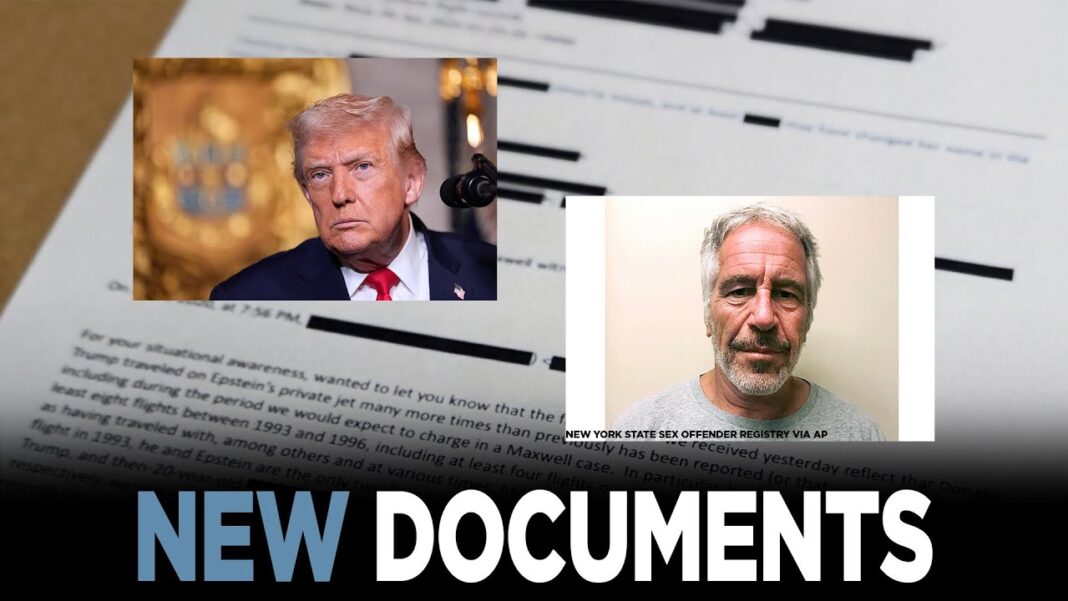
Among the most striking revelations in the second batch is a 2020 email apparently sent by a federal prosecutor in the Southern District of New York. As reported by The Hill, the email warned an unnamed recipient that flight records indicated Trump had traveled on Epstein’s private jet “many more times than previously has been reported (or that we were aware).” The assistant U.S. attorney who authored the message remains unnamed due to redactions, but the content of the email has drawn intense scrutiny.
According to The Hill, the same email references one flight on which Trump and Epstein were the only listed passengers, and another in which the only passengers were the two men and a “then-20-year-old,” whose identity has been redacted. Trump’s defenders stress that the existence of such flights is not, in itself, evidence of criminal behavior. Indeed, much more has become publicly known about Epstein’s flight logs since 2020, and mere presence on a plane does not establish knowledge of or participation in abuse.
Nonetheless, the reference to an anonymized 20-year-old passenger, combined with the suggestion that the flights were more frequent than Trump had previously acknowledged, raises questions that are difficult to dismiss entirely. They are questions of proximity, of judgment, and of candor—questions that, while not dispositive of guilt, feed a public hunger for fuller transparency.
The new disclosures do not stop there. Another document cited by The Hill describes a subpoena sent to Trump’s Mar-a-Lago residence in 2021 in connection with the prosecution of Ghislaine Maxwell, Epstein’s longtime associate. Maxwell was ultimately convicted on sex trafficking charges and sentenced to 20 years in prison. The subpoena itself offers little detail about what was sought, but its existence underscores the extent to which investigators cast a wide net in pursuit of evidence.
In yet another eyebrow-raising detail, investigators in a separate matter reportedly discovered a photograph of Trump and Maxwell on a phone belonging to Steve Bannon in 2021. As with many elements of the Epstein files, the photograph’s context—when it was taken, under what circumstances, and what it signifies—remains unclear. Yet in an environment already saturated with suspicion, even ambiguous artifacts acquire outsized significance.
The Justice Department, for its part, has moved swiftly to contain the fallout. In a post on the social platform X, the DOJ asserted that “some of these documents contain untrue and sensationalist claims made against President Trump,” suggesting that false accusations had been advanced in an effort to influence the 2020 presidential election. “To be clear,” the department wrote, “the claims are unfounded and false, and if they had a shred of credibility, they would have been weaponized against President Trump already.”
The controversy deepened further when the DOJ declared that a letter purportedly written by Epstein to convicted pedophile Larry Nassar was a fabrication. The letter, which suggested that Trump “shares our love for young, nubile girls,” ignited an immediate firestorm online. But the department outlined several reasons for concluding the letter was fake: the handwriting did not match Epstein’s; it was postmarked in northern Virginia three days after Epstein’s death in New York; and the return address neither listed Epstein’s jail nor included his inmate number, which the DOJ stated is required for outgoing mail.
As of early Friday evening, Trump had not addressed the latest disclosures directly, with the DOJ’s statements serving as the primary official response. On Monday, however, Trump offered a somewhat unexpected comment in response to photographs of former President Bill Clinton that had surfaced in the initial batch of Epstein-related materials. “I don’t like the photos of Bill Clinton being shown,” Trump said, according to The Hill, adding that individuals who had merely been socially acquainted with Epstein were seeing their reputations tarnished. “You probably have pictures being exposed of other people that innocently met Jeffrey Epstein years ago,” he remarked.
Trump also suggested that renewed media focus on Epstein was intended to “deflect from the tremendous success” of the Republican Party—an assertion that reflects a broader political interpretation of the timing of the releases. Indeed, skeptics across the ideological spectrum have questioned why the DOJ chose the holiday season, when public attention traditionally wanes, to release such a voluminous and provocative set of documents.
The disclosures have also revived bipartisan frustration over the apparent absence of charges against others implicated, however tangentially, in Epstein’s world. On Tuesday, Senate Minority Leader Chuck Schumer publicly questioned why documents referenced 10 alleged co-conspirators without identifying or charging them. His comments echo a sentiment long expressed by victims’ advocates: that Epstein’s prosecution, cut short by his death, left too many questions unanswered and too many potential avenues unexplored.
What emerges from this latest chapter is not a verdict, but a portrait of systemic failure. The Epstein scandal has always been less about a single predator—however monstrous—and more about the ecosystems that enabled him: the wealth that insulated him, the institutions that deferred to him, and the social networks that normalized his presence. Intake documents, flight logs, emails, subpoenas, and photographs all form part of a vast mosaic that remains incomplete.
The resurfaced FBI intake report, with its harrowing secondhand allegations and unresolved questions surrounding a woman’s death, is a reminder of how many warnings were logged, how many voices came forward, and how often those warnings failed to produce decisive action. The newer disclosures, meanwhile, underscore how proximity to Epstein continues to haunt powerful figures, even absent formal accusations.
There are more documents to come. The DOJ has indicated that the Epstein archive has not yet been fully released. Each new batch carries the potential to illuminate, to confuse, or to inflame. For Trump, as for others whose names appear in these files, the coming weeks and months may bring further uncomfortable moments—less because of proven wrongdoing than because the Epstein scandal has become a symbol of institutional inadequacy.
In the end, the enduring power of these documents lies not in what they conclusively prove, but in what they reveal about a system that recorded allegations meticulously yet delivered resolution sparingly. They remind the public that justice delayed can become justice denied—and that transparency, however painful, remains essential if trust is ever to be restored.