



|
Getting your Trinity Audio player ready...
|
By: Arthur Popowitz
In recent days, Vice President JD Vance has stepped squarely into one of the most volatile moral and political debates confronting the United States: the alarming rise of antisemitism and the responsibility of national leaders to confront it with clarity rather than caveat. Yet, as reported on Monday at World Israel News, Vance’s remarks—delivered across a high-profile interview and a major conservative conference—have ignited fierce criticism for what many Jewish leaders, scholars, and security experts view as a troubling minimization of a genuine and escalating threat.
At a moment when antisemitic incidents in the United States have reached historic highs, the vice president’s insistence that only a “tiny percentage” of Americans harbor genuine anti-Jewish animus has struck critics as not merely misguided, but dangerously out of step with reality. According to the report at World Israel News, Vance’s comments risk reframing antisemitism not as a societal pathology requiring urgent confrontation, but as a misunderstood byproduct of foreign policy disagreement—an argument that many warn obscures the nature of contemporary Jew-hatred and emboldens its perpetrators.
Vance’s most explicit remarks came during an interview with the British media outlet UnHerd, published earlier this week and widely dissected by World Israel News. In that interview, the vice president argued that what is often described as antisemitism is, in his view, largely a “real backlash” against longstanding American support for Israel. While affirming that Israel is an important U.S. ally, Vance suggested that critics of American Middle East policy have been unfairly labeled antisemitic in an effort to shut down debate.
On its face, the argument may appear measured. But critics contend that it collapses under scrutiny. As World Israel News has repeatedly documented, antisemitism today is not confined to policy critique; it manifests in synagogue vandalism, violent assaults on visibly Jewish Americans, online conspiracy theories invoking “Jewish control,” and the rehabilitation of Holocaust denial under the guise of heterodox commentary. To conflate this phenomenon with legitimate foreign policy dissent, critics argue, is to fundamentally misunderstand—or willfully mischaracterize—the problem.
The vice president’s intervention came amid a widening rift within the American right, particularly within the populist and MAGA-aligned ecosystem, over the influence of far-right commentators such as Tucker Carlson and Candace Owens. Both figures have been accused by Jewish advocacy groups of amplifying narratives that, intentionally or not, echo classical antisemitic tropes. World Israel News has closely followed this intra-conservative struggle, describing it as a battle over whether antisemitism will be confronted or rationalized within right-wing discourse.
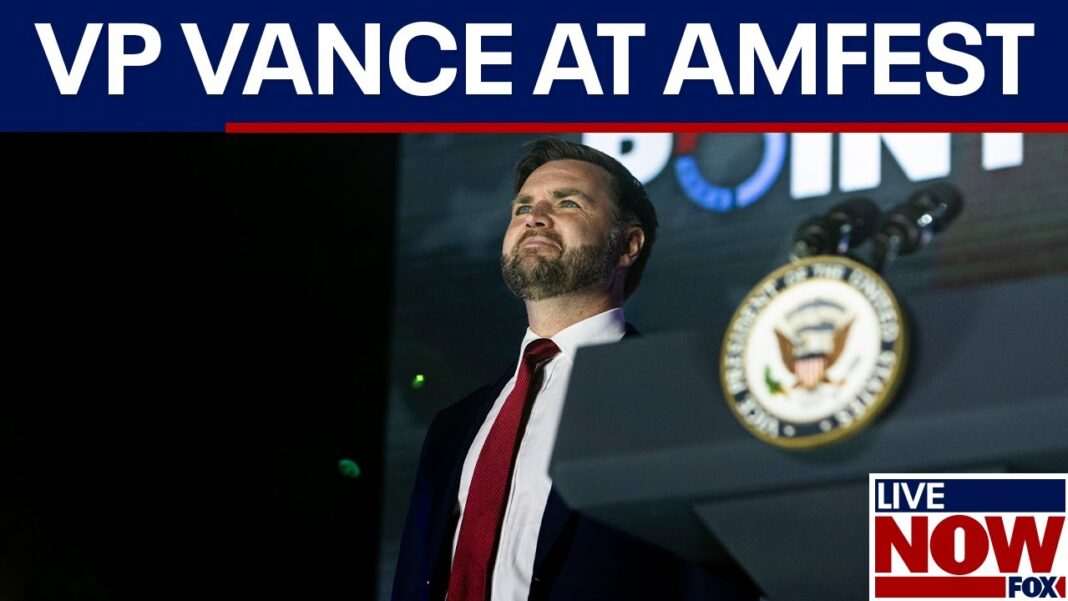
Speaking at Turning Point USA’s annual conference this week, Vance adopted a conciliatory tone, urging conservatives to reject what he called “self-defeating purity tests” and warning against internal “canceling.” While he avoided naming specific figures, his appeal for unity came just days after speeches at the same event by Ben Shapiro, Tucker Carlson, and Steve Bannon—each representing starkly different visions for the movement’s moral boundaries.
According to the information provided in the World Israel News report, this call for unity has been met with skepticism by Jewish observers who argue that moral clarity, not unity at all costs, is required when confronting bigotry. “Unity,” critics note, becomes a hollow virtue if it demands silence in the face of hatred or excuses those who normalize it.
In his UnHerd interview, Vance went further, explicitly defending Carlson from criticism leveled by Shapiro and others who argue that Carlson has abandoned conservative principles by flirting with antisemitic narratives. Vance dismissed such accusations as “gatekeeping,” suggesting they were driven by ideological score-settling rather than genuine concern.
This defense has proven especially controversial. As World Israel News has reported, Carlson has hosted or praised figures accused of Holocaust revisionism and has repeatedly framed global politics through the lens of shadowy elites—language that Jewish watchdog groups argue closely mirrors antisemitic conspiracy theories. By portraying criticism of Carlson as exaggerated or disingenuous, Vance, critics say, lends cover to a pattern of rhetoric that has real-world consequences.
To his credit, Vance did explicitly condemn white supremacist Nick Fuentes, who has praised Adolf Hitler and trafficked in overtly antisemitic invective. The vice president’s blunt dismissal of Fuentes—particularly in response to personal attacks against Vance’s wife—was unequivocal. World Israel News noted that this condemnation was among the strongest Vance has ever issued against the far-right agitator.
Yet even here, critics see a troubling inconsistency. While Fuentes represents the most explicit and crude expression of antisemitism, Jewish leaders warn that the greater danger lies not only with fringe extremists, but with those who sanitize or intellectualize antisemitic ideas for mainstream audiences. By focusing condemnation on figures like Fuentes while downplaying the broader ecosystem that enables antisemitism to flourish, Vance, critics argue, misses the forest for the trees.
Perhaps the most contentious aspect of Vance’s remarks was his statistical framing of antisemitism. Claiming that “99% of Republicans” and “97% of Democrats” do not hate Jews, the vice president argued that antisemitism is being overstated to avoid confronting legitimate debates over U.S. foreign policy. Antisemitism has never required majority participation to be deadly. Historically, a small but vocal minority—tolerated, ignored, or excused by the mainstream—has often been sufficient to unleash catastrophic harm.
Moreover, experts point out that antisemitism does not always announce itself as explicit hatred of Jews “for being Jewish.” It often disguises itself as obsessive fixation on Jewish power, selective outrage toward the world’s only Jewish state, or insinuations of dual loyalty. By defining antisemitism so narrowly, critics argue, Vance effectively excludes many of its most common modern expressions.
The timing of Vance’s comments has only intensified the backlash. Jewish institutions across the United States remain under heightened security amid threats, protests, and vandalism linked to the war in the Middle East. University campuses have become flashpoints of anti-Jewish harassment, and Jewish students report feeling unsafe expressing their identity. In this context, the vice president’s suggestion that antisemitism is largely a misdiagnosed policy disagreement has been received as profoundly tone-deaf.
Jewish leaders interviewed by World Israel News warn that such rhetoric risks delegitimizing Jewish concerns and discouraging victims from speaking out. If antisemitism is rebranded as mere “backlash,” they ask, what incentive remains for law enforcement, educators, or policymakers to treat it as an urgent threat?
There is also a geopolitical dimension to the controversy. By framing hostility toward Israel as a reasonable reaction to American policy, critics argue, Vance inadvertently validates the logic of those who hold Jews collectively responsible for the actions of a sovereign state. This, they note, is precisely the mechanism by which anti-Zionism so often bleeds into antisemitism.
When criticism is accompanied by demonization, double standards, or denial of Jewish self-determination, it crosses a line. Vance’s remarks, critics say, blur that line at a time when clarity is desperately needed.
As vice president, JD Vance occupies one of the most influential platforms in American public life. His words shape not only policy debates but cultural norms. In minimizing antisemitism, even inadvertently, he risks signaling to millions of Americans that Jewish fears are exaggerated, that rising hostility is overblown, and that those sounding the alarm are motivated by ulterior agendas.
In an era marked by the return of old hatreds in new guises, such signals carry profound consequences. As the World Israel News report observed, antisemitism thrives not only on hatred, but on denial. When leaders choose minimization over moral clarity, they do more than misdiagnose a problem—they help perpetuate it.
The question now confronting the American right, and the nation as a whole, is whether it will heed those warnings or continue to rationalize away a danger that history has shown never disappears on its own.
Closer to the truth is that Vance accepts and promotes the blatant anti Semitism of Tucker Carlson by protecting him. This is frightening, indeed. He converted to Catholicism and had the chutzpah to publicly express his desire that his Hindu wife convert. This is shameless arrogance and frankly, low-class stupidity. I think his roots are showing.