



|
Getting your Trinity Audio player ready...
|
By: Fern Sidman
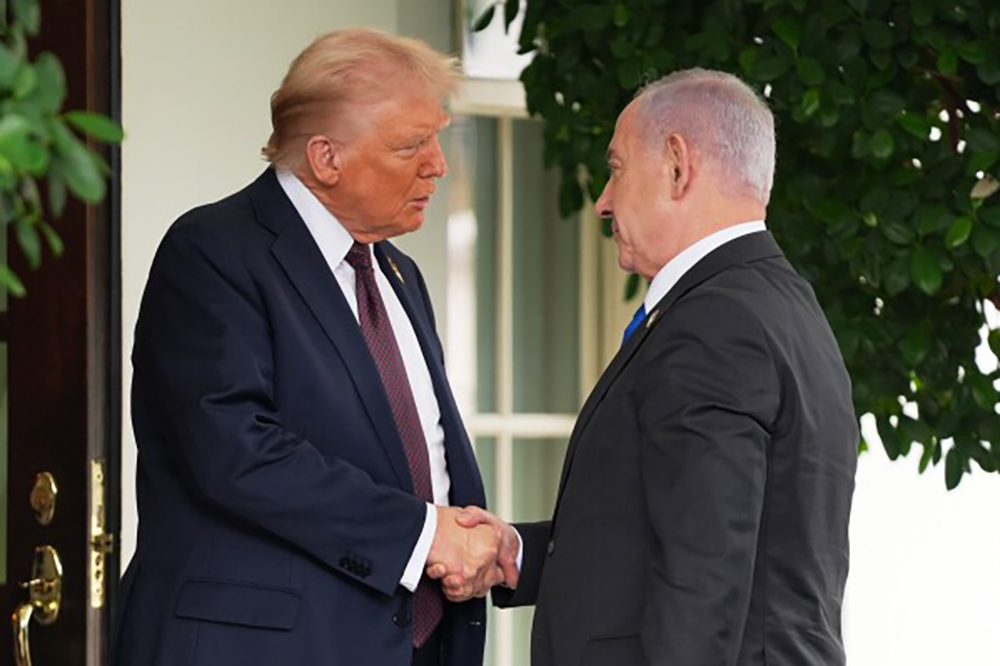
Israeli Prime Minister Benjamin Netanyahu’s long-anticipated meeting with President Donald Trump on Monday afternoon at the White House has become the focal point of an intensifying debate within Israel about the parameters of ending the war in Gaza. While both leaders presented a united front, pledging that the return of the remaining hostages and the defeat of Hamas remain paramount, sharp disagreements within Israel’s political and security establishment continue to simmer.
As reported by Israel National News, the prelude to the Netanyahu–Trump summit was marked by urgent consultations between the Prime Minister and key figures of Israel’s right-wing coalition. Among the most outspoken was National Security Minister Itamar Ben Gvir, who demanded that Netanyahu stand firm against what he described as “superficial solutions” and insist on nothing short of the total collapse of Hamas.
Ben Gvir’s message to Netanyahu was unequivocal. “Not just a superficial action, like what happened in southern Lebanon, where Hezbollah continued to control the area,” he declared, according to the report at Israel National News. “We need the collapse and dismantling of Hamas from the ground up, with no partial control or oversight left in the Gaza Strip.”
The invocation of Lebanon is no accident. The Israeli withdrawal from southern Lebanon in 2000 left Hezbollah entrenched, eventually transforming the Iranian-backed militia into one of Israel’s most formidable adversaries. For Ben Gvir and his supporters, the prospect of leaving Hamas partially intact in Gaza is an intolerable echo of past strategic miscalculations.
Finance Minister Bezalel Smotrich echoed Ben Gvir’s hardline stance, outlining what he termed Israel’s “non-negotiable red lines” ahead of Netanyahu’s White House meeting. As Israel National News reported, Smotrich demanded: The complete dismantling of Hamas’s terror infrastructure, both above and below ground. A permanent Israeli military presence within the Gaza perimeter, including control over the critical Philadelphi Corridor along the Egypt–Gaza border. Total operational freedom for the IDF across Gaza to prevent weapons smuggling and ensure security for Israel’s southern communities. No role whatsoever for the Palestinian Authority (PA) in Gaza, either now or in the future. Exclusion of Qatar from any arrangements regarding Gaza’s governance or reconstruction.
“There will be no mention, even indirectly, of a Palestinian state that could endanger Israel’s existence,” Smotrich warned, underscoring his rejection of international pressure for renewed talks on Palestinian sovereignty.
Adding to the drama, Axios reported Monday morning that one of Trump’s advisors claimed, “Hamas has agreed to the deal 100%. Now we’re waiting for the President to work his magic on Netanyahu.” The statement, widely circulated in Israeli media, fueled speculation that Trump might lean heavily on the Israeli Prime Minister to accept terms that prioritize the hostages’ release but fall short of the maximalist objectives outlined by Ben Gvir and Smotrich.
Trump has positioned himself as the indispensable broker, unveiling his “Principles for Peace” and insisting that Arab and Muslim nations had already signaled their support. Still, as the Israel National News report noted, skepticism remains widespread among Israelis who fear that international enthusiasm for a ceasefire could translate into strategic concessions that leave Hamas weakened but not eradicated.
While cabinet ministers sparred over the scope of Israel’s military objectives, the families of the 48 remaining hostages greeted the Trump–Netanyahu declarations with cautious optimism. The Tikva Forum, representing hostage families, issued a statement on Monday evening welcoming the agreement in principle.
“These declarations align with our principles and commitment: the return of all hostages in a single phase, with the living reunited with their families and the deceased brought back to Israel for burial,” the statement read. The group emphasized that defeating Hamas is not only a military necessity but also the only way to prevent future kidnappings.
At the same time, the families insisted on vigilance. “Should Hamas breach its obligations, we demand that the United States and the Prime Minister uphold their promise from this evening to continue military operations until the mission is complete and Hamas’s capabilities are fully dismantled,” they declared, according to the Israel National News report.
Another major advocacy group, the Hostages and Missing Families Forum Headquarters, struck a more celebratory note. “After almost two years of unimaginable anguish, we stand at a historic turning point,” the group proclaimed. “We are profoundly grateful to President Trump for his unwavering commitment to our families and the state of Israel, and for achieving what we have been desperately seeking since October 7 — a deal to bring all our loved ones home.”
Calling Trump’s efforts “historic,” the group praised his determination and the personal guarantee he had placed on the agreement. Yet they, too, issued a note of caution, reminding the Israeli government that “in the past, the releases were cut short by phased deals that never reached completion.”
“All 48 hostages must return — the living for rehabilitation, the deceased for burial in their homeland. Only then can we begin to heal as a nation,” the statement concluded.
For Netanyahu, the challenge lies in balancing his deep political alliance with Trump, whom he has lauded as “the greatest friend Israel has ever had in the White House,” with the demands of his domestic partners. As the Israel National News report highlighted, Netanyahu has sought to portray Trump’s plan as “realistic,” particularly in its exclusion of the Palestinian Authority as a governing force in Gaza.
“I appreciate your firm position that the PA could have no role whatsoever in Gaza without undergoing a radical and genuine transformation,” Netanyahu told Trump, according to the report at Israel National News. The Prime Minister noted that the vast majority of Israelis do not believe the PA is capable of reform, but praised Trump’s framework as providing “a practical and realistic path forward for Gaza in the coming years.”
Yet Netanyahu also sought to reassure his right-wing allies that Israel would “finish the job by itself” if Hamas rejected or undermined the deal. “We did not fight this horrible war so that Hamas could stay in power in Gaza and threaten us again and again with these horrific massacres,” he said.
The stakes are enormous. For Israel, agreeing to Trump’s framework could mean securing the return of hostages and forging deeper regional alliances at the cost of leaving Hamas partially intact — a scenario many in the Israeli right reject as dangerously short-sighted. For Trump, the deal represents an opportunity to burnish his credentials as a peacemaker while cementing his standing as Israel’s most steadfast ally.
As the Israel National News report emphasized, the debate within Israel reflects deeper questions about the country’s long-term security doctrine. Should Israel prioritize the immediate humanitarian imperative of recovering hostages, even if it means halting military operations before Hamas is fully dismantled? Or must it press on until Hamas’s total defeat is secured, regardless of international pressure and potential costs in lives?
The White House meeting between Netanyahu and Trump may well be remembered as a defining moment in Israel’s two-year war against Hamas. With hostage families cautiously hopeful, coalition ministers drawing hard red lines, and Trump applying maximum pressure for a deal, the path forward remains fraught with uncertainty.
As the Israel National News report observed, the decisions made in Washington on Monday will not only determine the fate of the hostages but also shape the strategic landscape of the Middle East for years to come. Whether Israel emerges with Hamas decisively defeated or merely weakened, and whether Trump’s “Principles for Peace” can deliver on their lofty promises, remains to be seen.
For now, one thing is clear: Israel stands at a crossroads, balancing the imperatives of justice, security, and survival against the shifting currents of international diplomacy.

Tony Blair is Deep State garbage. Who recommended him Whitkoff?