



|
Getting your Trinity Audio player ready...
|
By: Fern Sidman
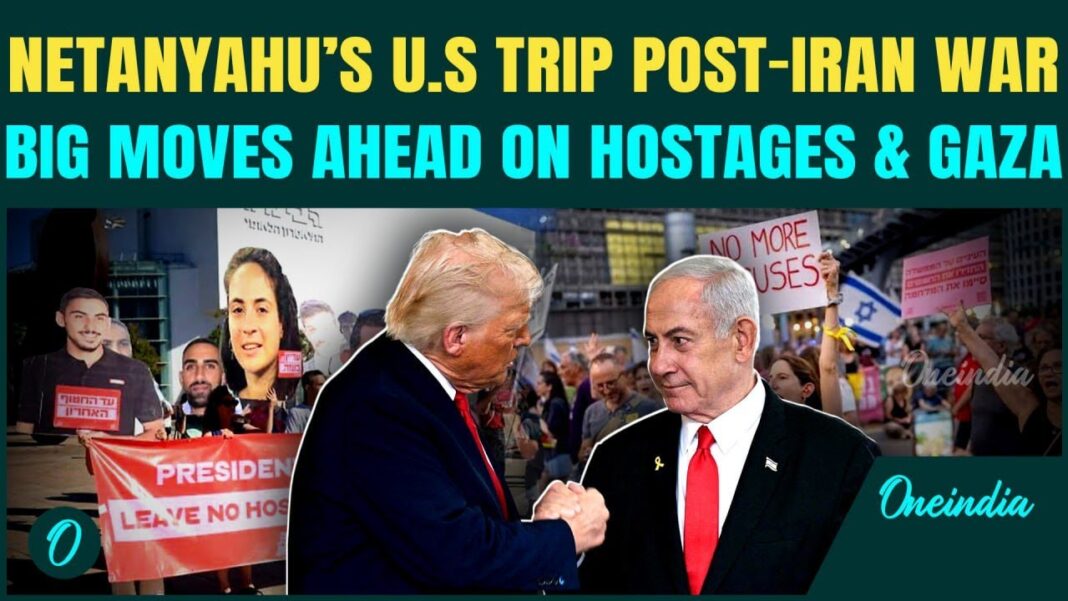
As Israeli Prime Minister Benjamin Netanyahu prepares for his upcoming trip to Washington, diplomatic observers and defense analysts are closely watching what could become one of the most consequential meetings of the year between two of the most dominant figures in Middle East policy—Netanyahu and President Donald Trump. Central to the Israeli leader’s agenda, according to a report that appeared at World Israel News on Wednesday, is a demand for American assurances that Israel will have the freedom to launch further military operations against Iranian nuclear and ballistic missile infrastructure if the Islamic Republic attempts to rebuild its capabilities.
While the meeting will certainly address the ongoing efforts to negotiate a ceasefire with Hamas in Gaza—along with the fate of the remaining Israeli hostages—sources cited by World Israel News say Netanyahu is determined to secure a more strategic commitment from the United States: namely, the ability to preemptively neutralize future threats from Tehran without risking diplomatic fallout from Washington.
The Israeli request for a U.S. green light comes on the heels of Operation Rising Lion, a highly coordinated 12-day air campaign launched by Israel last month. As reported by World Israel News, this operation struck deep into the heart of Iran’s military infrastructure, targeting uranium enrichment facilities, mobile ballistic missile launchers, missile factories, and key command-and-control centers used by the Islamic Revolutionary Guard Corps.
Though the operation dealt a significant blow to Tehran’s capabilities, Israeli officials are openly expressing concern that Iran may already be working to reconstitute its programs—necessitating what Defense Minister Israel Katz has described as “follow-up strikes.”
In a tweet last Friday, Katz underscored the urgency of the threat: “I have instructed the IDF to prepare an enforcement plan against Iran that includes: maintaining Israel’s air superiority, preventing nuclear development and missile production, and delivering responses against Iran for supporting terrorist activity against the State of Israel.”
Katz’s statement signals a shift in Israeli doctrine from one of reactive deterrence to ongoing proactive enforcement—a strategy that could only function effectively with the understanding, if not outright support, of the United States.
The stakes in Netanyahu’s meeting with Trump are thus twofold. First, the Israeli premier is expected to brief the president on efforts to secure a temporary ceasefire in Gaza, including a possible 60-day truce that Trump recently claimed Israel has agreed to “in principle.” As World Israel News has reported, this pause in hostilities is seen as essential to facilitating negotiations over the remaining Israeli captives held by Hamas and allowing for a potential political solution to the months-long war.
But beyond Gaza, Netanyahu’s deeper strategic aim is to realign U.S.-Israel coordination on the Iranian front, particularly as global attention shifts toward post-conflict reconstruction and away from the broader regional chessboard. According to Israel’s national broadcaster Kan Reshet Bet, Netanyahu’s top priority during the Washington trip will be to extract a firm American commitment that Israel will not be constrained if it finds it necessary to act again militarily against Iran’s nuclear or ballistic programs.
The World Israel News report confirmed that this is not merely rhetorical posturing. The IDF has reportedly already updated its strike blueprints, including real-time satellite intelligence, enhanced targeting algorithms, and a reinforced aerial corridor through which future missions could be launched. These preparations are said to reflect both a military assessment of Iran’s continued threat and a political calculus that views Israeli unilateral action as inevitable should the international community fail to contain Tehran diplomatically.
Netanyahu’s proposed request marks an intensification of Israel’s longstanding policy of maintaining what it calls “qualitative military edge” and strategic autonomy. As the report at World Israel News has pointed out, Israeli defense planners have long regarded Iran’s nuclear ambitions as an existential threat—one that justifies unilateral preemption when necessary.
Operation Rising Lion was a significant manifestation of this doctrine. According to Israeli defense sources cited by World Israel News, the operation not only inflicted heavy material damage on Iran’s nuclear and missile programs but also tested the IDF’s ability to strike multiple high-value targets across vast geographic distances under strict operational secrecy.
Now, Israeli leadership fears that any gains could be short-lived if Tehran succeeds in rebuilding—particularly under the radar. The recent reassignment of elite intelligence and air force units toward continuous surveillance of Iranian territory underscores this concern.
“We will act regularly to thwart threats of this kind,” Katz declared, indicating that future strikes may become a normalized component of Israeli defense posture rather than exceptional responses.
While Netanyahu has long emphasized Israel’s right to self-defense, he is acutely aware of the diplomatic consequences that often accompany cross-border strikes, especially those involving a rival state like Iran. Hence his intention to secure Trump’s formal or informal endorsement for continued operations.
For Trump, who has repeatedly signaled solidarity with Netanyahu and castigated Iran as a “global menace,” the request is likely to be received favorably. During his first term, Trump withdrew the U.S. from the 2015 Iran nuclear deal (JCPOA), ramped up sanctions, and oversaw the targeted killing of Quds Force commander Qassem Soleimani.
Now, as reported by World Israel News, Trump has returned to the global stage with renewed confidence and is already calling the shots on ceasefire proposals and broader Middle East strategy. His public support for Netanyahu amid the latter’s ongoing corruption trial, which Trump has dismissed as a “witch hunt,” further emphasizes the closeness of their alliance.
The upcoming meeting between Netanyahu and Trump could mark a turning point in U.S.-Israel strategic relations, particularly in how both countries approach the Iranian nuclear threat moving forward.
According to the information provided in the World Israel News report, Israeli officials believe that a strong U.S.-Israel axis on Iran—publicly affirmed and operationally aligned—would deter Tehran from trying to reconstitute its nuclear infrastructure, thereby reducing the likelihood of escalation.
But should Tehran persist, Netanyahu appears determined to ensure that Israel can act decisively—and with American backing if not outright partnership.
In the words of one senior Israeli official quoted by World Israel News, “Iran needs to understand that the clock is not theirs. The clock is ours. And it is ticking.”
As Netanyahu lands in Washington for what may be one of the most critical meetings of his premiership, both allies and adversaries will be watching closely—not just for what is said, but for what is promised behind closed doors.

Trump cannot be permitted to damage Israel’s self-defense for his narrow political aims. Nothing will deter Iran from rushing as quickly as it can to reconstitute its nuclear weapons program. Israel needs to win the war and destroy Iran’s nuclear capacity.
This news is not being widely disseminated, and I suspect is being censored by the mainstream anti-Israel media. TJV, keep up the good work of sounding the alarm.
(This reminds me of Vietnam, where rather than fight, America declared victory and left. The little Jewish media which continues to exist and has not deluded itself into thinking they are not existentially threatened will soon find themselves in the position of American Jews in the 1930’s.
I wonder if American Jews are not starting to sympathize at all, since their future in America is being threatened. Too many of them appear committed to their own eventual destruction.)