



|
Getting your Trinity Audio player ready...
|
Netanyahu and Vance Meet in Jerusalem to Deepen U.S.–Israel Partnership and Advance Trump Peace Plan
By: Fern Sidman
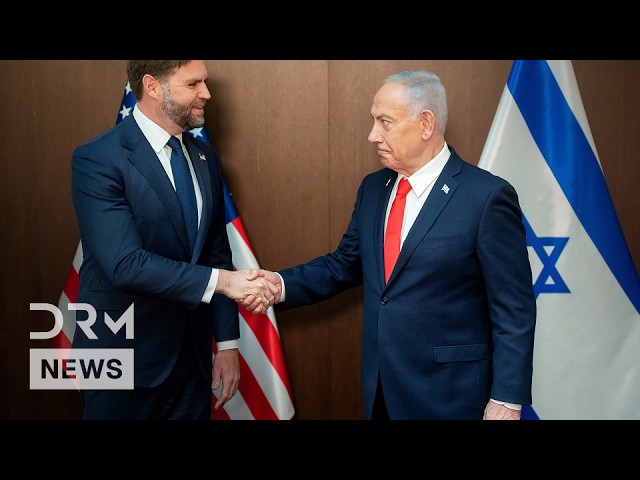
In what both sides described as a reaffirmation of the “unmatched alliance” between Jerusalem and Washington, Israeli Prime Minister Benjamin Netanyahu met on Wednesday morning with Vice President JD Vance at his Jerusalem office — the second day of Vance’s official visit to Israel. The high-level meeting, reported by The Jewish News Syndicate (JNS) on Wednesday, comes amid renewed diplomatic and security coordination following U.S. President Donald Trump’s recent visit to Israel, and at a time of fragile calm in the Gaza Strip following repeated Hamas ceasefire violations.
Vance, accompanied by his wife, Second Lady Usha Vance, was greeted by Netanyahu and Sara Netanyahu at the Prime Minister’s Office, where the two couples exchanged warm greetings before engaging in extended bilateral talks centered on regional security, reconstruction efforts in Gaza, and the ongoing implementation of the Trump administration’s peace framework.
In his public remarks alongside the vice president, Netanyahu hailed what he called an “unmatched alliance and partnership” between Israel and the United States under the Trump administration — one that he said has reshaped the strategic balance of the Middle East and “will be remembered for generations.”
“A few days ago, we had our historic visit by President Trump that will be etched in the annals of our nation’s history,” Netanyahu said, as quoted in the JNS report. “We’re fortunate today to have a visit by Vice President JD Vance. In the last year, we’ve had an unmatched alliance and partnership with the United States that is changing the Middle East, and it’s also changing the world. It creates opportunities not only for security but for the expansion of peace, which we’re working on very diligently.”
The prime minister, who has worked closely with successive U.S. administrations over three decades, emphasized that the current collaboration under Trump and Vance stands apart in scope and sincerity. “I’ve been through several administrations,” Netanyahu told reporters, according to the JNS report. “I welcome the partnership and assistance we’ve had before, but there’s never been anything like this. The level of understanding, trust, and shared vision we have today is truly unique.”
Vance, for his part, thanked Netanyahu for what he called Israel’s “unwavering friendship” and the “extraordinary hospitality” extended to him and his wife. He described the bilateral relationship as one grounded in shared values and in the commitment to preserve stability across the Middle East.
“We have a very, very tough task ahead of us,” Vance said during the meeting, as reported by JNS, “which is to disarm Hamas, rebuild Gaza to make life better for the people in Gaza, and ensure that Hamas is no longer a threat to our friends in Israel.”
The vice president underscored that Washington’s goal is not only to secure Israel’s safety but to pave the way for a sustainable peace. “We have an opportunity to do something really historic,” he said, “working closely not only with our Israeli friends but with partners across the Arab world who want to see a positive and peaceful outcome in Gaza.”
Vance reiterated that while the United States supports humanitarian recovery and reconstruction in Gaza, such efforts cannot move forward until Hamas is fully disarmed. He praised Israel’s restraint in maintaining the ceasefire despite ongoing provocations, saying, “The people of Israel have endured much, but their resolve remains extraordinary.”
The timing of Vance’s visit — coming just days after renewed Hamas rocket fire into southern Israel — has drawn considerable attention in diplomatic circles. As JNS reported, the vice president landed at Ben-Gurion International Airport in Tel Aviv on Tuesday afternoon, against the backdrop of escalating tensions and amid U.S. efforts to preserve the Trump-brokered ceasefire agreement in the Gaza Strip.
Vance was greeted at the airport by Israeli Justice Minister Yariv Levin, who serves concurrently as Deputy Prime Minister. From there, the vice president traveled south to Kiryat Gat, where he addressed reporters at a press conference alongside Israeli officials, expressing optimism that the ceasefire could still hold.
“I’m very optimistic that this deal will hold,” Vance told journalists, according to the report at JNS. “Maintaining it will require constant effort, coordination, and trust — but those are things that our alliance with Israel is built on.”
The vice president stressed that his trip was not a last-minute reaction to the latest violence but had been scheduled months in advance. “This trip has been planned for quite some time,” he said. “I wanted to check in on things personally, to see how the situation on the ground is evolving, and to make sure our teams are working hand-in-hand.”
Still, Vance acknowledged that the ceasefire’s longevity was not guaranteed. “Can I say with 100% certainty that it’s going to work? No,” he said candidly. “But you don’t do difficult things by only doing what’s 100% certain. We owe it to our allies and to the people of the region to keep trying.”
Following his arrival, Vance convened a working lunch with U.S. Middle East envoy Steve Witkoff and Trump’s senior adviser and son-in-law Jared Kushner, both of whom had arrived in Israel earlier in the week to coordinate diplomatic efforts to stabilize Gaza and prevent further hostilities.
As the JNS report noted, Witkoff and Kushner have been central to the Trump administration’s regional peace framework, working closely with Israeli and Arab leaders on post-conflict reconstruction mechanisms and on ensuring that humanitarian aid does not fall into the hands of Hamas or other terrorist factions.
A senior Israeli official told JNS that the presence of all three figures — Vance, Witkoff, and Kushner — in Israel underscored “the seriousness with which the Trump administration is approaching the Gaza file” and reflected a high degree of synchronization between Washington and Jerusalem.
“The United States understands that any lasting peace must begin with the complete demilitarization of Hamas,” the official said. “Vice President Vance made that absolutely clear.”
The visit also serves as a continuation of President Trump’s broader Middle East realignment strategy, which seeks to consolidate Israeli security gains while fostering regional cooperation among Arab states that share U.S. and Israeli concerns over Iran and Islamist extremism.
According to the information provided in the JNS report, Vance’s trip to Israel is part of a wider regional tour that includes meetings with Egyptian, Emirati, and Saudi leaders — all of whom play crucial roles in the multinational peace plan for Gaza. The plan, outlined earlier this month by the White House, calls for a multinational stabilization task force to oversee Gaza’s reconstruction while ensuring that Hamas’s political and military infrastructure is dismantled.
During their meeting, Netanyahu thanked Vance for his personal commitment to these efforts. “You are carrying forward President Trump’s vision of peace through strength,” Netanyahu said. “This vision has brought our nations closer than ever and has opened new possibilities across the region.”
Vance, in turn, praised Netanyahu’s leadership during what he described as “one of the most challenging and consequential periods in Israel’s history.” “The strength and determination of the Israeli people have inspired the world,” he said, as quoted in the JNS report.
Beyond the political and diplomatic dimensions, the talks also touched on humanitarian coordination and the return of the remains of deceased hostages still held in Gaza. Vance acknowledged that progress on this front would be slow and painstaking but emphasized the moral imperative of the effort.
“There are still families waiting for closure,” Vance said, according to the JNS report. “We owe it to them to bring their loved ones home, no matter how long it takes or how difficult the process.”
Netanyahu agreed, adding that Israel’s commitment to recovering every captive and every fallen soldier remains “unwavering.” He also stressed that humanitarian operations must not come at the expense of security. “We will continue to facilitate humanitarian aid to civilians in Gaza,” Netanyahu said, “but we will never allow Hamas to exploit that aid for terror.”
Observers have noted the personal rapport between Netanyahu and Vance, which the JNS report described as both “warm and businesslike.” Netanyahu has praised Vance in the past as “a man of principle who understands the moral clarity of Israel’s fight against terror.”
During Wednesday’s meeting, both leaders spoke of the shared moral foundations of the U.S.–Israel alliance. “This relationship is not just strategic — it’s deeply rooted in shared values, faith, and history,” Netanyahu said. “Our nations believe in freedom, in democracy, and in the eternal connection between the Jewish people and their land.”
For his part, Vance said he was “deeply moved” by his visit to Jerusalem, calling it “a reminder that America’s bond with Israel is sacred and enduring.”
As Vance concludes his visit, officials on both sides expressed cautious optimism that the partnership between the U.S. and Israel will continue to shape the region’s postwar landscape. JNS reported that the White House is expected to unveil the next phase of its Gaza peace implementation plan later this month, with both Israeli and U.S. officials pledging close coordination in its rollout.
Netanyahu concluded the meeting by reaffirming Israel’s gratitude to the Trump administration and its representatives. “Our alliance with the United States has never been stronger,” he said. “Together, we are building not only a safer Israel but a more stable Middle East.”
Vice President Vance echoed the sentiment, calling his trip “an opportunity to witness firsthand the resilience of the Israeli people and the unbreakable bond between our two nations.”
As reported by JNS, the meeting ended on an optimistic note — a reflection of the enduring strategic partnership that continues to define U.S.–Israel relations amid one of the most volatile and consequential chapters in the region’s history.