



|
Getting your Trinity Audio player ready...
|
Michigan Church Massacre: Marine Veteran Identified as Gunman in Deadly Attack on Latter-day Saints Congregation
By: Andrew Carlson
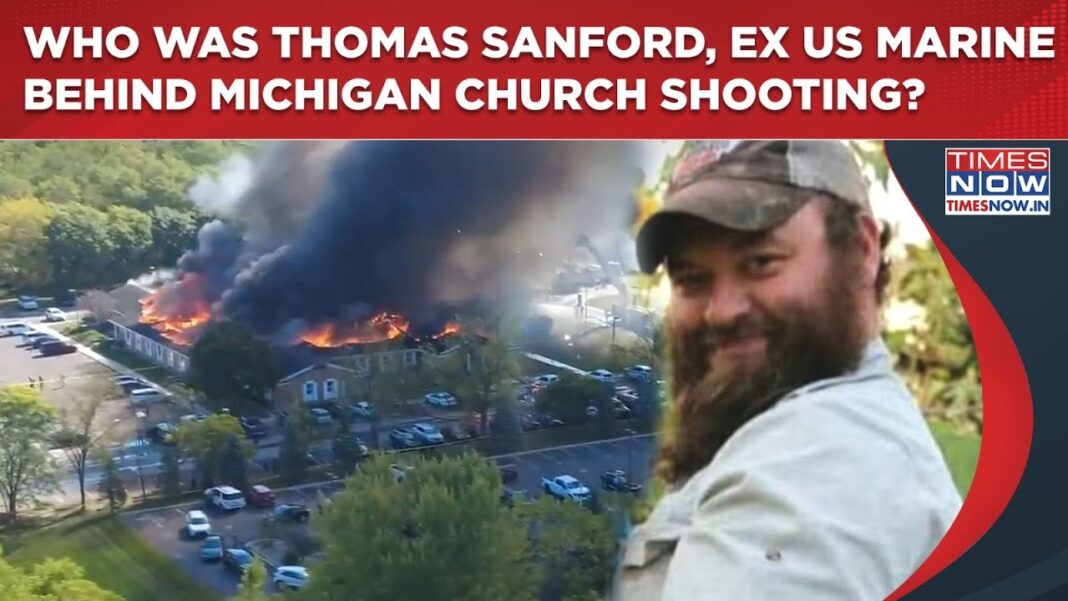
Grand Blanc Township, Michigan – In the aftermath of one of the most shocking acts of violence in Michigan’s recent history, authorities have identified the assailant responsible for Sunday’s devastating attack on a Latter-day Saints church in Grand Blanc Township as 40-year-old Thomas Jacob Sanford, a Marine veteran who once served in Iraq. The assault, which combined arson, gunfire, and explosives, left at least two worshippers dead and nine others wounded, turning a sacred place of peace and prayer into a battlefield of terror.
According to investigators cited in a report on Sunday at VIN News, Sanford drove his Chevy Silverado directly into the entrance of the Church of Jesus Christ of Latter-day Saints before storming the building armed with a semi-automatic rifle. As congregants scrambled to comprehend the unfolding horror, Sanford opened fire indiscriminately, striking men, women, and children who had gathered for Sunday worship.
Police responding to the chaotic scene engaged Sanford in a deadly firefight inside the burning building. He was killed at the scene. Authorities later discovered several explosive devices scattered across church property, though the precise cause of the blaze that engulfed and ultimately destroyed the church remains under active review.
Witnesses described scenes of almost unimaginable terror.
Hundreds of congregants rushed to flee as flames ripped through the sanctuary. According to first-hand accounts obtained by VIN News, the shooter’s truck crash had already set off alarms and panic even before the first shots rang out. Thick, black smoke filled the air as families attempted to escape through shattered windows and side exits.
“I grabbed my kids and just ran. People were screaming, and the smoke was choking us,” one survivor told reporters, her clothes still singed from the fire. “You couldn’t see anything—just fire, screaming, and gunshots.”
Aerial images captured hours later revealed that the once-proud structure had been reduced to smoldering ruins. Only the church’s outer walls remained standing, grim silhouettes against the Michigan sky.
Authorities now face the grim task of piecing together Sanford’s journey from decorated military veteran to perpetrator of one of Michigan’s deadliest church shootings.
Sanford, 40, was a Marine who had served in Iraq, a conflict that left many veterans grappling with trauma and reintegration challenges. According to public records and reporting by VIN News, Sanford appeared outwardly to be a devoted family man. Social media profiles linked to him included photographs of his wife and young son.
A GoFundMe campaign created in 2015 for his son—born with a rare insulin disorder—once rallied community support for the family, portraying Sanford as a father dedicated to his child’s care. That starkly humanizing detail has left neighbors and acquaintances struggling to reconcile the man they thought they knew with the gunman who tore through a house of worship.
The discovery of multiple explosive devices on church grounds has deepened the sense of horror. Law enforcement has not yet disclosed whether Sanford intended to detonate them during the attack or if they were meant as secondary weapons against first responders.
The ATF and FBI have joined local authorities in examining the explosives and reviewing Sanford’s digital and personal history for signs of radicalization or premeditation. As VIN News reports, investigators are also scrutinizing whether Sanford acted alone or had connections to extremist groups. At this stage, police emphasize that no clear motive has been established.
Grand Blanc Township, a suburb of Flint, has been thrust into the national spotlight. Residents gathered for impromptu vigils late Sunday night, laying flowers near the police barricades that now surround the destroyed church grounds.
For the Latter-day Saints community, the attack is a profound blow. The church, a long-standing center of worship and community activity, has now been reduced to ash, with its congregants traumatized and its leadership grappling with grief and unanswered questions.
“Our congregation is heartbroken,” said a local church elder in remarks to VIN News. “This was not just a building—it was a place of family, of belonging, of faith. To see it destroyed in this way, and to lose members of our community to such senseless violence, is beyond comprehension.”
The massacre has already drawn national attention, with religious freedom advocates and policymakers condemning the violence and calling for renewed efforts to protect houses of worship.
As the VIN News report highlighted, the incident adds to a tragic pattern of attacks on religious institutions across the United States, from synagogues and mosques to churches. In each case, faith communities have found themselves vulnerable to acts of targeted violence that combine hatred, mental illness, or radical ideology with easy access to deadly weapons.
Michigan officials acknowledged the broader implications. “This was not just an attack on a building or a congregation—it was an attack on the very principle of religious freedom in America,” said one state representative.
The horror in Grand Blanc Township inevitably recalls past tragedies: the 2015 shooting at Emanuel AME Church in Charleston, South Carolina; the 2018 massacre at Pittsburgh’s Tree of Life Synagogue; and the 2017 attack on the First Baptist Church in Sutherland Springs, Texas.
As the VIN News report noted, each of these events underscored vulnerabilities in security and highlighted how sacred spaces can become targets. What distinguishes the Michigan attack is the combination of firearms, explosives, and arson, suggesting a chilling level of premeditation and intent to maximize destruction.
For survivors, the road to recovery will be long and fraught. Hospitals across the Flint area are treating at least nine wounded individuals, some in critical condition.
Counselors and clergy have mobilized to provide mental health support to survivors and their families. Trauma specialists warn that the combination of fire, gunfire, and explosions in a crowded worship setting is likely to leave deep psychological scars.
As one mental health worker told VIN News, “We are not just dealing with physical injuries here. We are dealing with entire families who watched their loved ones gunned down, who ran for their lives through fire and smoke. This will live with them forever.”
Perhaps the most pressing question remains: why?
Authorities have yet to establish Sanford’s motive. No manifesto or written explanation has been discovered thus far. Investigators are combing through his military records, financial history, and online communications. While his military service may offer some context, officials caution against assuming that combat alone explains such calculated violence.
As VIN News reported, the broader picture of Sanford’s life—his family, his son’s health struggles, and his seemingly ordinary suburban existence—renders the attack all the more bewildering.
The destruction of the Grand Blanc Township church and the loss of innocent lives will leave a permanent scar on Michigan’s history. For the families of the victims, for the survivors still clinging to life in hospital beds, and for the faithful who once gathered weekly in the now-ruined sanctuary, the pain is raw and immeasurable.
As the VIN News report emphasized, what happened on Sunday is not just a Michigan story—it is a cautionary tale for the nation. It raises urgent questions about security, mental health, the challenges of reintegrating veterans into civilian life, and the vulnerability of religious communities.
In the ruins of the Latter-day Saints church, one truth endures: a sacred space was desecrated, lives were extinguished, and a community was left searching for answers. As investigators continue their work, as families grieve, and as survivors heal, the attack will remain a reminder of both the fragility of peace and the resilience of faith.
