



|
Getting your Trinity Audio player ready...
|
Edited by: TJVNews.com
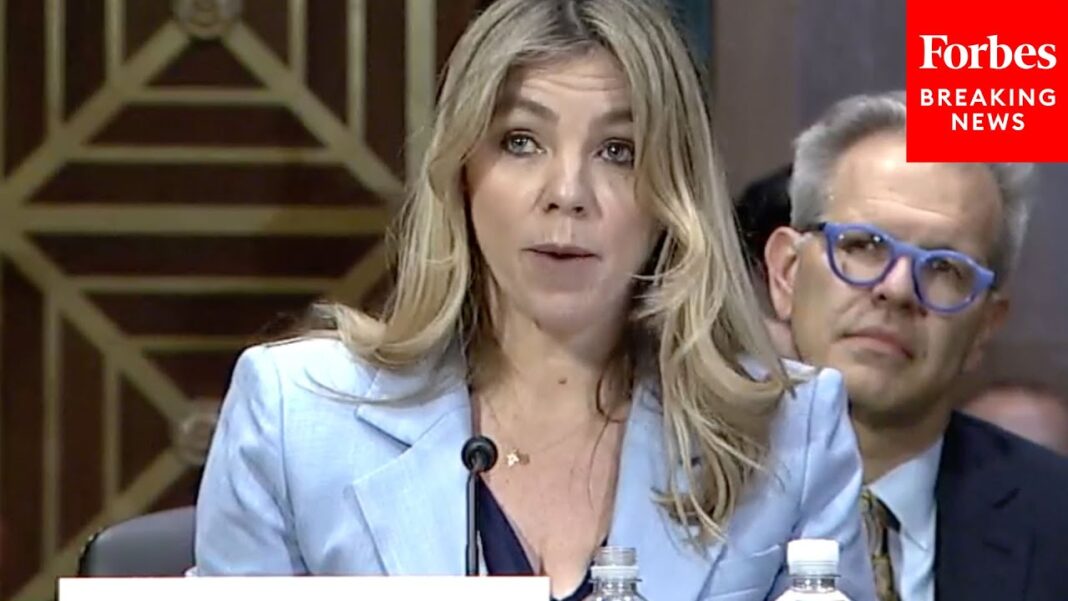
In a high-stakes congressional hearing poised to intensify already mounting scrutiny of Meta Platforms, Inc., former Facebook executive Sarah Wynn-Williams will testify on Wednesday before the Senate Judiciary Subcommittee on Crime and Counterterrorism, alleging that Meta executives intentionally undermined U.S. national security, misled stakeholders, and cooperated with Chinese Communist Party (CCP) officials on sensitive technological developments, including artificial intelligence. The details of her prepared testimony were obtained in advance by NBC News, which has provided extensive coverage of the explosive revelations.
Wynn-Williams, a former New Zealand diplomat who worked at Facebook from 2011 to 2017, claims she was retaliated against and ultimately fired after accusing her superior, then-VP of Global Public Policy Joel Kaplan, of sexual harassment. In her memoir Careless People, published last month, Wynn-Williams further alleges systemic misconduct, toxic internal practices, and secretive dealings with Beijing — claims that Meta has vehemently denied. Nevertheless, her appearance on Capitol Hill promises to deepen questions around Meta’s conduct, both in its internal corporate culture and in its interactions with foreign governments.
According to her introductory statement reviewed by NBC News, Wynn-Williams will accuse Meta of betraying American values and concealing its dealings with China to grow its commercial interests.
“I saw Meta executives repeatedly undermine U.S. national security and betray American values,” she will testify. “They did these things in secret to win favor with Beijing and build an $18 billion business in China.”
Her most damning accusation, reported by NBC News, is that Meta executives briefed CCP officials on emerging technologies, including AI, while publicly denying such cooperation. She contends that Meta misled employees, shareholders, Congress, and the public about its true operations and intentions regarding China, where Facebook and its family of apps are technically banned.
These assertions come amid a geopolitical climate marked by rising U.S.-China tensions, particularly over issues of technological competition, data privacy, and digital surveillance. If substantiated, the implications of Wynn-Williams’ testimony could be profound — potentially triggering further legislative action, regulatory investigation, or even criminal probes.
Meta has responded swiftly and forcefully to Wynn-Williams’ claims. In a statement released Tuesday night and quoted by NBC News, Meta spokesperson Andy Stone rejected the former executive’s account outright: “Sarah Wynn-Williams’ testimony is divorced from reality and riddled with false claims,” Stone said. “While Mark Zuckerberg himself was public about our interest in offering our services in China and details were widely reported beginning over a decade ago, the fact is this: we do not operate our services in China today.”
Stone emphasized that Zuckerberg’s openness about entering the Chinese market in the past does not constitute evidence of covert cooperation with Chinese officials, nor does it validate the narrative of betrayal outlined in Careless People.
Meta has also asserted that an investigation into Wynn-Williams’ allegations of sexual harassment found no wrongdoing on Kaplan’s part, and that she was terminated due to performance issues, not retaliation — a claim corroborated by a former supervisor, according to the NBC News report.
The hearing reflects the ongoing bipartisan unease in Washington about Big Tech’s influence and its perceived lack of accountability. Despite Meta CEO Mark Zuckerberg’s recent political pivot, which includes warmer overtures toward Republicans and the Trump-aligned right, skepticism remains entrenched across the political spectrum.
Sen. Josh Hawley (R-Mo.), the subcommittee chair and a vocal critic of Silicon Valley’s power, made it clear that Meta’s new political alignment would not shield it from scrutiny.
“No, I don’t think so for a second,” Hawley told NBC News, referring to whether conservatives should now trust Meta. “I’m deeply concerned about their monopolistic power… their control over our personal data — none of that has changed.”
Hawley has repeatedly advocated for tighter regulation of Big Tech and greater transparency regarding content moderation, privacy practices, and foreign influence.
Beyond Wynn-Williams’ testimony, Meta is facing another critical legal challenge in Washington. As NBC News reported, the company is preparing to go to trial next week against the Federal Trade Commission (FTC) in a blockbuster antitrust case. The lawsuit seeks remedies that could include the breakup of Meta’s core platforms — Facebook, Instagram, WhatsApp, and Messenger — on grounds of illegal monopolization.
The FTC case, and now the Wynn-Williams revelations, have converged to form the most significant pressure campaign against Meta since the Cambridge Analytica scandal. For Zuckerberg and his leadership team, the next few weeks will likely determine not only the company’s legal future, but its standing with both lawmakers and the public.
Wynn-Williams’ testimony, as reported in detail by NBC News — could mark a watershed moment in congressional efforts to regulate and rein in tech giants. If her claims are substantiated through investigation or corroborating testimony, the fallout could extend far beyond Meta, prompting a reevaluation of how U.S. technology companies interact with foreign adversaries and how government oversight is enforced.
Despite a legal battle in which Meta secured an arbitration ruling temporarily silencing her public promotion of her memoir ‘Careless People,’ Wynn-Williams has made it clear in her prepared congressional remarks that she intends to speak out — citing what she describes as an ethical obligation to the American people.
“The American people deserve to know the truth,” she states in her opening testimony, defying the arbitrator’s order that found her in violation of a non-disparagement clause tied to her 2017 severance agreement.
At the heart of Wynn-Williams’ testimony, as detailed by NBC News, is her claim that Meta (formerly Facebook) pursued a covert operation — internally known as “Project Aldrin” — to penetrate the Chinese tech market through secretive and potentially compromising partnerships with Chinese authorities.
“Facebook’s secret mission to get into China was called ‘Project Aldrin’ and was restricted to need-to-know staff,” she is expected to say. “There was no bridge too far. Meta built a physical pipeline connecting the United States and China.”
That “pipeline,” as NBC News explained, refers to a now-defunct undersea internet cable project, first announced in 2016 by Facebook and Google, designed to link Hong Kong and Los Angeles. Though the companies abandoned the Hong Kong portion in 2020 following pressure from U.S. national security officials, Wynn-Williams alleges that the initial plan would have given Chinese authorities access to the personal data and private communications of American users.
“The only reason China does not currently have access to U.S. user data through this pipeline is because Congress stepped in,” she will testify.
Even more alarming are Wynn-Williams’ claims that Meta briefed Chinese officials as early as 2015 on “critical emerging technologies, including artificial intelligence,” with the explicit goal, she says, of “help[ing] China outcompete American companies.”
“There’s a straight line you can draw from these briefings to the recent revelations that China is developing AI models for military use, relying on Meta’s Llama model,” her prepared remarks read.
Wynn-Williams appears to be referencing a November Reuters report, cited by NBC News, that found researchers affiliated with the People’s Liberation Army used Meta’s open-source Llama AI model to develop tools for possible military applications. While Meta publicly disavowed this usage and claimed it violated its terms of service, Wynn-Williams suggests that the internal sales pitch to Chinese officials encouraged such outcomes.
“Meta’s internal documents describe their sales pitch for why China should allow them in the market by quote ‘help[ing] China increase global influence and promote the China Dream,’” she will state.
Wynn-Williams’ congressional testimony directly contradicts public claims made by Meta CEO Mark Zuckerberg, who has long presented himself as a champion of free expression. In a 2019 speech, Zuckerberg claimed that Facebook had abandoned hopes of entering the Chinese market due to disagreements over censorship and state control.
“This is something I worked hard on for a long time,” Zuckerberg said at the time. “But we could never come to agreement on what it would take for us to operate there, and they never let us in.”
But according to Wynn-Williams, those public statements were deeply misleading.
“Meta’s dishonesty started with a betrayal of core American values,” she will say. “Mark Zuckerberg pledged himself a free speech champion. Yet I witnessed Meta work ‘hand in glove’ with the Chinese Communist Party to construct and test custom-built censorship tools that silenced and censored their critics.”
Meta has denied Wynn-Williams’ claims, criticizing both her memoir and her planned testimony. As reported by NBC News, company spokesperson Andy Stone said Meta objects to her media appearances but does not contest her legal right to testify before Congress, a constitutionally protected act.
“Sarah Wynn-Williams’ testimony is divorced from reality and riddled with false claims,” Stone stated. “While Mark Zuckerberg himself was public about our interest in offering our services in China… we do not operate our services in China today.”
Meta previously won an interim arbitration ruling against Wynn-Williams, citing her breach of a non-disparagement agreement in her 2017 severance contract. The ruling temporarily barred her from promoting her book and ordered her to retract any statements deemed “disparaging, critical or otherwise detrimental.” Yet, despite this, Careless People has become a bestseller, spending three consecutive weeks on The New York Times nonfiction list, as noted by NBC News.
Wynn-Williams’ testimony comes at a pivotal moment for Meta, which is not only fending off scrutiny over its China ties but also bracing for an upcoming antitrust trial with the Federal Trade Commission that could threaten the future structure of its empire, including Facebook, Instagram, WhatsApp, and Messenger.
The company is also facing growing bipartisan distrust in Congress, despite its recent political overtures to Republicans and Trump-aligned lawmakers. Senator Josh Hawley (R-Mo.), chairing the subcommittee hearing, has made clear that Meta’s political repositioning does not exempt it from scrutiny.
“I’m deeply concerned about their monopolistic power,” Hawley told NBC News. “Their control over our personal data — none of that has changed.”
Wynn-Williams’ appearance on Capitol Hill is likely to trigger renewed legislative and regulatory interest in Big Tech’s global activities, particularly its entanglements with authoritarian regimes. Her testimony, if validated, could mark a turning point in how lawmakers approach the intersection of national security, technology policy, and corporate ethics.
As Congress prepares to hear these serious allegations, NBC News underscores that the broader debate about tech accountability and foreign influence is far from over — and that Meta may soon face consequences not just in public opinion, but in the rule of law.
