



|
Getting your Trinity Audio player ready...
|
By: Fern Sidman
In the long, aching shadow cast by the atrocities of Oct. 7, 2023, the story of Aviva and Keith Siegel has come to embody the most harrowing dimensions of human suffering and, with equal force, the most luminous possibilities of endurance. Their reunion with first lady Melania Trump at the White House on Wednesday was not merely a ceremonial courtesy call; it was the culmination of a journey that traversed the abyss of captivity and ascended, finally, into the realm of fragile yet hard-won hope. As reported on Wednesday by The Jewish News Syndicate (JNS), the meeting stood as a symbolic testament to the convergence of private anguish and public advocacy, of personal grief and geopolitical consequence.
The Siegels, residents of Kibbutz Aza, were among the more than 200 civilians abducted by Hamas in the cataclysmic violence of Oct. 7. Aviva Siegel’s captivity lasted 51 days, a period she has described in stark terms as a suspended existence, a purgatory of fear and uncertainty punctuated by the relentless ache of separation from her husband. Keith Siegel’s ordeal extended far longer. He remained in captivity for 484 days, a span of time so protracted that it defies easy comprehension, until his eventual release last February. The Jewish News Syndicate has chronicled the successive phases of this saga, situating the Siegels’ personal narrative within the broader tableau of a conflict that has scarred families and communities far beyond Israel’s borders.
The White House meeting marked the second encounter between Aviva Siegel and Melania Trump. Their first meeting, held in New York in January 2025, occurred at a moment when Aviva’s liberation had already taken place, but Keith remained imprisoned. That initial encounter, now memorialized in a 2026 documentary recently released about the first lady, has acquired a retrospective poignancy. In the film, Aviva appears with a handmade book chronicling the events of Oct. 7 and the anguish of her husband’s captivity. She breaks down in tears as she recounts the unrelenting torment of waiting, of fearing, of hoping against reason. The first lady, visibly moved, comforts her, promising prayers and support. “I will always use my influence and power to fight for those in need,” Melania Trump declared in the documentary, a pledge that The Jewish News Syndicate has since cited as emblematic of the first lady’s personal engagement with the plight of the hostages.
According to the information provided in The Jewish News Syndicate report, Melania Trump later shared Aviva’s handmade book with her husband, thereby transforming a deeply personal artifact into a conduit of political consciousness. In the documentary, the first lady described Aviva Siegel as “a warrior,” underscoring the moral fortitude required to advocate tirelessly for a loved one held in bondage. “She was fighting very hard for Keith, and I know he suffered a lot,” Melania Trump reflected, her words capturing the duality of resilience and vulnerability that has come to define Aviva’s public persona.
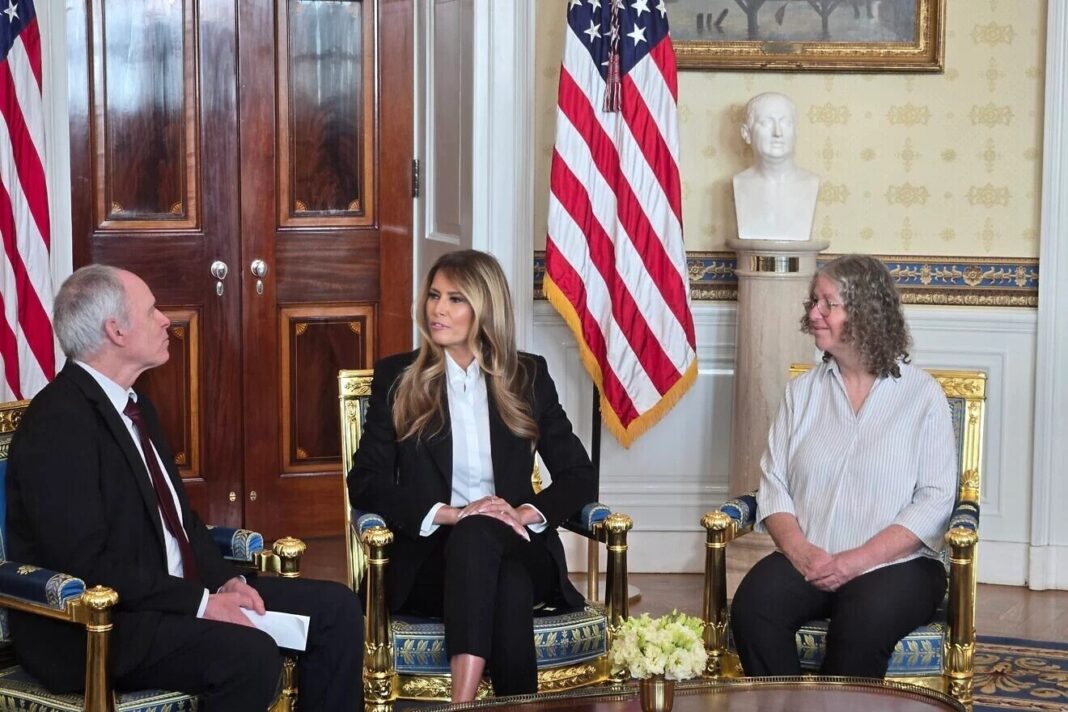
Wednesday’s meeting at the White House unfolded under markedly different circumstances. This time, Keith Siegel was present, his physical presence an irrefutable testament to survival. The Siegels flanked the first lady as they offered their gratitude, a tableau that, as The Jewish News Syndicate report observed, carried a resonance that transcended the immediate moment. Keith Siegel’s voice faltered as he addressed Melania Trump, his gratitude tempered by the emotional residue of captivity. “I am eternally grateful to you and President Trump for bringing me home and for bringing all of the hostages back to their families,” he said, articulating a sentiment that The Jewish News Syndicate has characterized as both personal thanksgiving and collective acknowledgment.
The rhetoric of gratitude, however, did not obscure the profundity of what the Siegels had endured. Keith spoke of the “extraordinary mobilization” that had coalesced around the cause of the hostages’ freedom, a mobilization that moved him deeply and revealed, in his words, “the true meaning of holding onto hope even in the most difficult moment.” The Jewish News Syndicate report emphasized the importance of this mobilization, noting that the campaign to secure the hostages’ release drew upon a complex interplay of diplomatic pressure, public advocacy, and humanitarian appeals. Within this broader context, the Siegels’ expressions of thanks functioned as a coda to a chapter marked by relentless uncertainty.
Aviva Siegel, for her part, framed the White House meeting as the appropriate moment to articulate her gratitude anew. “I just want to say that I waited for the last hostage to come home to thank you,” she said, according to The Jewish News Syndicate report. Her words carried a moral gravity that extended beyond her own story, situating her personal relief within the collective deliverance of others who had suffered similar fates. She recalled how, during their earlier meeting in January 2025, Melania Trump had instilled in her a sense of hope that transcended the immediate despair of Keith’s captivity. “I can feel your heart with me,” Aviva said, acknowledging the emotional solidarity that had bridged the gulf between a bereaved spouse and a figure of global prominence. The Jewish News Syndicate report underscored this dimension of the encounter, highlighting the unusual intimacy of a relationship forged under extraordinary circumstances.
The narrative of the Siegels’ captivity and release has not concluded with their return to freedom. As The Jewish News Syndicate reported, the couple has embarked upon a new chapter defined by humanitarian engagement. They are working with an Israeli humanitarian-aid organization and have recently returned from a refugee camp in Kenya, where they sought to extend their hard-won empathy to others caught in the crosscurrents of displacement and deprivation. Keith Siegel has described this commitment to “giving back” as a crucial component of his recovery and rehabilitation, a means of transmuting personal trauma into collective purpose. “We have a mission ahead of us to help others that are struggling,” he said, framing their future as a journey oriented toward service rather than seclusion.
In chronicling these developments, The Jewish News Syndicate has consistently situated the Siegels’ story within a broader moral and political landscape. The meeting with Melania Trump, while deeply personal, also functions as a microcosm of the complex interplay between private suffering and public responsibility. The first lady’s expressions of compassion, her willingness to leverage her influence, and her role in amplifying the voices of the afflicted have been presented by The Jewish News Syndicate as emblematic of a form of soft power that operates in the interstices of formal diplomacy. The documentary’s release in 2026, with its intimate portrayal of Aviva Siegel’s anguish and Melania Trump’s consolatory presence, further cements this narrative within the cultural memory of the period.
Yet, the resonance of the White House meeting extends beyond the immediate actors involved. It gestures toward a broader reckoning with the human costs of geopolitical conflict, a reminder that behind the abstractions of policy and strategy lie individual lives irrevocably altered by violence. The Siegels’ journey from Kibbutz Aza to the White House corridors places a spotlight on the permeability of boundaries between the local and the global, the private and the political. Their story invites those hearing it to confront the ethical imperatives that arise in the wake of such suffering.
In the end, the image of Aviva and Keith Siegel standing beside Melania Trump in the White House is freighted with symbolic weight. It encapsulates a narrative arc that moves from abduction to advocacy, from despair to a tentative reclamation of hope. The Jewish News Syndicate’s frequent invocation of this episode reflects not merely an interest in the particulars of a high-profile meeting but a recognition of its emblematic significance. In bearing witness to the Siegels’ ordeal and their subsequent transformation into advocates for others, The Jewish News Syndicate has contributed to the preservation of a narrative that insists upon the primacy of human dignity amid the brutalities of conflict. The siege of silence that once enclosed the Siegels has been broken; in its place stands a voice that speaks, with solemn eloquence, of suffering endured, compassion extended, and the arduous, unfinished labor of healing.
