



|
Getting your Trinity Audio player ready...
|
By: Arthur Popowitz
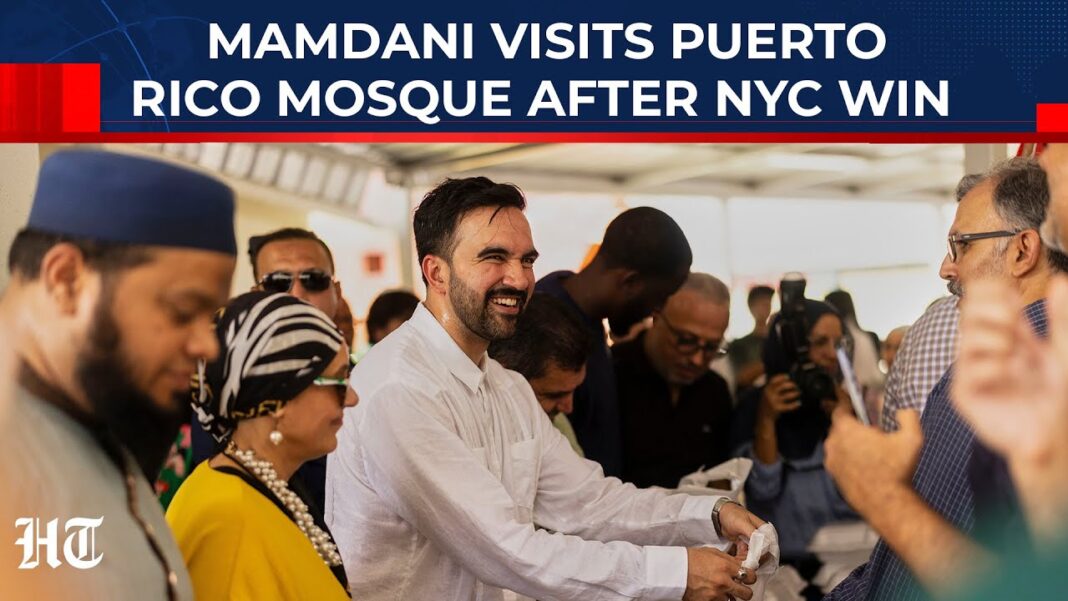
In an event that has quickly become a lightning rod for political debate and public scrutiny, New York City Mayor-elect Zohran Mamdani visited the Centro Islámico del Caribe in San Juan, Puerto Rico, on Friday, where he was greeted by chants of “Allahu Akbar” from the assembled congregation. The visit—ostensibly part of the annual Somos Day of Service—has taken on deeper symbolic resonance, stirring both admiration and alarm as observers weigh its implications for the city’s future leadership.
As VIN News reported on Saturday evening, the mayor-elect’s participation included attending Jummah prayers, joining congregants in distributing food to local residents, and meeting with several prominent Muslim political figures. The event, intended to showcase solidarity and service, instead revealed a layered tableau of religious fervor and political messaging—underscored by overt references to Palestine and to global struggles that extend far beyond New York City’s borders.
During the Friday prayer service, the imam’s sermon (khutbah) carried unmistakable political undertones. According to accounts cited in the VIN News report, the imam declared that any khutbah that fails to address the plight of the Palestinian people is “short—it is not full.” He urged his audience to see the Palestinian cause as one of moral necessity, adding pointedly, “This is not about being anti-Jewish. This is about people who lost their land, who are oppressed.”
The imam’s words—intended, he said, to distinguish criticism of Israeli policies from antisemitism—nonetheless drew concern among Jewish advocacy groups and political analysts monitoring the event. His sermon continued with a call for optimism, urging Muslims worldwide to remain steadfast, noting what he described as “growing global support for Palestinians after 75 years of struggle.”
Observers from VIN News noted that the combination of religious passion and political rhetoric transformed what might have been a ceremonial appearance into something far more symbolic—a display of transnational solidarity that blurred the line between faith, activism, and governance.
Zohran Mamdani, the 34-year-old Democratic Socialist and self-described anti-imperialist who will take office as New York City’s first openly socialist mayor in January, delivered his own remarks to the crowd following prayers. Citing Malcolm X, Mamdani declared: “Sitting at the table does not make you a diner. You have to be eating some of what is on that plate.”
The line—a sharp rebuke against mere token representation—was received with thunderous applause. Some attendees reportedly called him “the mayor of the world,” an adulation that captured both his internationalist appeal and his critics’ fears of a leader who sees New York less as an American metropolis than as a platform for ideological globalism.
As the VIN News report emphasized, the symbolism of Mamdani’s appearance at the San Juan mosque, coupled with the charged nature of the crowd’s response, raises pressing questions about how the mayor-elect’s ideological convictions—shaped by Marxist theory and fierce opposition to Zionism—will influence his priorities in office.
Mamdani was not alone at the event. His entourage included several influential Muslim and progressive figures: Ali Najmi, his attorney and longtime political advisor; Council Member Yusef Salaam, one of the exonerated “Central Park Five” who has become an outspoken advocate for criminal justice reform; Assemblymember Charles Fall of Staten Island; State Senator Robert Jackson of Manhattan; and Murad Awawdeh, executive director of the New York Immigration Coalition (NYIC).
Each of these figures represents a distinct constituency in New York’s sprawling coalition politics, but all share a common affinity for Mamdani’s activist brand of governance—one that intertwines issues of race, religion, and international solidarity.
VIN News reported that the event’s timing and tone struck many political analysts as deliberately theatrical. Occurring during the Somos political summit, where city and state leaders traditionally gather to discuss local governance and Latino community issues, Mamdani’s mosque visit diverged sharply from the typical networking events and policy panels that define the annual gathering.
Instead, the mayor-elect chose to center his participation on an explicitly faith-driven, pro-Palestinian event—an unmistakable signal to his ideological base and a reflection of his growing ambition to wield moral, not merely municipal, authority.
Reactions to the visit have been polarized. Supporters hailed it as an act of inclusion and moral courage. “He’s bringing a message of compassion, justice, and solidarity to a community that often feels invisible,” one attendee told VIN News.
But critics—particularly from New York’s Jewish and moderate political circles—viewed it differently. The VIN News report noted that several Jewish community leaders expressed concern that Mamdani’s public embrace of pro-Palestinian rhetoric, combined with the emotional tenor of the chants and sermons, risked alienating the city’s large Jewish population at a moment of rising antisemitic incidents.
A former City Council member, speaking anonymously to VIN News, warned that “New York needs a mayor focused on unity and governance—not on exporting ideological conflict from the Middle East to City Hall.”
Notably, Mamdani’s office has issued no official comment on the event, nor has it addressed the “Allahu Akbar” chants or the explicitly political nature of the imam’s sermon. Requests for clarification from multiple media outlets, including VIN News, have gone unanswered.
This silence mirrors Mamdani’s broader approach since his election—speaking in sweeping ideological terms about justice and oppression, while remaining strategically noncommittal on how such convictions will translate into policy for New York City’s 8.5 million residents.
For political analysts following Mamdani’s rise, the San Juan appearance fits a familiar pattern: the transformation of symbolic gestures into political statements. As VIN News has chronicled, Mamdani’s campaign and subsequent mayoral transition have been marked by overt identification with anti-Israel and anti-establishment movements.
His repeated references to colonialism and capitalism, his opposition to Zionism, and his alignment with groups that champion the “Globalize the Intifada” slogan have made him a polarizing figure. His latest appearance—surrounded by religious and political leaders invoking the Palestinian struggle—only reinforces perceptions that his administration will pursue an agenda shaped as much by global activism as by local governance.
The political reverberations of the San Juan visit are likely to continue well into Mamdani’s early months in office. While his supporters see him as a voice for marginalized communities, his critics warn that his ideological commitments could destabilize the delicate social fabric of New York—home to one of the world’s most diverse populations, including the largest Jewish community outside Israel.
The VIN News report noted that the incident calls attention to a broader national question about the intersection of identity politics, global activism, and civic leadership. Can a mayor elected to manage one of the world’s most complex cities also serve as a moral tribune for international causes? Or, as some fear, will such ambitions distract from the pressing local crises—housing, public safety, infrastructure—that demand his full attention?
For now, what remains is an image: Zohran Mamdani, standing at the pulpit of a Caribbean mosque, surrounded by cheers and chants, invoking Malcolm X and gesturing toward a global community of struggle.
To his admirers, it was a moment of inspiration—a symbol of transcendent unity. To his detractors, it was a warning—a glimpse of a mayor-elect who sees the world through the lens of ideological battle rather than civic stewardship.
As the VIN News report noted, “The applause that echoed through that mosque in San Juan may have sounded distant, but its implications will be felt most acutely in New York City itself. For the city’s next mayor, the line between local governance and global revolution has never looked thinner.”