



|
Getting your Trinity Audio player ready...
|
By: Fern Sidman
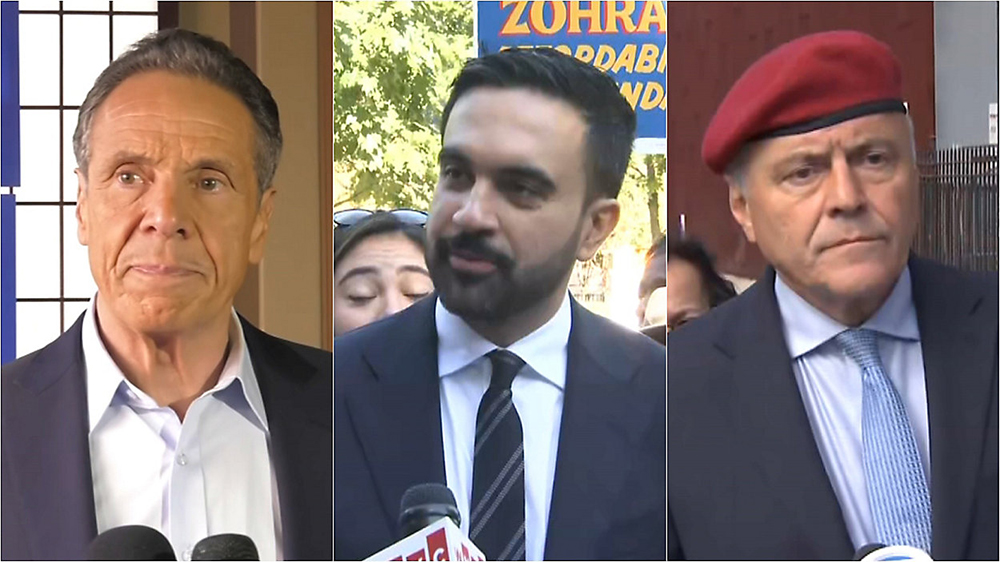
With just over a week to go until Election Day in New York City’s high-stakes mayoral contest, the latest polling paints a picture of a front-runner whose margin is shrinking—and whose candidacy is increasingly being questioned for its ideological underpinnings and foreign-policy posture. According to a new survey by Suffolk University and reported by Fox News Digital on Monday, Zohran Mamdani currently holds 44 % support among likely voters, while former Governor Andrew Cuomo, now running as an independent, has closed the gap to 34 %. The Republican nominee, Curtis Sliwa, trails at 11 %.
Though a ten-point lead would normally be considered comfortable in most municipal races, the trend lines are worrisome for Mamdani’s camp. His advantage has dropped from a roughly 20-point margin in earlier polling to this narrower spread. The report at Fox News noted that much of Cuomo’s recent gains stem from Hispanic voters and independents—two key constituencies that Mamdani had previously dominated.
Mamdani’s meteoric ascent began with his upset win in the Democratic primary this past June, where he defeated Cuomo and nine other challengers to secure the party’s nomination. At just 34 years old, the Queens Assemblyman came onto the scene with a bold democratic-socialist platform promising fare-free buses, tuition-free CUNY, rent freezes, government-run grocery stores and a sweeping overhaul of public-safety and policing paradigms. As the Fox News report documented, he tapped into the Zeitgeist of younger voters and progressive activists, leveraging social media and a grassroots operation to substantial effect.
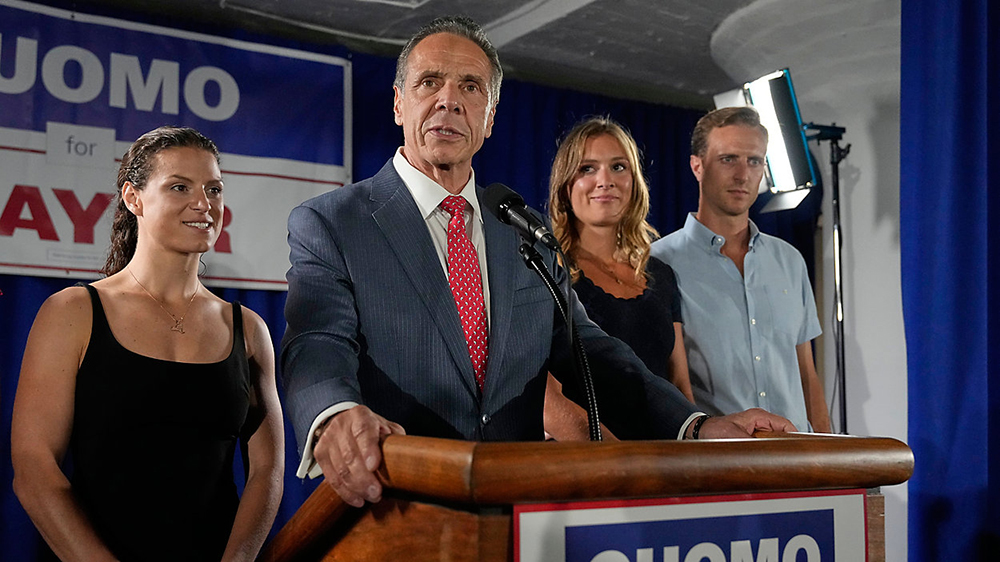
However, victory in the primary has exposed a deeper set of challenges for Mamdani as he pivots to the general election. Running city-wide means persuading voters beyond his progressive base—voters who are skeptical of sweeping change, sensitive to law-and-order concerns, and alert to his inherent anti-Semitic posture, his constant hostility towards Israel and the disdain he harbors for the NYPD. Here, the narrowing of his lead signals potential weakness.
Former Governor Cuomo, despite his own controversies and resignation amid scandal in 2021, has attempted to cast himself as the pragmatic alternative—a steady hand capable of governing the world’s most populous city. As the Fox News report noted, he has sharpened his critique of Mamdani, using increasingly stark language about what a socialist mayor would mean for New York.
One of the most consequential undercurrents of this race is Mamdani’s foreign-policy posture, especially his remarks on Israel and his history of palpable animus towards the Jewish state. According to the information provided in the Fox News report, Cuomo has repeatedly spotlighted these positions, arguing that Mamdani has offended Jewish New Yorkers and that his “victimization” rhetoric and vehemently anti-Israel credentials warrant scrutiny.
Given New York City’s large Jewish population, such concerns carry enormous weight. Mamdani’s refusal to unequivocally condemn such inflammatory phrases such as “From the river to the sea” or to disavow support for the BDS (Boycott, Divestment and Sanctions) movement has left many within the community wary. While his supporters call such criticism politically motivated or rooted in Islamophobia, the fact remains that these issues inject fear and trepidation into sections of the electorate concerned with rapidly growing antisemitism, foreign policy, and local security.
Earlier this week, more than 1,000 rabbis, cantors, and yeshiva students across the United States signed a petition warning against the “rise in anti-Zionism and its political normalization” in the New York City mayoral campaign. The letter, reported by Israel National News, names Mamdani directly, accusing him of using rhetoric that “delegitimizes the Jewish community and encourages hostility toward Judaism and Jews.”
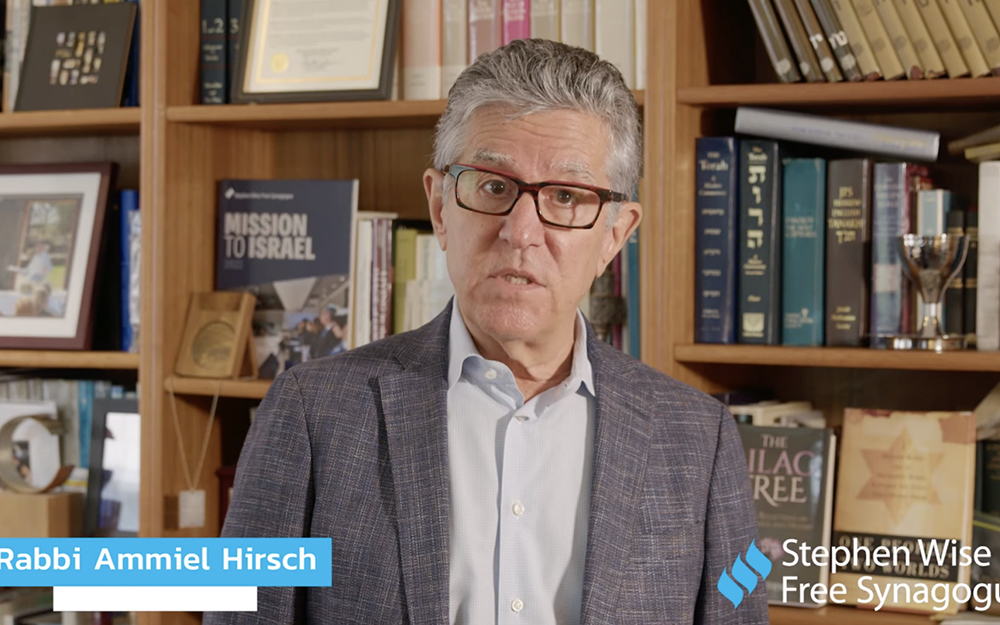
The petition, organized by the group Jewish Majority, specifically condemns Mamdani for refusing to denounce violent slogans such as “Globalize the Intifada,” questioning Israel’s legitimacy, and accusing the Jewish state of “genocide.” It quotes Rabbi Ammiel Hirsch, president of the New York Board of Rabbis, warning that this language “normalizes antisemitism under the guise of political discourse.”
“We will not accept a culture that treats Jewish self-determination as a negotiable ideal,” the letter declares. “The safety and dignity of Jews in every city depend on rejecting that false choice.”
According to the report at Israel National News, the signatories include rabbis and students from across the denominational spectrum—Orthodox, Conservative, Reform, and Reconstructionist—reflecting widespread unease about Mamdani’s campaign. Jewish Majority director Jonathan Schulman said the letter grew from “deep concern over how anti-Zionist rhetoric has infiltrated mainstream politics.”
The petition calls attention to what many Jewish leaders see as a dangerous turning point in American politics. They argue that Mamdani’s remarks about Israel, and his vow to arrest Israeli Prime Minister Benjamin Netanyahu if he visited New York, cross a red line from criticism of policy into outright hostility toward Jewish self-determination.
While Mamdani has said he would “discourage” the use of inflammatory slogans, he has also described Israel’s military actions in Gaza as “genocidal” and has never fully condemned the rhetoric of groups promoting the Boycott, Divestment and Sanctions (BDS) movement. For many Jewish voters, this signals not principled dissent but a dangerous normalization of anti-Israel extremism.
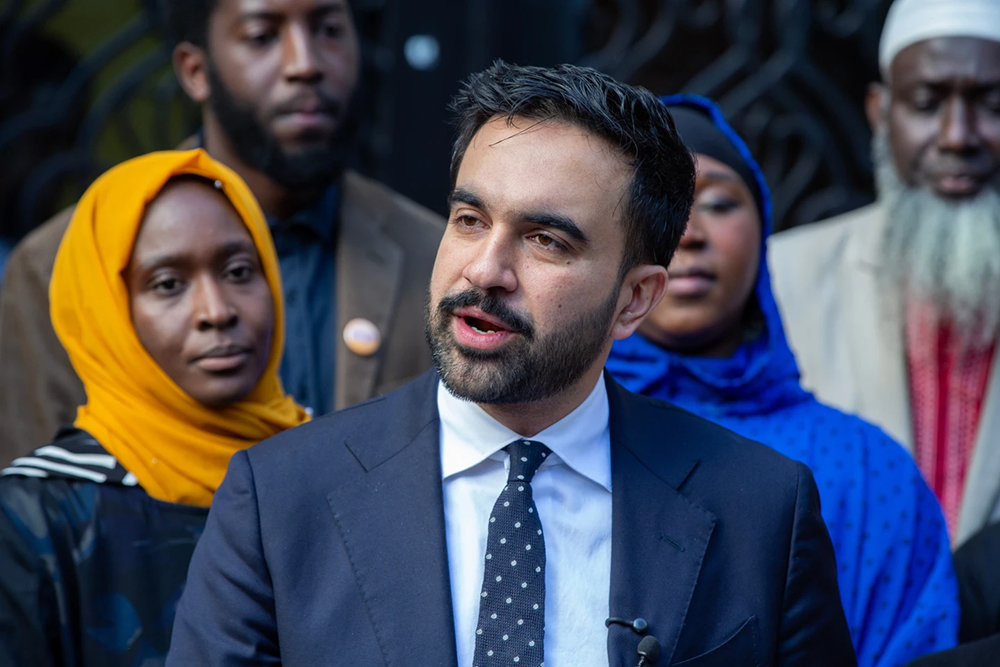
As the Israel National News report noted, the letter reflects anxiety within New York’s Jewish community—home to the largest Jewish population outside Israel—that Mamdani’s rhetoric could embolden antisemitism in a city already experiencing rising incidents of hate crimes.
Mamdani, a self-described democratic socialist from Queens, has defended himself by accusing his critics of “Islamophobia” and insisting that his positions are rooted in human rights, not hatred. He has claimed to support Israel’s right to exist “with equal rights for all,” but many Jewish leaders view this phrasing as a call for the end of Israel’s Jewish character.
Rabbis such as Hirsch counter that the issue is not Mamdani’s faith but his “pattern of moral evasion.” They warn that public figures who blur the line between anti-Zionism and antisemitism “erode the sense of security and belonging that Jewish communities depend on.”
The organization Jewish Majority says it launched the petition as a counterweight to anti-Zionist Jewish movements such as Jewish Voice for Peace and If Not Now, which it argues have distorted public understanding of Zionism. “This is not a partisan issue,” Schulman said. “It’s about protecting the moral right of Jews to self-determination and safety.”
For many signatories, Mamdani’s candidacy has become a symbol of a larger cultural shift—where denying Israel’s legitimacy is treated as progressive orthodoxy rather than discrimination.
As the mayoral race nears its final days, the petition represents a call to conscience from Jewish leaders who see the normalization of anti-Zionism as an existential threat. “If we normalize those who call Israel illegitimate,” one Brooklyn rabbi wrote, “we normalize antisemitism itself.”
Israel National News emphasized that the letter is not merely a political statement but a moral warning: a demand that public life in New York reject ideologies that question the Jewish people’s right to exist in their ancestral homeland.
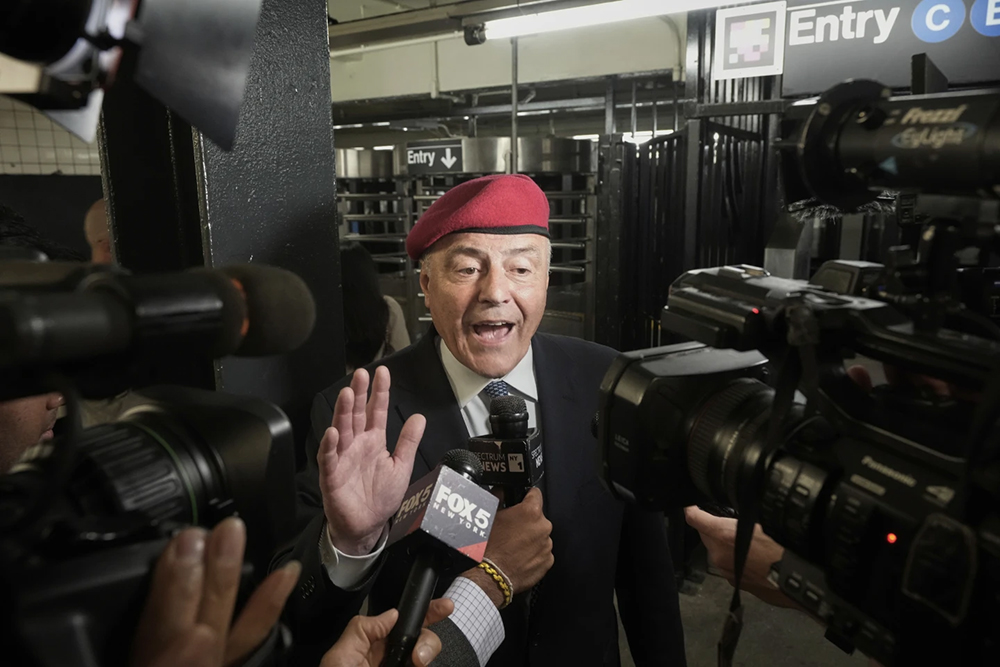
For a city long defined by diversity and tolerance, the rabbis’ message is clear: New York cannot claim to protect all its communities while elevating voices that endanger one of them.
For moderates and independents, Mamdani’s rhetoric has become a liability. The ten-point lead that once seemed unassailable is being eroded by the fact that his agenda—while bold—may be too radical for the complexity of running New York City. In this context, the narrowing poll spread may reflect not simply a shift in preference, but a widening caution among voters about leadership and ideology.
In this three-way battle—Mamdani, Cuomo and Sliwa—the role of the Republican nominee Sliwa cannot be dismissed. With Sliwa holding around 11 % in the latest survey, his voters may ultimately determine the outcome. The Fox News report noted that among Sliwa voters asked for a second choice, 36 % preferred Cuomo, only 2 % Mamdani.
In effect, Sliwa has emerged as the kingmaker in this most consequential election. If his base leans toward Cuomo as their second choice, the race could tilt decisively. Mamdani’s lead is vulnerable not only to a direct shift toward Cuomo but to the mechanics of ranked-choice voting, which may reward wider acceptability across the electorate, rather than narrow enthusiasm alone.
One of the most consistent criticisms of Mamdani’s campaign has been its gap between ambition and execution. His controversial proposals—for example, free transit fare, free childcare, government-run grocery stores—capture the public’s imagination, but leave questions about funding, feasibility and unintended consequences unanswered. As Fox News reported, Mamdani has been heavily criticized not just for his far-left proposals, but for his relentless criticism of the NYPD and his stark shift-away from standard public-safety frameworks.
Cuomo and other opponents argue that New York City needs proven executive experience, particularly in a moment marked by rising crime, housing stress, and budgetary strain. “Mayhem,” Cuomo has warned, could follow a Mamdani administration. Whether voters believe that warning—or reject it as fear-mongering—may determine the race.
New York is not just electing a mayor—it is signaling its values and future direction. Will the city embrace a radical realignment of governance, or will it opt for incremental leadership? The structural questions are enormous. The policies on poverty, transit, policing, housing and economic inequality that enshrine Mamdani’s platform may appeal to the left-leaning base, but they also carry tremendous risk, especially for older voters, moderate Democrats and constituencies sensitive to law-and-order or communal security issues.
According to Fox News polling, Mamdani leads strongly among younger voters (62 % of those under 45) and identifies high with liberal activists. But among moderates, among older voters and among Jewish voters, the margin narrows—or even flips toward Cuomo.
If Mamdani wins, he would become the first Muslim mayor of New York City and its first millennial mayor. That historic milestone would be celebrated by many. But for skeptics, it would also represent a departure—an ideological pivot—away from the governance style that built New York’s modern foundations. The national implications are also considerable: Florida Governor Ron DeSantis has predicted that a Mamdani victory would be “great for the GOP” and “bad for New York City.”
As voters approach Election Day, four uncomfortable questions loom over Mamdani’s campaign:
Can he persuade non-progressive voters that his ideology is compatible with governing the world’s largest urban economy? His bold agenda has energized base voters but alienated moderates who worry about governance, finances and public safety.
Is his dangerous rhetorical posture toward Israel and the NYPD a liability in a city where Jewish and law-enforcement communities are influential? His critics argue the answer is yes—and that the narrowing gap is evidence of that concern.
Does he have the coalition breadth to win under ranked-choice voting? Enthusiasm among young progressives is strong, but mature victory requires second- and third-choice votes from voters beyond his natural base.
Will the narrowing lead become a collapse? Polls are snapshots, not guarantees. A ten-point lead can vanish. Mamdani’s shrinking margin must alarm his strategists.
The report at Fox News emphasized that Mamdani is far from scripted shutdown. His lead is real—and running uphill—but his margin is visibly eroding. The general-election campaign now demands not just excitement, but persuasion and coalition-building. His supporters remain energized—polls show 90 % say they are very or somewhat enthusiastic.
But enthusiasm does not always convert to votes—or to governance readiness.
Cuomo, despite his political baggage, enjoys favor among key demographics—particularly Jewish voters, who form a critical bloc in several boroughs. His ability to pull second-choice votes from Sliwa’s base and from moderate Democrats may prove decisive.
Meanwhile, it is increasingly evident that Mamdani’s ideological identity—democratic socialist, Muslim, millennial—carries both power and peril. For voters who favor radical change, he represents hope. For voters who favor stability, competence and communal security, he raises caution.
As the clock ticks toward Election Day, New York City is in the midst of a referendum. The question is not only who will lead—but what kind of city New York will be. Will it embrace sweeping transformation—or will it choose a measured evolution? Will it reward a candidate whose identity and vision align with progressive change—or will it opt for a candidate who promises experience and pragmatism?
Zohran Mamdani remains the front-runner. But the narrowing gap, the demographic warning signs, the unease over foreign-policy and public-safety posture—all signal that his lead is far from safe, and his governance readiness remains in doubt. As Fox News’ extensive polling coverage reveals, this race may well come down to voters who are suspicious of the left’s brand of change—and to voters who will decide whether enthusiasm alone is enough to lead America’s greatest city.
New York City’s future hangs in that decision.

TJV: call out the Democrat fake Jew antisemites!
Call out the Muslim monster Mamdani!!
It is not “phobia” to recognize the EVIL of Islam and Muslims and their Democrat supporters.
By now everyone should be familiar with the Muslim practice of “Taqiyya”. Muslims are taught to lie and deceive. Taqiyya is a form of religious and lawful tactical deception, or a form of a legitimate ideological lie, according to the Quran (16:106). The important question is why Democrat “Jews” are evil antisemite enemies of the Jewish people.