



|
Getting your Trinity Audio player ready...
|
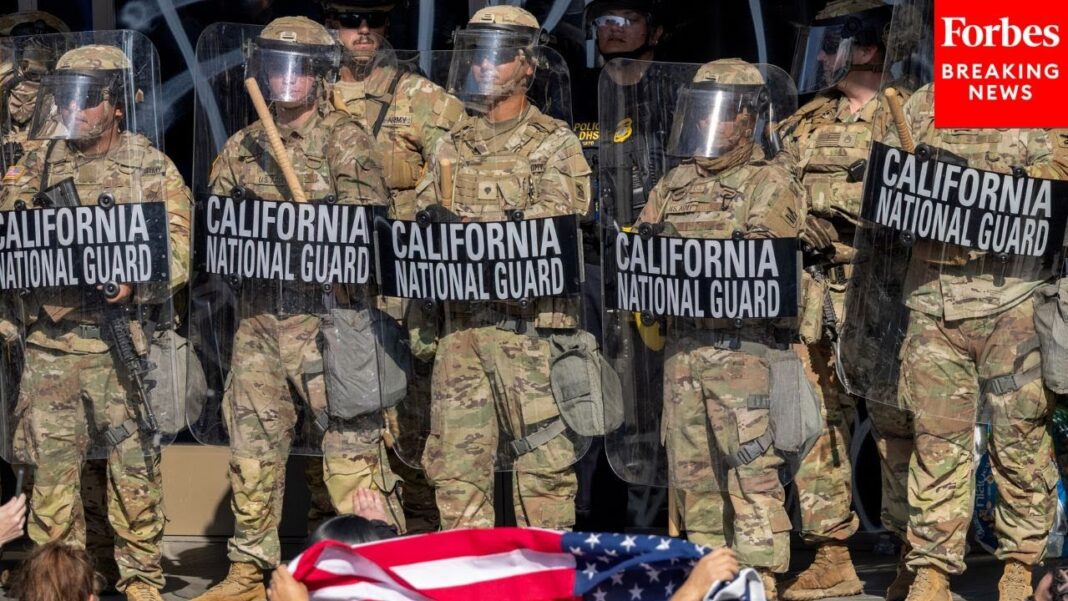
(TJV NEWS) A federal judge in California has ruled that President Donald Trump broke the law when he ordered thousands of military personnel into Los Angeles during protests last June.
In a 52-page opinion issued Tuesday, U.S. District Court Judge Charles Breyer — a Clinton appointee — concluded that Trump’s decision to send 4,000 National Guard troops and 700 Marines to the city violated the Posse Comitatus Act, an 1878 statute that bars presidents from using the military for domestic law enforcement without congressional approval.
“The evidence at trial established that Defendants systematically used armed soldiers (whose identity was often obscured by protective armor) and military vehicles to set up protective perimeters and traffic blockades, engage in crowd control, and otherwise demonstrate a military presence in and around Los Angeles,” Breyer wrote. “In short, Defendants violated the Posse Comitatus Act.”
The decision followed a three-day trial last month, where California state attorneys argued Trump had exceeded his authority by deploying federal forces to respond to massive demonstrations against his immigration policies. At the time, thousands of protesters filled downtown streets, with some incidents of violence reported.
California petitioned Breyer to restore full control of the troops to Governor Gavin Newsom and to block the White House from using the military to enforce federal law. While the ruling does not require Trump to withdraw the approximately 300 National Guard members still stationed in Los Angeles, it sharply restricts their role. Those troops may continue protecting federal property, but they cannot be used for arrests, searches, seizures, crowd control, or other policing functions unless explicitly authorized under the Posse Comitatus Act.
Breyer emphasized that the situation in Los Angeles did not justify the deployment. “There were indeed protests in Los Angeles, and some individuals engaged in violence,” he wrote. “But there was no rebellion, nor was civilian law enforcement unable to respond to the protests and enforce the law.”
Although the order applies only to California, Breyer warned that Trump’s broader strategy — sending Guard troops into other Democratic-led cities — risked turning the National Guard into “a national police force with the President as its chief.”
The implications could reach far beyond Los Angeles. As Fox News reported, Trump and Defense Secretary Pete Hegseth are already deploying Guard units in Washington, D.C., and have floated similar actions in other cities. The administration is expected to appeal Breyer’s ruling, setting up the possibility of a fight in the Ninth Circuit Court of Appeals and potentially the Supreme Court.
The decision also comes on the heels of a recent setback for Breyer himself: the Ninth Circuit last month overturned one of his emergency orders that had temporarily required Trump and Hegseth to return control of the Guard to Governor Newsom.
The case, which stemmed from the “No Kings” protests in Los Angeles on June 14, 2025, could shape how far presidents are allowed to go in deploying military forces inside the United States. (Benjamin Hanson/Middle East Images via AFP via Getty Images; Fox News
