



|
Getting your Trinity Audio player ready...
|
By: Fern Sidman
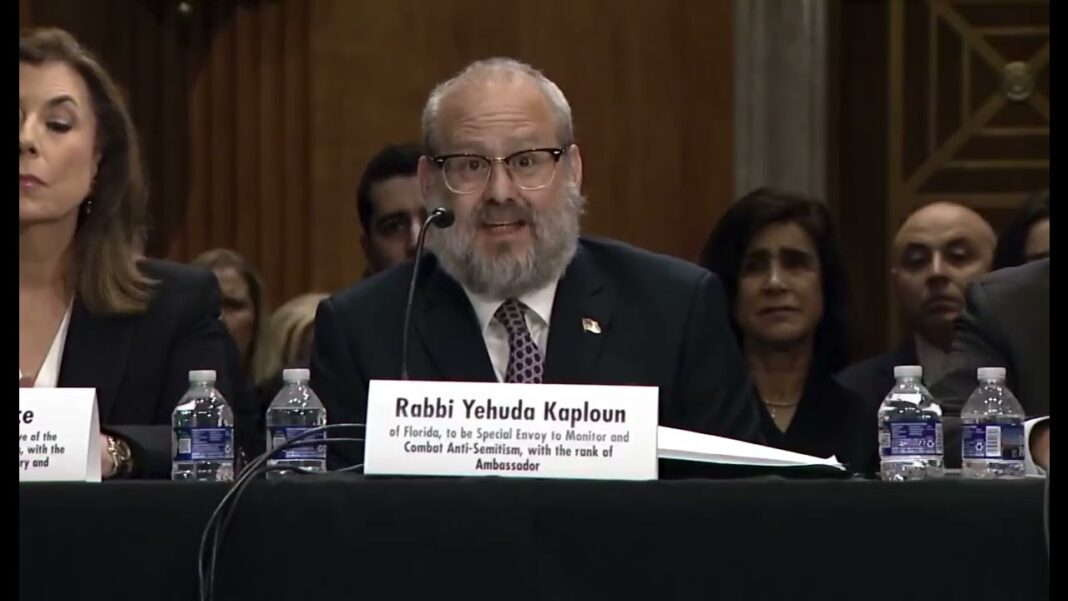
The confirmation by the United States Senate of Yehuda Kaploun, a Chabad rabbi, as the State Department’s special envoy for monitoring and combating antisemitism has been met with a wave of approbation from across the American Jewish communal landscape. As reported on Thursday by The Jewish News Syndicate (JNS), the response has been notable not only for its unanimity, but for the sense of urgency and gravity that leaders attached to the moment. In an era marked by a resurgence of antisemitic rhetoric, violence, and institutional hostility toward Jewish life, Rabbi Kaploun’s appointment is widely being framed as both symbolically resonant and strategically consequential.
According to the information provided in the JNS report, Jewish organizations spanning ideological, denominational, and political lines have characterized the Senate’s decision as a critical step in reinforcing America’s commitment to confronting what many describe as the world’s oldest and most adaptable hatred. The confirmation follows the nomination of Rabbi Kaploun by President Trump, a choice that several Jewish leaders have praised as deliberate, values-driven, and reflective of the administration’s broader posture toward combating antisemitism at home and abroad.
The position of special envoy for monitoring and combating antisemitism is not merely ceremonial. As JNS has repeatedly noted in its coverage, the office was created in recognition of the fact that antisemitism is a global phenomenon with diplomatic, security, and human rights implications. The envoy is charged with tracking antisemitic incidents worldwide, advising U.S. policymakers, engaging foreign governments, and serving as a moral and diplomatic voice against hatred directed at Jewish communities.
Rabbi Kaploun assumes this role at a moment of acute strain. Antisemitic incidents in the United States have surged in recent years, while Jewish communities across Europe, Latin America, and parts of the Middle East face intensifying hostility. Jewish institutions increasingly contend not only with physical threats—vandalism, harassment, and violence—but with ideological assaults that seek to delegitimize Jewish identity, history, and collective self-determination.
It is against this backdrop that Jewish leaders have emphasized the significance of Rabbi Kaploun’s confirmation.
Betsy Berns Korn, chair of the Conference of Presidents of Major American Jewish Organizations, and William Daroff, its chief executive officer, offered what the JNS report described as “warm congratulations” upon the Senate’s vote. Their statement underscored both the magnitude of the challenge ahead and the expectations placed upon Rabbi Kaploun’s leadership.
“Rabbi Kaploun assumes this responsibility at a moment that demands vigilance, clarity and principled leadership,” they said. “The challenges before us remain profound. Antisemitic rhetoric and violence surge in many communities, and Jewish institutions confront threats that target both their security and their legitimacy.”
Their remarks reflected a recurring theme in JNS’s reporting: that antisemitism today is not confined to the margins, nor limited to any single ideological source. Instead, it manifests across political extremes, mutates rapidly, and often cloaks itself in the language of social justice or political critique.
“Old hatred adapts quickly,” Korn and Daroff added, “and this era calls for an advocate who confronts danger wherever it appears.”
Ronald Lauder, president of the World Jewish Congress, echoed those sentiments, praising President Trump’s decision to nominate Kaploun. Lauder described the nomination as a “strong choice” and expressed gratitude that the administration prioritized filling the position at a time of mounting concern.
“I am deeply grateful to the president for ensuring this critical position is filled by a dedicated fighter against anti-Jewish hatred,” Lauder said.
The endorsement carries particular weight given Lauder’s longstanding involvement in global Jewish advocacy and his frequent engagement with governments confronting antisemitism. JNS has often highlighted Lauder’s insistence that combating antisemitism requires not only moral clarity but diplomatic persistence—qualities he and others see reflected in Kaploun’s background and approach.
Alyza Lewin, president of U.S. affairs at the Combat Antisemitism Movement, also welcomed Kaploun’s confirmation “warmly,” emphasizing the timeliness of his appointment. According to the JNS report, Lewin framed the confirmation as a response to an unmistakable global trend.
“He assumes this critical role at a time when antisemitism is rising across the United States and around the world,” she said.
Lewin further noted that Kaploun brings “the urgency, moral clarity and bipartisan credibility the moment demands.” Throughout the confirmation process, she said, he demonstrated a personal commitment to confronting Jew-hatred “in all its forms” and to educating societies to respect the dignity and rights of Jewish communities.
The Combat Antisemitism Movement has been particularly vocal about the need for cross-party consensus in addressing antisemitism, warning that politicization of the issue risks undermining its moral force. Lewin’s emphasis on Rabbi Kaploun’s bipartisan credibility reflects a broader hope that the envoy will serve as a unifying figure in an often-polarized political environment.
Jewish leaders also situate Rabbi Kaploun’s confirmation within the context of President Trump’s broader policy initiatives. Lewin explicitly commended the administration for prioritizing the fight against antisemitism, citing several executive orders aimed at strengthening protections for Jewish communities and confronting discrimination in educational and institutional settings.
As JNS has documented, these measures have included directives addressing antisemitism on college campuses, expanding the interpretation of civil rights protections, and reinforcing the U.S. government’s commitment to international frameworks for monitoring antisemitic activity.
“We commend President Trump for this nomination and for prioritizing the fight against antisemitism,” Lewin said, “and we thank Senate leadership for enabling this confirmation.”
She added that the Combat Antisemitism Movement is confident that Ambassador Kaploun will “serve with distinction and help strengthen global efforts to confront antisemitism and hatred wherever they arise.”
The Republican Jewish Coalition also welcomed the Senate’s decision, expressing confidence in Rabbi Kaploun’s resolve and values. In a statement cited in the JNS report, the organization described Rabbi Kaploun as “a proud American Jew” who will “unflinchingly confront the world’s oldest hatred wherever it appears.”
Crucially, the group emphasized that Rabbi Kaploun’s appointment sends a clear signal about American policy. “He will make clear that the United States will not compromise with antisemitism,” the statement read.
The JNS report noted that symbolic leadership matters in shaping international norms. By appointing a figure widely respected within Jewish communities—and one whose religious identity is openly embraced—the United States underscores that combating antisemitism is not a peripheral concern, but a core moral and diplomatic priority.
Rabbi Kaploun’s identity as a Chabad rabbi has not gone unnoticed. Chabad-Lubavitch has long been associated with grassroots engagement, global outreach, and a refusal to retreat in the face of hostility. Its emissaries operate in some of the world’s most challenging environments, often serving as both religious leaders and de facto representatives of Jewish resilience.
For many observers, Rabbi Kaploun’s background signals an approach to the envoy role that is both principled and pragmatic—rooted in moral conviction, yet attuned to the realities faced by Jewish communities on the ground.
This lived experience may prove invaluable as Rabbi Kaploun engages with foreign governments, international organizations, and civil society actors. Rather than approaching antisemitism as an abstract policy issue, he brings with him a deep familiarity with its human consequences.
Despite the celebratory tone surrounding the confirmation, Jewish leaders have been candid about the scale of the task ahead. Antisemitism is neither static nor monolithic. It emerges in conspiracy theories, violent extremism, online harassment, and institutional bias. It can be overt or insidious, local or global, state-sponsored or grassroots.
Rabbi Kaploun’s challenge will be to navigate this complexity while maintaining moral clarity and diplomatic effectiveness. That includes holding allies accountable, engaging adversaries constructively when possible, and ensuring that antisemitism is neither minimized nor instrumentalized.
The widespread support expressed by Jewish organizations suggests that Rabbi Kaploun begins his tenure with significant communal trust. Whether that trust translates into tangible progress will depend on the resources afforded to his office, the cooperation of international partners, and the political will to act on his recommendations.
As JNS has suggested in its coverage, the Senate’s confirmation of Rabbi Yehuda Kaploun is more than a personnel decision. It is a statement—about values, priorities, and the refusal to accept antisemitism as an inevitable feature of modern life.
At a time when Jewish communities are increasingly forced to confront hostility in public spaces, educational institutions, and online platforms, Rabbi Kaploun’s appointment is being interpreted as a reaffirmation of the United States’ role as a defender of religious freedom and human dignity.
Whether history ultimately judges this moment as a turning point will depend on what follows. But for now, as Jewish leaders across the spectrum have made clear, the confirmation of Rabbi Yehuda Kaploun represents a moment of resolve—one that acknowledges the gravity of the threat and the necessity of confronting it with courage, clarity, and conviction.