



|
Getting your Trinity Audio player ready...
|
By: Fern Sidman
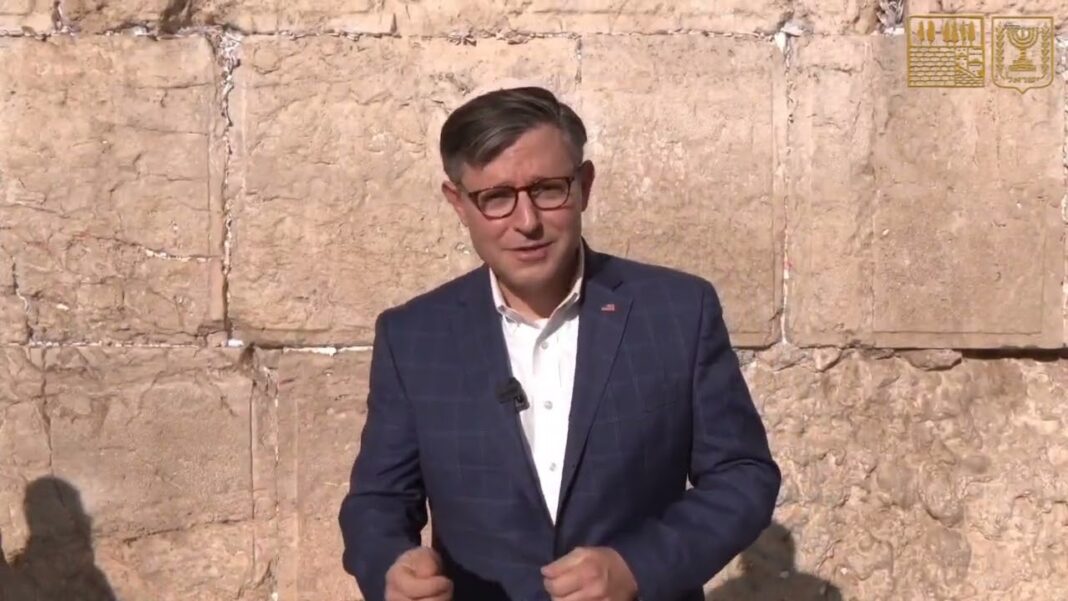
As the somber fast of Tisha B’Av drew to a close this year, the Western Wall in Jerusalem became the site of a highly symbolic encounter between ancient memory and modern diplomacy. U.S. House Speaker Mike Johnson, accompanied by a bipartisan delegation of congressional members, stood before the Wall’s weathered stones, joining Jewish worshippers in reflection and prayer.
The visit, which coincided with the day of mourning that commemorates the destruction of both the First and Second Temples, carried a powerful resonance. According to a report that appeared on Sunday at Israel National News (INN), Johnson’s presence underscored not only the enduring relevance of the Western Wall to Jewish history and faith but also the depth of the U.S.-Israel relationship at a critical moment in global affairs.
Speaker Johnson opened his remarks with a message that blended reverence with political commitment. “We are grateful for the privilege of being here in Israel today, on the day we recognize the destruction of the Temple twice in history. It is a moving time for us to be at the Wailing Wall. Our prayer is that America will always stand with Israel and for the preservation and peace of Jerusalem,” Johnson said, as quoted in the INN report.
His words, delivered at the close of a day that Jews worldwide observe through fasting and lamentation, framed the visit as both an act of solidarity and a pledge of continued American partnership. The symbolism was not lost on local officials. Rabbi Shmuel Rabinowitz, Chief Rabbi of the Western Wall and Holy Sites, warmly welcomed the delegation, stressing the significance of their presence at a time when Jews were recalling the centuries of destruction and exile.
Mordechai Eliav, Director General of the Western Wall Heritage Foundation, also greeted the delegation, offering an overview of the Wall’s enduring role in Jewish life and underscoring the importance of U.S. lawmakers affirming their support in such a visible and meaningful setting. As reported by INN, both Rabinowitz and Eliav thanked Johnson and his colleagues for their steadfast commitment to combating antisemitism worldwide.
Tisha B’Av, the ninth day of the Hebrew month of Av, is marked by fasting, prayer, and the recitation of Lamentations. Traditionally, it commemorates the destruction of Solomon’s Temple by the Babylonians in 586 BCE and the Second Temple by the Romans in 70 CE. Beyond these twin tragedies, Jewish tradition has associated the day with other calamities, including the expulsion from Spain in 1492 and more recent tragedies of the modern era.
As the Israel National News report noted, the alignment of the congressional visit with this sacred day heightened the spiritual and symbolic weight of the moment. For Jews worldwide, Tisha B’Av represents both loss and resilience — the ability of a people to endure devastation and yet hold fast to their identity. Johnson’s visit, therefore, resonated not only as an expression of political alliance but also as an acknowledgment of the Jewish people’s enduring historical journey.
The delegation’s itinerary included a tour of the new “Gate of Heaven” exhibition in the Western Wall Tunnels, a recently unveiled presentation chronicling the Jewish people’s journey across centuries of dispersion and return.
According to the information provided in the INN report, the exhibition uses immersive technology to connect visitors with Jewish history, weaving together archaeological evidence, historical accounts, and cultural memory. The lawmakers were shown depictions of ancient Jerusalem, Jewish life in exile, and the ultimate restoration of a sovereign Jewish state. For the visiting members of Congress, the exhibition offered not only a lesson in Jewish resilience but also a lens through which to understand why the Western Wall remains a living symbol of continuity.
As evening fell, Speaker Johnson and his fellow lawmakers approached the Wall itself, each slipping a personal prayer note between the stones. The act — a deeply intimate tradition for Jewish and non-Jewish visitors alike — underscored the personal connection that individuals often feel when encountering the Wall for the first time.
Johnson’s prayer, recorded in the official guest book, carried a message that reflected both faith and diplomacy: “May God continue to bless and protect the people of Israel and its greatest friend and ally, the USA.” According to the INN report, this inscription echoed the broader message of the visit — that the United States views its relationship with Israel not simply as strategic but as rooted in shared values and a sense of spiritual kinship.
The Speaker’s visit joins a long history of high-level American officials who have chosen the Western Wall as a site for symbolic gestures. Presidents Richard Nixon, Jimmy Carter, and Bill Clinton visited the Wall, though usually in private or semi-official capacities. President Donald Trump’s 2017 visit marked the first time a sitting U.S. president came to the Wall while in office, an act widely covered by INN as emblematic of his administration’s close ties to Israel.
More recently, congressional delegations have increasingly made the Western Wall a focal point of their visits, particularly during times of heightened tension in the Middle East. For Speaker Johnson, the choice of timing on Tisha B’Av reinforced the Wall’s role not only as a religious symbol but as a platform for reaffirming political and cultural solidarity.
The visit occurred against a backdrop of intensifying challenges for Israel, including ongoing threats from regional adversaries and a rise in international criticism. INN reported that Johnson’s delegation emphasized the importance of maintaining bipartisan American support for Israel’s security and sovereignty.
By linking the visit to Tisha B’Av, Johnson and his colleagues sought to emphasize that U.S.-Israel ties are not merely transactional but are anchored in a deep respect for the historical and spiritual journey of the Jewish people. As the INN report highlighted, the symbolism of America’s legislative leadership standing at the Western Wall on this day of mourning reflected a message of steadfastness: that Israel’s ally will remain present not only in moments of triumph but also in times of remembrance and grief.
The congressional delegation’s visit to the Western Wall concluded with a mix of prayer, reflection, and pledges of support. While Johnson’s message centered on faith and shared values, the broader implications were unmistakably political.
The visit represented a convergence of history and diplomacy: an acknowledgment of ancient tragedies and a reaffirmation of modern alliances. By standing before the Wall on Tisha B’Av, Speaker Johnson and his colleagues demonstrated how symbols of faith can carry profound political meaning, reinforcing the enduring bond between the United States and Israel.
