



|
Getting your Trinity Audio player ready...
|
Edited by: TJVNews.com
In a tense and politically charged session before the House Judiciary Committee, House Speaker Mike Johnson expressed strong skepticism about FBI Director Christopher Wray’s testimony regarding the assassination attempt on former President Donald Trump, according to information provided in a report on Thursday on the NBC News website. The contentious exchange highlighted the deepening divisions within the political landscape and raised questions about the credibility and transparency of federal investigative agencies.
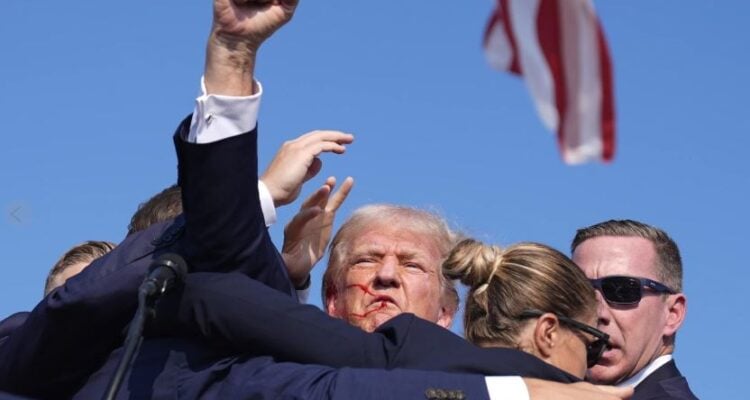
Christopher Wray, who has led the FBI since his nomination by Trump in 2017, provided an update on the ongoing investigation into the assassination attempt during a rally in Pennsylvania. NBCNews.com reported that Wray stated, “I think with respect to former President Trump, there’s some question about whether or not it’s a bullet or shrapnel that, you know, hit his ear.” This statement indicated uncertainty about the precise nature of the projectile that injured Trump and suggested that the investigation was far from conclusive.
House Speaker Mike Johnson responded forcefully, dismissing Wray’s cautious language. “We’ve all seen the video, we’ve seen the analysis, we’ve heard it from multiple sources in different angles that a bullet went through his ear. I’m not sure it matters that much,” Johnson asserted, as per the NBC News report. His statement emphasized a consensus among certain political factions and media analyses that a bullet was indeed the cause of Trump’s injury. Johnson’s comments reflect a broader frustration with a clear lack of transparency and accountability within the FBI and potentially other federal agencies such as the Secret Service.
The reaction from Trump’s camp was swift and unequivocal. Campaign spokesman Steven Cheung vehemently criticized Wray, stating, “Anyone who believes this conspiracy bulls— is either mentally deficient or willfully peddling falsehoods for political reasons, the NBC News report affirmed. ” This harsh rebuke highlights the campaign’s position that the FBI’s narrative is flawed and possibly influenced by political motives.
In a statement released Thursday, the FBI defended its handling of the investigation. “Since the day of the attack, the FBI has been consistent and clear that the shooting was an attempted assassination of former President Trump which resulted in his injury, as well as the death of a heroic father and the injuries of several other victims.” NBC News reported that the FBI’s Shooting Reconstruction Team continues to analyze evidence, including bullet fragments, reinforcing that the investigation is ongoing and far from settled.
Johnson’s critique and the Trump campaign’s outright dismissal of Wray’s testimony underscore a broader mistrust of federal institutions among certain political factions. This skepticism is not new but has intensified in the current polarized climate. The insistence that a bullet—not shrapnel—caused Trump’s injury speaks to a desire for a clear and unequivocal narrative that aligns with their perspective.
Despite the high-profile nature of the incident, the Trump camp has withheld medical records detailing his treatment post-shooting. The former president’s doctors have also been conspicuously absent from public scrutiny. Instead, the Trump campaign has relied on a letter from Rep. Ronny Jackson, R-Texas, a former White House physician, to counter FBI Director Christopher Wray’s cautious remarks on the nature of Trump’s injury.
NBC News reported that in a strongly worded post on social media platform X, Jackson lambasted Wray’s testimony. “What little credibility he may have left is gone after recklessly suggesting Trump might not have been hit from a bullet. It was a bullet — I’ve seen the wound. Pathetic!!!” Jackson’s vehement denial of Wray’s suggestion that the injury might have been caused by shrapnel instead of a bullet added fuel to an already raging fire.
Jackson’s letter, dated July 20, provided a detailed medical description of Trump’s injury. According to Jackson, he evaluated and treated Trump’s wound daily since the shooting. “As reported and witnessed by the entire world, he sustained a gunshot wound to the right ear from a high-powered rifle used by the would-be assassin,” Jackson wrote, the NBC News report said. He described the wound as a 2 cm wide track extending to the cartilaginous surface of the ear, with significant initial bleeding but no need for sutures due to the nature of the wound.
The controversy did not end with medical disputes. Rep. Dan Goldman, D-N.Y., highlighted the absence of independent medical verification. Calling Wray’s testimony “noteworthy,” Goldman argued that Trump “owes it to the American people to be honest, and to say exactly what happened,” according to the NBC News report. He criticized the reliance on Jackson’s account, labeling it hyper-partisan and insufficiently transparent.
The situation was further complicated by Trump’s reaction to another part of Wray’s testimony. NBC News also reported that Wray stated he had not noticed any cognitive decline in President Joe Biden, which Trump took as a direct affront. “Anybody can see that Joe Biden is cognitively and physically challenged, and if you can’t see that, you sure as hell can’t be running the FBI,” Trump wrote on social media, calling for Wray’s immediate resignation for “LYING TO CONGRESS!”
