



|
Getting your Trinity Audio player ready...
|
By: Abe Wertenheim- Jewish Voice News
In a rare display of bipartisan unanimity on a matter touching the deepest nerves of U.S. national security and foreign policy, the U.S. House of Representatives on Monday approved a measure that would render anyone involved in the Hamas-led Oct. 7, 2023 massacre in southern Israel permanently inadmissible to the United States. The move, covered by The Jewish News Syndicate (JNS) on Monday, reflects Washington’s sharpened consensus that the atrocities of Oct. 7 must trigger hardline immigration safeguards — even as lawmakers clash over how broadly the Immigration and Nationality Act should be revised to confront modern terrorism.
The legislation, titled the “No Immigration Benefits for Hamas Terrorists Act of 2025,” was introduced by Rep. Tom McClintock (R-Calif.) along with 18 Republican co-sponsors, including Reps. Joe Wilson (R-S.C.), Claudia Tenney (R-N.Y.), and Ann Wagner (R-Mo.). As JNS reported, the bill amends the Immigration and Nationality Act (INA) to explicitly bar from U.S. entry or immigration benefits any individual who “carried out, participated in, planned, financed, afforded material support to, or otherwise facilitated” the assault launched by Hamas on Oct. 7 — an act that claimed over 1,200 Israeli lives and triggered the most consequential Middle East conflict in decades.
The scope of the bill is sweeping. According to the information provided in the JNS report, the prohibition applies not only to formal members of Hamas but also to individuals affiliated with Palestinian Islamic Jihad (PIJ) or anyone who played a role — however peripheral — in the Oct. 7 atrocities. Its passage marks a significant moment in Congress’s ongoing effort to confront the global reach of Hamas and its support networks.
Republican lawmakers lauded the bill as a long-overdue correction to gaps in U.S. immigration law. McClintock, speaking on the House floor in remarks highlighted by JNS, argued that the explicit inclusion of Oct. 7 perpetrators in the INA is appropriate and morally imperative, comparing Hamas directly to the Nazi Party and the Palestine Liberation Organization — both already named in the Act as groups whose members are automatically ineligible for U.S. immigration benefits.
“Does anyone seriously argue that we should repeal the sanctions against persons who aided and abetted the Nazis’ Holocaust?” McClintock asked. “If not, then why would they oppose extending the same sanctions to the Nazis’ would-be modern-day successors, who just two years ago slaughtered infants, children, the elderly — all because they were Jewish?”
His comments echoed the broader Republican position that the Oct. 7 atrocities represent a historic rupture requiring unprecedented legislative action. Several GOP lawmakers cited JNS reporting on the barbarity of the attacks — including verified accounts of torture, mass sexual assault, and the systematic execution of families — to underscore their argument that the INA must be revised in terms as specific as the crimes themselves.
McClintock also invoked the case of Mahmoud Amin Ya’qub al-Muhtadi, a Gaza-born resident of Louisiana charged last month by the U.S. Justice Department for participating in the Oct. 7 massacre before illegally entering the United States in 2024. The case, widely covered by JNS, has become a touchstone for Republicans arguing that existing immigration provisions are insufficient.
“New laws would be helpful to prevent a future Joe Biden from reopening our borders to violent criminals and terrorists,” McClintock said.
Despite broad Democratic support for barring Hamas terrorists, several key Democrats objected to the method by which the bill revises the INA. Rep. Jamie Raskin (D-Md.), speaking for his caucus, emphasized that the Democratic Party supports prohibiting Hamas affiliates from entering the United States — a policy already codified under the classification of Hamas as a U.S.-designated Foreign Terrorist Organization.
But Raskin insisted, in remarks documented by JNS, that Congress has never previously amended the INA to cite a specific terrorist incident — not even after the Sept. 11, 2001 attacks.
“To put into perspective just how anomalous this approach is, consider our response to the 9/11 attacks,” Raskin said. “We did not amend the INA to specifically reference the events of Sept. 11. We overhauled immigration laws broadly. We created the Department of Homeland Security. But we did not write 9/11 directly into the Act.”
Democratic lawmakers argued that the U.S. already bars members of Hamas and PIJ from immigration benefits, and they criticized the Republican-authored bill for setting what they consider an unwise legislative precedent.
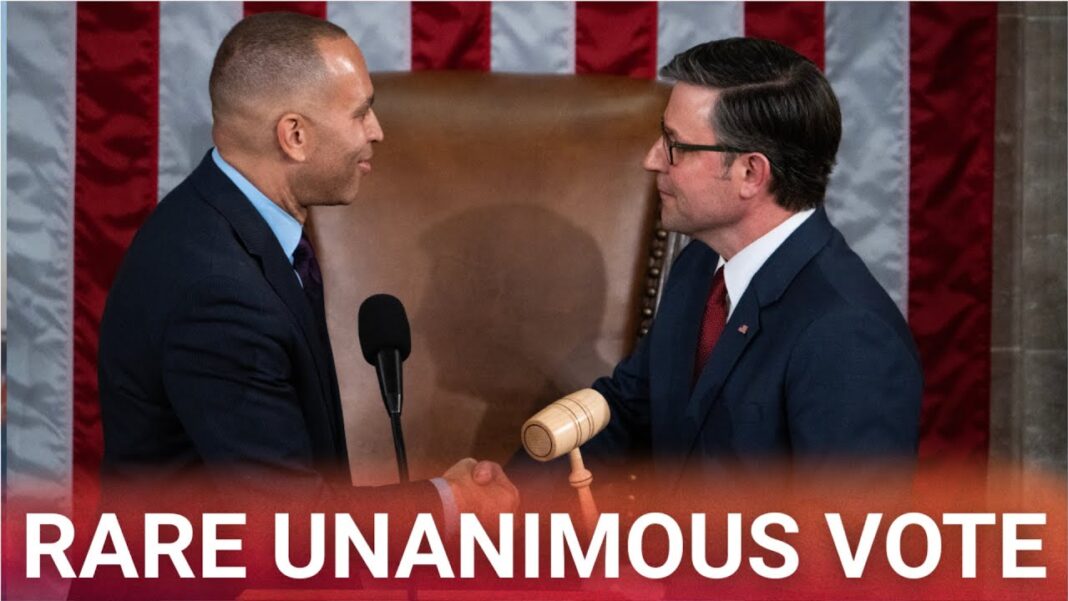
Still, no Democrat voiced opposition forcefully enough to object during the voice vote — meaning the measure passed without a single audible dissent.
During the floor debate, Raskin also pressed Republicans on whether the proposed law would apply to individuals convicted of financing Hamas indirectly — including Binance founder Changpeng Zhao, who pleaded guilty in 2023 to enabling cryptocurrency transfers used by terrorist organizations, including Hamas. Zhao was controversially pardoned by President Donald Trump last year — a move condemned by multiple analysts interviewed by JNS.
Raskin asked whether Republicans intended the new law to apply to Zhao or others similarly situated.
McClintock replied he was unfamiliar with the case — underscoring what critics have described as uneven Republican attention to the financial networks sustaining Hamas.
The bill’s voice-vote passage represents a dramatic legislative victory for Republicans, who have sought for two years to push stricter immigration restrictions related to Hamas through Congress. Its prospects in the Senate, however, remain unclear.
As the JNS report noted, a previous version of the bill stalled in the upper chamber, where Democratic leadership refused to bring it to the floor. The Senate now faces renewed pressure to advance the measure, given the overwhelming bipartisan moral weight behind barring Oct. 7 terrorists from American soil.
Still, procedural roadblocks remain possible. Senate Democrats may seek amendments to remove the specific reference to Oct. 7 while preserving the general prohibition — an approach party leaders say is intended to maintain legislative neutrality and avoid tailoring immigration law to individual terror incidents.
The vote comes amid a broader congressional reckoning with U.S. policy in the Middle East and the domestic consequences of November 2024’s seismic political realignment. As JNS reported, lawmakers from both parties have voiced alarm about pro-Hamas radicalization on American campuses, threats against Jewish communities, and the influx of individuals from regions deeply penetrated by extremist groups.
Republican leaders argue that the United States cannot afford to treat Oct. 7 as a one-off event but must see it as a warning about the evolving sophistication of anti-Israel terrorism. Democrats, while largely aligned on the threat itself, insist the legal tools to address these dangers already exist.
Despite these tensions, both sides acknowledge that the political climate surrounding immigration has changed dramatically since Oct. 7, with national security concerns overtaking partisan narratives about border enforcement.
Ultimately, the House vote signals a rare moment of bipartisan accord in a polarized Congress: Hamas terrorists have no place in the United States, and the horrors of Oct. 7 demand a legal framework that leaves no ambiguity.
Whether that unity survives the Senate’s procedural rigor remains uncertain. The bill’s future may hinge on whether lawmakers can reconcile their differences over legislative form while honoring “the clearest moral imperative of the post–Oct. 7 era: ensuring those who participated in the massacre can never set foot on American soil.”
For now, the House has spoken overwhelmingly — and with moral clarity. The rest of Washington must decide whether it will follow.