



|
Getting your Trinity Audio player ready...
|
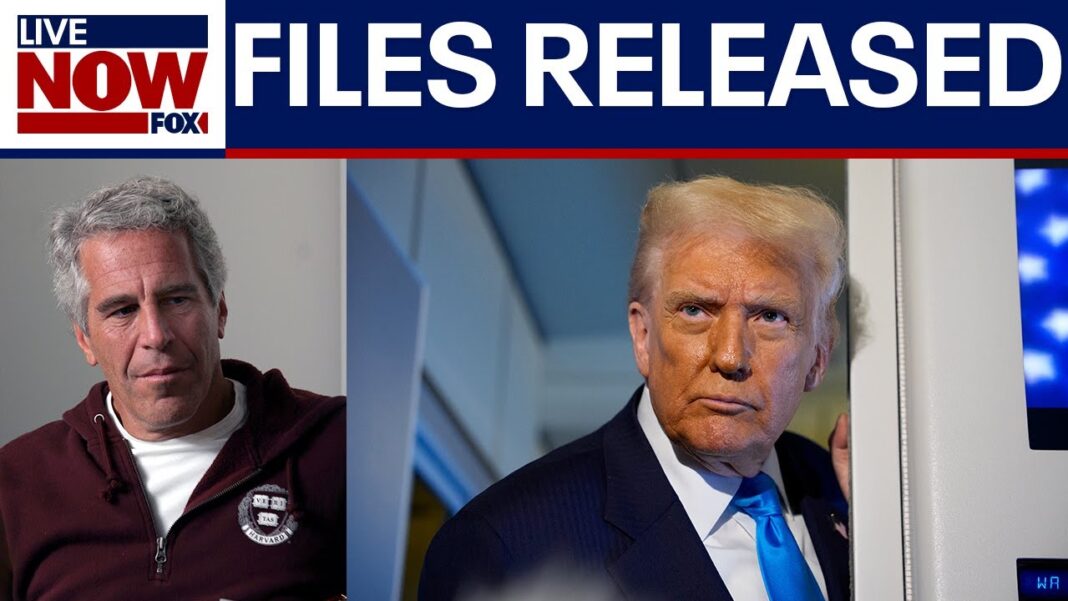
(JEWISH VOICE NEWS) The disclosure of newly unearthed Jeffrey Epstein emails by House Democrats has reignited a political and moral conflagration in Washington, drawing President Trump once more into the orbit of the disgraced financier’s shadow. As The New York Times reported on Wednesday, the messages—some of which date back more than a decade—raise renewed questions about the depth of the relationship between Mr. Trump and Mr. Epstein, and about what the former president may have known regarding Epstein’s extensive sexual abuse network.
According to the House Oversight Committee, the three email exchanges—released Wednesday after months of subpoenas, negotiation, and partisan rancor—suggest that Epstein believed Mr. Trump was aware of his predatory behavior toward underage girls. One 2011 message, addressed to Ghislaine Maxwell, Epstein’s longtime associate and co-conspirator, makes the stark assertion that “the dog that hasn’t barked is Trump,” followed by the claim that one of Epstein’s victims “spent hours at my house with him.”
In another, from 2019, written to journalist Michael Wolff, Epstein stated unequivocally: “Of course he knew about the girls as he asked Ghislaine to stop.” These emails, released in heavily redacted form, form part of a broader tranche of 20,000 pages of documents provided by Epstein’s estate to Congress in compliance with a bipartisan subpoena request—though, as The New York Times noted, their selection and timing are being bitterly contested across party lines.
As The New York Times report detailed, the April 2011 email from Epstein to Maxwell is especially striking for its tone and implications. Written three years after his lenient Florida plea deal, in which he pled guilty to state charges of soliciting prostitution but avoided federal prosecution, Epstein was attempting to reassure Maxwell amid growing press scrutiny of his misconduct.
“I want you to realize that that dog that hasn’t barked is Trump,” Epstein wrote, invoking the language of omission as a form of self-defense—suggesting that Mr. Trump’s silence on his crimes was itself telling. Epstein went on to note that “an unnamed victim spent hours at my house with him,” a reference that Democrats say was likely to Virginia Giuffre, the Florida teen recruited by Maxwell while working at Mar-a-Lago, Mr. Trump’s Palm Beach club.
Ms. Giuffre, who later became one of Epstein’s most vocal accusers, died by suicide in April, a fact that lent an eerie and tragic resonance to the release of these materials. As The New York Times recounted, she had previously testified in a 2016 deposition that while she believed Mr. Trump had been in Epstein’s orbit, she had never witnessed him participate in or condone sexual abuse. “I don’t think Donald Trump participated in anything,” she said. “I never saw or witnessed Donald Trump participate in those acts.”
Nonetheless, Democrats argue that Epstein’s own writings suggest he perceived Mr. Trump as more complicit—or at least more knowledgeable—than the public has been led to believe. Representative Robert Garcia, Democrat of California and the Oversight Committee’s ranking member, told reporters that “these latest emails and correspondence raise glaring questions about what else the White House is hiding and the nature of the relationship between Epstein and the president.”
The White House moved swiftly to contain the political shockwave. Karoline Leavitt, the press secretary, dismissed the emails as “desperate political theater,” telling The New York Times that Democrats were exploiting the memory of a deceased victim for partisan gain.
“The fact remains that President Trump kicked Jeffrey Epstein out of his club decades ago for being a creep to his female employees, including Giuffre,” Leavitt said in a statement. “These stories are nothing more than bad-faith efforts to distract from President Trump’s historic accomplishments, and any American with common sense sees right through this hoax.”
But on Capitol Hill, the emails have deepened existing fissures between and within the parties. The New York Times report noted that the release came just as the House prepared to vote on legislation to reopen the federal government after weeks of a partial shutdown—ensuring that the Epstein revelations would dominate headlines and committee chatter alike.
Republicans accused Democrats of “cherry-picking documents to generate clickbait”, claiming that the materials were being selectively leaked to smear the former president while withholding evidence that implicated Democratic officials. “Democrats continue to carelessly cherry-pick documents that are not grounded in the facts,” a Republican committee spokesperson told reporters. “The Epstein Estate has produced over 20,000 pages of documents, yet Democrats are intentionally withholding records that name Democrat officials.”
The feud comes amid a larger battle over transparency. According to the report in The New York Times, House Democrats have long demanded the full release of all investigative files related to Epstein, Maxwell, and their network—requests that have been repeatedly rebuffed by Justice Department officials aligned with the Trump administration. A small bloc of moderate Republicans has joined those calls, arguing that the suppression of such documents erodes public trust.
Perhaps the most explosive of the emails, however, dates from January 2019, a few months before Epstein’s arrest and eventual death in federal custody. In that exchange, Epstein wrote to author Michael Wolff—who had recently published an insider account of the Trump White House—asserting that Mr. Trump “knew about the girls” and “asked Ghislaine to stop.”
According to the information provided in The New York Times report, this message was sent during a moment of mounting legal peril for Epstein, as The Miami Herald had just published its investigative series exposing his 2008 plea deal and renewing public scrutiny of his crimes.
Epstein, who by then had become increasingly paranoid about media coverage, also complained to Wolff about “false stories” linking his activities to Mar-a-Lago. “Never a member ever,” he wrote defensively, contradicting Trump’s longstanding claim that he had expelled Epstein from the club.
The New York Times analysis pointed out that while there is no independent corroboration of Epstein’s 2019 claim, the phrasing—“of course he knew”—suggests Epstein assumed Trump’s awareness was self-evident. “It reads less like a confession and more like an expectation that Wolff would understand what Epstein viewed as the obvious truth,” one congressional investigator told the paper.
The Democrats’ statement accompanying the release added that a whistleblower had informed the committee that Maxwell, now serving a 20-year sentence, was preparing to formally request a commutation of her prison term from Mr. Trump—raising further concerns about the former president’s willingness to intervene in cases tied to Epstein’s network.
As The New York Times report observed, the Epstein affair has functioned as a mirror reflecting America’s unease with power, privilege, and impunity. Since Epstein’s death in 2019—ruled a suicide but shadowed by suspicion—the question of who knew what, and when, has transcended partisan boundaries.
In this latest phase, however, the political implications are unmistakable. Democrats argue that Trump’s repeated denials, juxtaposed with Epstein’s own admissions, constitute a pattern of obfuscation. “At best, the president misled the public about his association with a convicted sex trafficker,” said Rep. Garcia. “At worst, he was complicit in concealing what he knew about Epstein’s crimes.”
Republicans, for their part, have sought to turn the issue back on their opponents, noting that figures including former President Bill Clinton and Senate Majority Leader Chuck Schumer had also been associated socially with Epstein. Yet, as The New York Times report noted, the tone of Wednesday’s disclosures—direct, detailed, and personal—sets the Trump correspondence apart.
The committee’s document release, comprising excerpts rather than full chains of emails, has also stirred concerns about contextual distortion. Without the surrounding messages, it remains unclear whether Epstein’s statements about Trump were literal assertions, manipulative boasts, or self-serving misdirection.
Still, the symbolic potency of the emails cannot be ignored. For years, Trump’s relationship with Epstein has oscillated between cordial denial and awkward proximity. The two men—both fixtures of the 1990s New York elite—were photographed together at Mar-a-Lago and in Manhattan social circles. Trump once famously described Epstein as a “terrific guy” who “likes beautiful women as much as I do—and many of them are on the younger side.”
By 2004, their relationship had soured, allegedly over a real estate dispute, though Trump’s own recollections of that rupture have shifted over time. In more recent years, he has presented himself as an antagonist of Epstein’s, claiming he barred him from Mar-a-Lago after learning of his inappropriate behavior toward a female employee.
The New York Times report emphasized that the name Virginia Giuffre—redacted by Democrats but subsequently revealed by Republicans—remains central to the story. Giuffre’s own legal filings established that she was recruited into Epstein’s network while working as a locker-room attendant at Mar-a-Lago at age 17, an association that implicates Trump’s environment if not his direct actions.
Giuffre’s death earlier this year, ruled a suicide in her New York apartment, has reignited discussions about the toll exacted on Epstein’s victims, and about the incomplete nature of justice in the case. “She was the human link between the two worlds—Epstein’s depravity and Trump’s proximity,” a former Justice Department official told The New York Times.
That connection, however tenuous, ensures that each new revelation—whether an email, photograph, or court transcript—reverberates far beyond the confines of partisan politics.
At the core of Wednesday’s furor lies a deeper institutional struggle over transparency and accountability. For months, House Democrats have accused the Trump administration of reneging on its earlier promise to fully release Epstein-related investigative material, including FBI correspondence and sealed plea negotiations.
The New York Times reported that the dispute has alienated some of Trump’s most ardent allies in the populist right, who see the withholding of Epstein files as a betrayal of his “drain the swamp” pledge. “If there are documents that expose corruption, they should be made public—period,” said one Republican House aide.
The issue reached a procedural climax Wednesday, as Democrats secured the final signature needed to trigger a discharge petition compelling a House vote on full document disclosure. Representative-elect Adelita Grijalva of Arizona, sworn in hours before the release, provided the decisive endorsement. The vote is expected to take place within days, though the White House has signaled strong opposition, citing national security and privacy concerns.
“The American people deserve the truth about who enabled Jeffrey Epstein,” Garcia told The New York Times. “What we are witnessing is an administration trying to bury that truth under the weight of bureaucracy and fear.”
The saga of Epstein’s emails, as chronicled in The New York Times report, illustrates how a man dead for more than half a decade continues to haunt the corridors of American power. His correspondence—sprawling, cryptic, and meticulously archived—constitutes a map of influence stretching from Wall Street to the White House, implicating financiers, academics, and world leaders.
While many of Epstein’s communications remain sealed under court order, the few that have surfaced reveal a pattern of strategic flattery and mutual leverage. In that light, Epstein’s references to Trump—whether sincere or manipulative—may have been part of a broader effort to maintain relevance among the powerful even as his legal troubles mounted.
Yet, as The New York Times report observed, what distinguishes this week’s revelations is their convergence with political timing. With the government on the brink of reopening and Trump poised to return to the campaign trail, the emails serve as both a historical reckoning and a present-day provocation.
Beyond the partisan theatrics, the renewed scrutiny of Epstein’s ties to Trump reopens a broader societal wound—one that The New York Times has described as America’s “unfinished confrontation with power and sexual exploitation.”
Epstein’s story remains a parable of impunity: a man who built his empire by exploiting proximity to the elite, shielded by institutions too compromised or complicit to stop him. For many observers, the persistence of unanswered questions about his enablers—whether in finance, academia, or politics—reflects the unfinished work of accountability.
The release of these emails, then, is not just a political act but a moral one—a demand that history not be sanitized by the convenience of denial. As Representative Garcia put it, “We are not just investigating Epstein. We are investigating the conditions that made Epstein possible.”
As The New York Times report observed, the newly disclosed Epstein emails represent another turn in a story that refuses to end—a story about power’s capacity to conceal, to corrupt, and to survive even in disgrace.
President Trump continues to deny any wrongdoing or knowledge of Epstein’s crimes, dismissing the controversy as a partisan hoax. Yet each revelation deepens the sense that the truth about Epstein’s reach—and the complicity of those within it—remains incomplete.
In Washington, where scandal often fades with the news cycle, Epstein’s ghost endures. The dog that “hasn’t barked,” as Epstein once put it, may yet find its voice—not in the words of the powerful, but in the persistence of a public unwilling to let silence absolve the past.
Do you consider this even vaguely “Jewish news”? With all the real news significantly impacting Jews in the war against the Jewish people and Israel, TJV has gone off the rails as a radical Democrats surrogate propagandist. Whomever compiled this lengthy Democrat political hit job, using every fake news source available for broadcast by TJV should be identified, and in my opinion fired for abusing your platform as Jewish news. IMO it is not a coincidence that virtually every fake news organization combining to create this manufactured media is participants in the blood libel slanders against Israel and the Jewish people. E.g., The NY Times, CNN, and “Live Now FOX” (despicable unethical “streaming reporting” which IGNORES every professional journalistic standard in immediately spewing lies and blood libels).
One minute “ Guy” is calling Trump an enemy of Jews , next minute – how dare you report the lead political story of the day – Do you ever stop ranting and raving ?