



|
Getting your Trinity Audio player ready...
|
By: Fern Sidman
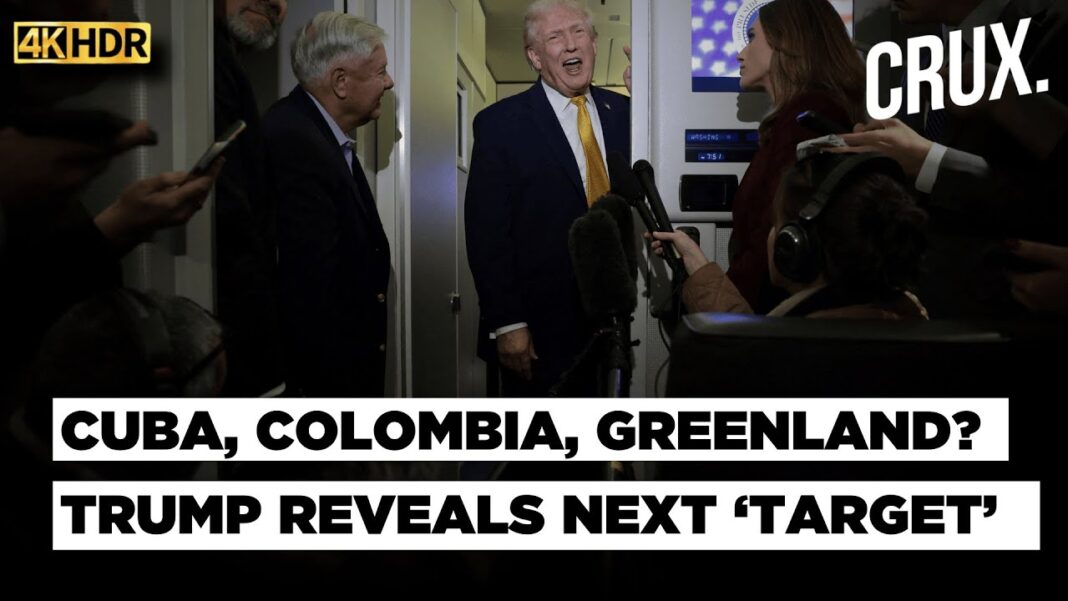
In the wake of the stunning U.S. military operation that culminated in the capture of Venezuelan President Nicolás Maduro and his wife, the geopolitical landscape of the Americas has shifted dramatically. As Israel Hayom has reported, President Donald Trump’s public remarks aboard Air Force One as he reviewed the Venezuela mission revealed a broader, assertive vision of American power. In rapid succession, he invoked names that might once have seemed unlikely subjects of direct U.S. strategic attention—Colombia, Cuba, Mexico, and even Greenland—signaling a potentially seismic reshaping of U.S. foreign policy in the Western Hemisphere and beyond.
Trump’s comments, delivered with the unfiltered candidness that has become a hallmark of his leadership style, did more than highlight specific countries; they encapsulated a sweeping doctrine that some analysts are already labeling the “Don-roe Doctrine,” an evolution of the 19th-century Monroe Doctrine adapted for the challenges of the 21st century. This doctrinal reinvention, explicitly articulated in the Trump administration’s national security strategy, emphasizes reclaiming U.S. primacy in the Western Hemisphere and preventing external powers from gaining footholds that could threaten American interests.
At its core, Trump’s renewed foreign policy approach draws on the 1823 Monroe Doctrine, which warned European powers against further colonization or interference in the Americas. The doctrine’s logic was straightforward: the Western Hemisphere was the United States’ strategic backyard. Over the centuries, successive administrations have interpreted that principle in diverse ways, from Theodore Roosevelt’s corollary asserting the right of U.S. intervention to Cold War era containment of Soviet influence. Trump’s “Don-roe” iteration adapts this tradition to confront contemporary competitors and non-state threats.
According to the Israel Hayom report, the administration’s national security strategy articulates this evolution directly, describing the United States’ intention to prevent “competitors from outside this hemisphere from placing forces or threatening capabilities, or controlling vital strategic assets.” The unstated implication is clear: Russia and China, whose influence has grown in recent years, are no longer viewed as distant geopolitical actors but as proximate threats to American security.
Yet the document’s vision appears to extend beyond responding to external powers. The very list of nations Trump mentioned—Greenland, Cuba, Mexico, Colombia—suggests an agenda that could embroil the United States in complex diplomatic and possibly military tensions, including with long-standing allies.
Greenland and US Strategic Interests
Perhaps the most unorthodox item on Trump’s post-Venezuela list was Greenland, the vast Arctic island that lies thousands of miles north of the contiguous United States yet looms large in strategic calculus. Reuters reported that Trump’s public statements and the White House’s subsequent communications have confirmed that the administration is seriously exploring options to acquire Greenland, even suggesting that U.S. military force remains among the possibilities to secure what it considers vital national strategic assets.
The Reuters report also underscored the strategic rationale behind this interest: Greenland’s geography gives it immense value in monitoring and countering Russian and Chinese activity in the Arctic, and its mineral wealth—especially rare earth elements critical for cutting-edge technology—could significantly bolster U.S. economic and defense capabilities.
But Israel Hayom and other observers caution that Greenland’s status complicates any potential overtures. It is an autonomous territory within the Kingdom of Denmark, a NATO ally, and Danish and Greenlandic leaders have repeatedly stated that the island is not, and will not be, for sale. Indeed, the Danish prime minister has made clear that an attempt to acquire Greenland by force would jeopardize NATO itself, triggering mutual defense obligations under Article 5.
The suggestion that Greenland could be taken “by any means necessary” has drawn sharp rebukes from European capitals, with Denmark, France, Germany, and the United Kingdom issuing unified statements affirming the island’s sovereignty and the inviolability of international borders, as was reported by the Associated Press. Such pushback illustrates the potential for a conflict of interests not just with rival great powers, but with key allies whose cooperation has underpinned Western security for decades.
Cuba: The Old Cold War Archetype
If Greenland represents a novel target for 21st-century geopolitics, Cuba is the enduring symbol of Cold War rivalry. U.S.–Cuban relations have been fraught since the 1959 revolution, and even brief detente under the Obama administration yielded only modest changes before relations hardened again, as was reported by Hays Post. In the aftermath of Venezuela’s upheaval, Trump has seized on Cuba’s dependence on Venezuelan oil and its tenuous economic situation, asserting that the island’s government is “in a lot of trouble” and “ready to fall.”
Secretary of State Marco Rubio, a son of Cuban refugees and a staunch critic of Havana’s communist government, echoed this sentiment, telling reporters that “if I lived in Havana and was part of the government, I’d be a bit concerned.” Israel Hayom reported that such remarks emphasize the administration’s sense that the removal of Maduro could catalyze broader instability that might bring about a fundamental realignment in Cuba’s political landscape—perhaps even an opportunity for U.S. interests to reassert themselves more directly.
Yet Cuba’s internal resilience and the lingering hostility toward U.S. intervention among much of its population mean that any American effort to capitalize on Venezuela’s collapse carries significant risks, Sky News reported. A misstep could easily inflame nationalist sentiment and further strain relations with other Latin American nations that have long resisted external interference.
Mexico: Cartels, Migration, and Security Challenges
Mexico’s inclusion on Trump’s informal list stems less from ideological confrontation and more from persistent security concerns. The United States views Mexico not as an adversary but as a neighbor burdened with some of the most powerful drug cartels in the world. Israel Hayom reported that Trump has publicly criticized Mexico’s leadership, asserting that cartels “run” segments of the country and that “something has to be done.”
While Mexico has denounced the Venezuela operation and condemned unilateral intervention, its government has also cooperated with the United States on cartel enforcement. Sky News reported that Mexican President Claudia Sheinbaum opposes external meddling but has pursued policies against cartel leaders and strengthened security operations domestically—suggesting a complex, pragmatic approach to the shared drug-related crisis.
Despite this cooperation, Trump’s rhetoric blurs the line between partnership and pressure, raising concerns that American impatience with cartel violence and the ongoing fentanyl epidemic could push the administration toward ever more intrusive engagement. Hays Post reported that the legal basis for such action is being shaped by the designation of cartels as terrorist organizations, which—while controversial—provides Washington with a securitized framework for potential use of force or sanctions that go well beyond conventional law enforcement cooperation.
Colombia: Between Diplomacy and Confrontation
Colombia’s significance derives from being the world’s largest source of cocaine production and a long-time U.S. partner in counter-narcotics operations. Yet Trump’s public characterization has been blunt and provocative, labeling Colombia as “run by a sick man who likes making cocaine” and suggesting that direct U.S. intervention “sounds good to me” according to a Sky News report.
Colombian President Gustavo Petro, a leftist whose policies diverge from Washington’s preferences, has responded with defiance, asserting that he would “bear arms” if necessary—a stark reminder that nationalist sentiment and sovereign pride remain potent barriers to external interference. Media reports indicate that the U.S. designation of Colombia as failing to cooperate with drug control obligations has already led to cuts in assistance, a diplomatic lever that risks further deterioration in ties.
While the likelihood of a Venezuelan-style operation in Colombia remains remote, the rhetoric illustrates the administration’s willingness to publicly pressure allied governments when strategic interests are at stake, Sky News reported. This approach risks alienating partners and fragmenting regional cooperation frameworks that have, in recent decades, served as bulwarks against cartels and insurgent groups alike.
Overlaying all these developments is the domestic political context in Washington. According to the Israel Hayom report, Trump’s intensified focus on foreign policy comes as he faces persistent political headwinds domestically—relatively weak approval ratings, factional unrest within his party related to scandals, and the looming midterm elections that could render him a “lame duck” if his party loses control of Congress. Historically, presidents have often turned to assertive foreign initiatives to redirect public attention and demonstrate leadership when domestic politics prove challenging.
This dual logic—strategic imperative and political calculation—helps explain why the administration is broadcasting threats and objectives with such urgency. Whether the rhetoric will lead to concrete policies remains to be seen, but its mere articulation has already sent ripples through diplomatic corridors in Europe and Latin America.
The Trump administration’s posture carries profound implications for international stability. Europe’s unified rejection of U.S. designs on Greenland underscores the risks of alienating allies and undermining longstanding alliances like NATO. Meanwhile, Latin American governments are watching closely, wary that Washington’s return to Monroe-era posturing may herald a deeper interventionism that could destabilize the region rather than secure it.
As Israel Hayom has documented, the “Don-roe Doctrine” is more than a catchy phrase—it is a concept that encapsulates an era of American assertiveness whose reverberations could reshape hemispheric geopolitics for decades to come. Whether it ultimately proves stabilizing or destabilizing will depend on how deftly the U.S. balances strategic ambition with respect for sovereignty, alliance commitments, and the complex realities of 21st-century global politics.

Brilliant analysis, and clear and cogent writing, as always!
Amy Neustein, Ph.D.