



|
Getting your Trinity Audio player ready...
|
By: Fern Rosenblatt
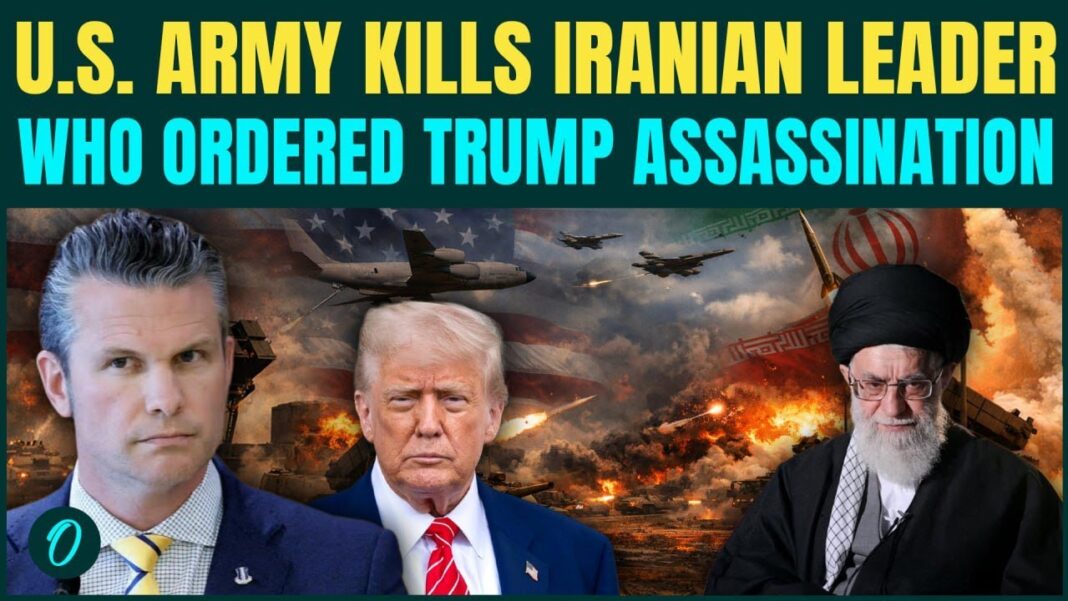
In a development that spotlights the extraordinary stakes of America’s confrontation with the Iranian regime, Defense Secretary Pete Hegseth confirmed Wednesday that U.S. forces eliminated the leader of an Iranian unit allegedly connected to a plot to assassinate President Donald Trump. The strike, carried out amid ongoing American military operations targeting Iranian missile infrastructure, marks a dramatic turn in a shadow conflict that has spanned years and multiple administrations.
World Israel News reported on Wednesday that Hegseth disclosed the operation during a briefing, explaining that the targeted individual had been linked to threats against American officials, including President Trump. While the defense secretary declined to identify the operative by name, he stated unequivocally that the elimination occurred during a precision aerial strike Tuesday after U.S. forces identified what he described as an actionable opportunity.
“Iran tried to kill President Trump, and President Trump got the last laugh,” Hegseth declared, in remarks carried by World Israel News. The statement, stark in tone and symbolism, encapsulated both the gravity of the alleged Iranian plot and the administration’s posture of resolute retaliation.
The broader U.S. campaign against Iran, Hegseth emphasized, remains focused primarily on degrading Tehran’s missile capabilities and dismantling launch infrastructure that poses a threat to American forces and regional allies. The elimination of the Iranian figure connected to assassination efforts, he said, was not the principal objective of the operation but rather an opportunistic strike executed when conditions permitted.
“We’ve known for a long time that Iran had intentions of trying to kill President Trump and/or other U.S. officials,” Hegseth said, as was reported by World Israel News. According to the defense secretary, intelligence assessments had long placed individuals tied to such plots on a list of potential targets. When operational circumstances aligned, American forces acted decisively.
The revelation casts renewed light on a pattern of alleged Iranian activities targeting senior American officials. World Israel News has consistently chronicled U.S. accusations that Tehran orchestrated attempts to assassinate figures associated with the “maximum pressure” policy that defined Trump’s first term. The Justice Department has previously outlined charges in connection with such plots, describing efforts by Iranian operatives and intermediaries to recruit individuals to carry out attacks on American soil.
In 2024, federal prosecutors alleged that a Pakistani national, Asif Merchant, had been tasked with executing a plan to assassinate then-presidential candidate Trump. Merchant was arrested in July of that year and charged with working in coordination with Iranian elements. According to court filings cited by World Israel News, prosecutors contend that Merchant outlined aspects of the assassination plan to another individual who was secretly cooperating with the FBI, thereby providing U.S. authorities with critical insight into the alleged conspiracy.
That case remains ongoing, with Merchant currently standing trial. The Justice Department has framed the episode as part of a broader Iranian campaign to retaliate against U.S. officials for policies enacted during Trump’s presidency, particularly the withdrawal from the Joint Comprehensive Plan of Action and the reimposition of sweeping economic sanctions.
The United States has also brought charges related to a separate 2022 Iranian plot targeting John Bolton, Trump’s former national security adviser and a principal architect of the administration’s hardline posture toward Tehran. Prosecutors alleged Iranian operatives sought to arrange Bolton’s assassination as retribution for U.S. actions, including the 2020 strike that killed Iranian General Qassem Soleimani.
In this context, Hegseth’s announcement suggests that the conflict between Washington and Tehran has never been confined to abstract geopolitical maneuvering. Rather, it has included direct and personal threats against senior American leaders. The decision to eliminate an operative allegedly involved in such plots signals a continuation of the administration’s doctrine that individuals targeting Americans will face consequences.
Importantly, U.S. officials have clarified that neither the shooting at a Trump campaign rally in Butler, Pennsylvania, during the 2024 election season nor a separate incident at Trump’s Florida golf course was linked to Iran. Authorities have explicitly stated that those events, though alarming, were not connected to Tehran. Nonetheless, the existence of documented Iranian plots reinforces the sense of an enduring and multifaceted threat.
The strike itself occurred amid a broader campaign targeting Iranian missile assets. According to Hegseth’s remarks, American forces have concentrated on destroying launchers and related capabilities that could endanger U.S. bases and regional allies, particularly Israel. The World Israel News report highlighted that the U.S. operations unfolded in the wake of escalating tensions following Israeli action against Iranian facilities, underscoring the interconnected nature of American and Israeli security concerns.
By emphasizing that the assassination-linked operative was not the central target of the campaign, Hegseth sought to situate the strike within a larger strategic framework rather than portray it as a singular act of retribution. Yet the symbolic resonance of the elimination is undeniable. For an Iranian unit allegedly tasked with targeting the President of the United States, the outcome serves as a stark warning.
The administration’s messaging has also aimed to counter narratives suggesting that Israel maneuvered Washington into confrontation. As World Israel News reported, President Trump has categorically rejected claims that U.S. actions were driven by Israeli pressure. Instead, he has asserted that the decision-making process was rooted in American assessments of imminent threats.
This insistence on agency is central to the administration’s strategic communication. By framing the strike as an American decision based on American intelligence and interests, the White House seeks to dispel the notion of reactive entanglement and instead project deliberate resolve.
From a strategic standpoint, the elimination of an individual tied to assassination planning represents both a tactical victory and a broader message of deterrence. Intelligence operations that identify, track, and neutralize operatives involved in threats against senior officials require extensive coordination across agencies and international partners. The success of such an operation underscores the depth of U.S. surveillance capabilities and the willingness to act when actionable intelligence emerges.
Yet the episode also raises questions about escalation dynamics. While the administration has portrayed its actions as preventive and defensive, Tehran may interpret targeted strikes on its personnel as provocation. The World Israel News report noted that the broader conflict remains fluid, with regional actors closely monitoring developments.
For Israel, the elimination of an Iranian figure connected to assassination plots carries particular resonance. The Jewish state has long faced threats from Iranian proxies and direct rhetoric from Tehran’s leadership calling for its destruction. The alignment between American and Israeli security objectives in confronting Iranian aggression reflects a shared assessment of the regime’s destabilizing ambitions.
As the dust settles from the latest strike, the contours of the conflict remain in flux. The administration has signaled that its campaign is focused on degrading capabilities rather than pursuing regime change. Yet the targeting of individuals implicated in assassination schemes suggests a willingness to blur traditional boundaries between battlefield objectives and counterterrorism imperatives.
The World Israel News report noted that the elimination of the Iranian operative is likely to reverberate in diplomatic and security circles alike. For the White House, the episode reinforces a narrative of vigilance and resolve. For Tehran, it serves as a stark reminder that plots against American leaders carry consequences.
In a geopolitical landscape marked by shadow warfare and covert operations, the strike speaks volumes about a sobering reality: the contest between Washington and Tehran is not confined to rhetoric or sanctions. It encompasses real threats, real intelligence, and, as Wednesday’s announcement confirmed, real consequences.
